 NL·0077
Herbarium of the Nature Library
- Name
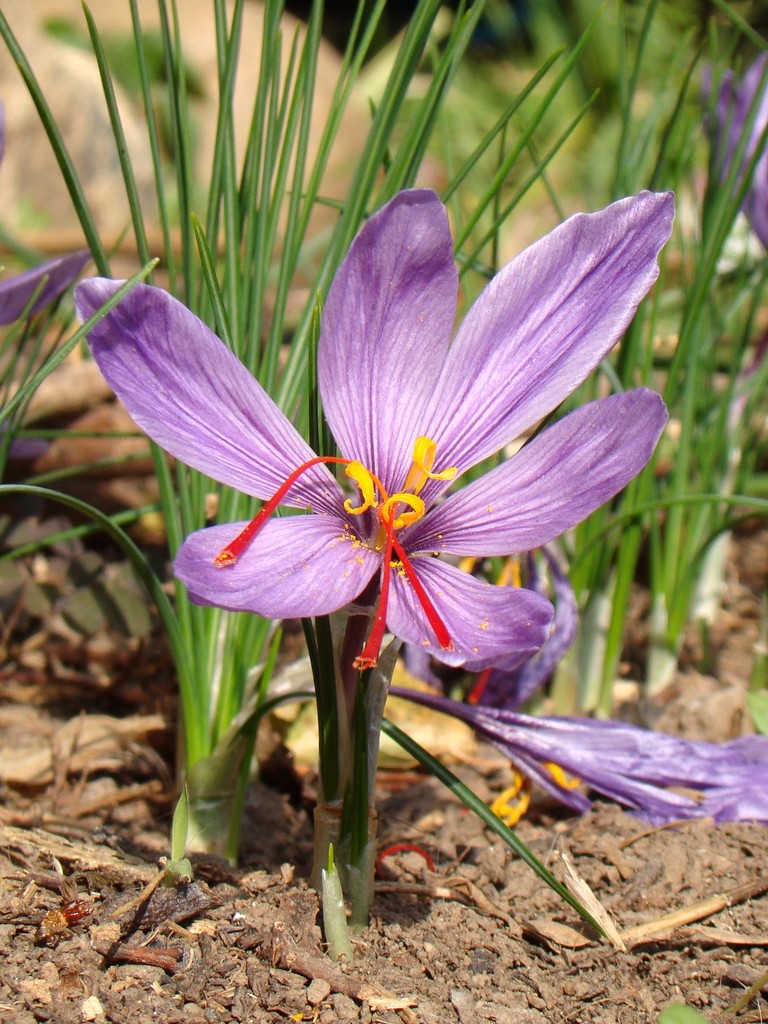
- Crocus sativus
- Family
- Iridaceae
- Native to
- Known only in cultivation; arose from the wild Crocus cartwrightianus in Bronze Age Greece. Grown mainly in Iran, Kashmir, Spain, Greece and Morocco
- Habitat
- Farmland, Mediterranean and continental semi-arid plateaus
Saffron crocus
Crocus sativus
Also calledZaʿfarān زعفران (Arabic/Persian/Urdu) · Kesar (Hindi) · Kunkuma (Sanskrit) · Fān hóng huā 番红花 (Chinese) · Azafrán (Spanish) · Kong posh (Kashmiri)
An autumn-flowering crocus whose three crimson stigmas, picked by hand, are the world's most expensive spice. It is a sterile triploid that has not set seed in thousands of years and survives only because people replant its corms.
Crocus sativus, commonly known as saffron crocus or autumn crocus, is a species of flowering plant in the iris family Iridaceae. A cormous autumn-flowering cultivated perennial, unknown in the wild, it is best known for the culinary use of its floral stigmas as the spice saffron. Human cultivation of saffron crocus and the trade and use of saffron have endured for more than 3,500 years and span different cultures, continents, and civilizations. Wikipedia
What it can do
- iStigmas contain crocin, a water-soluble carotenoid that dyes intensely golden
- iiSafranal, formed from picrocrocin as the stigmas dry, gives saffron its hay-like aroma
- iiiSterile triploid: every plant is a clone, multiplied only by daughter corms
- ivFlowers in autumn, before its leaves fully emerge
At the table
Eatendried stigmas (spice)
Safe in culinary amounts (a few threads). Doses of about 5 g or more are toxic, and around 12–20 g has been reported as potentially lethal. Do not confuse it with the deadly autumn crocus (Colchicum autumnale), which looks similar but has six stamens and no long red stigmas.
In the medicine cabinet
| Tradition | Use |
|---|---|
| Unani / Persian medicine | Zafran as an exhilarant (mufarrih) for melancholy, a heart tonic and an aphrodisiac |
| Ayurveda | Kunkuma for skin complexion, menstrual complaints, cough and as a rejuvenating tonic in milk |
| Traditional Chinese Medicine | Zanghonghua ('Tibetan red flower', also fanhonghua) to invigorate blood, cool the blood and calm the spirit, for amenorrhoea, postpartum pain and low mood |
| Modern phytotherapy | Small trials of 30 mg/day extract for mild to moderate depression, with positive results |
Weight of evidence
Moderate. Some clinical trials with promising but limited or mixed results.
Active compounds
crocin, crocetin, picrocrocin, safranal, kaempferol
Seed
Seed
Sterile; does not produce viable seed
- Dispersal
- Human propagation of corms
- Germination
- Not grown from seed
How to grow it
Hardiness (USDA zones)
USDA 6–9. Survives winters down to about -23 °C.
- Light
- Full sun
- Water
- Low; dry summer dormancy
- Soil
- Light, very well-drained, slightly alkaline
- Propagation
- Corms
- To harvest
- Flowers 6–8 weeks after late-summer planting
- Climates
- Mediterranean, Continental semi-arid
- 1Plant corms 10 cm deep and 10 cm apart in late summer
- 2Water lightly in autumn if dry
- 3Pick flowers in the morning as they open and pluck out the three red stigmas
- 4Dry stigmas gently and store airtight in the dark; lift and divide crowded corms every 3–4 years
Can it grow where you are?
Where it lives
Recorded sightings
—
geo-referenced records in GBIF, from museums, herbaria and field observers.
Native range
Known only in cultivation; arose from the wild Crocus cartwrightianus in Bronze Age Greece. Grown mainly in Iran, Kashmir, Spain, Greece and Morocco
Drag the globe to turn it. Dots are where records exist, not a range map; darker means more records.
In Gerard's Herball, 1597

First Booke · Chap. 80 · p. 123 · read the page →
Of Saffron.
John Gerard, The Herball, or Generall Historie of Plantes, London, 1597. What England's best-known herbal said of saffron crocus, in its own spelling.
- The vertues
- A Auicen affirmeth that it caufeth headach, and is hurtfull to the braine, which it cannot doe by taking it now and then, but by too much vfing of it: for too much vfing of it cutteth off fleepe, through want whereof the head and fences are out of frame. But the moderate vfe of it is good for the head, and maketh the fences more quicke and liuely, fhaketh off heauie and drowfie fleepe, and maketh a man merrie. B Alfo Saffron ftrengtheneth the hart, concocteth crude or rawe humors of the cheft, openeth the lungs, and remooueth obftructions or ftoppings. C It is alfo fuch a fpeciall remedie for thofe that haue confumption of the lungs, and are, as we tearm it, at deaths doore, & almoft paft breathing, that it bringeth breath againe, & prolongeth life for certaine daies, if ten or twentie graines at the moft be giuen, with new or fweete wine. For we haue found by often experience that being taken in that fort, it prefently, and in a moment remooueth away difficultie of breathing, which moft dangerously and fuddenly happeneth.
- The place
- Common, or the beft knowne Saffron groweth plentifully in Cambridgefhire, Saffron Walden and other places thereabout, as corne in the fieldes.
- The time
- Saffron beginneth to flower in September, and prefently after fpring vp the leaues, and remaine greene all the winter long.
- The temperature
- Saffron is a little aftringent or binding, but his hot qualitie doth fo ouer rule in it, that in the whol essence it is in the number of thofe herbes which are hot in the fecond degree, and drie in the firft: therfore it alfo hath a certaine force to concoct, which is furthered by the fmall aftricti…
- The names
- Saffron is called in Greeke κρόκος: in Latin Crocus: in Mauritania Zaffaran: in Spanifh Açafron: in Englifh Saffron: in the Arabicke toong Zahafaran. Some that are difposed to dissemble and ieft with their friends and to make them merrie with pretie Poeticall figmentes, haue giuen it the name of a Damfell, whereof Ouid maketh mention, which to recite were impertinent to our hiftorie.
Gerard wrote within Galenic humoral medicine, and his opinions, including about the peoples of the Americas and their crops, are those of 1590s London. His “vertues” are history, not advice. Transcription: Source Library (CC BY-SA 4.0). The whole chapter in the Herball Room.
In the old herbals & bestiaries
Woodcuts and engravings matched from the Source Library’s scanned books by name. Plates marked “relative” show a close kin rather than this exact species. Click a plate to read the page it came from, with translation.

Hortus Eystettensis
Basilius Besler · 1640 · p.209

Notable Commentaries on the History of Plants
Leonhart Fuchs · 1542 · p.475

Discourses on the Six Books of Dioscorides
Dioscorides; Pietro Andrea Mattioli (comm.) · 1568 · p.259

The Flowering Garden: Autumn
Crispijn van de Passe · 1616 · p.64

Hortus Eystettensis
Basilius Besler · 1640 · p.389

History of Rare Plants
Carolus Clusius · 1601 · p.218

History of Rare Plants
Carolus Clusius · 1601 · p.218

Ortus sanitatis
1491 · p.142

Garden of Health (Hortus Sanitatis)
Jacob Meydenbach · 1491 · p.117

Garden of Health
1507 · p.115
In the stacks
Searching the stacks…
Every page naming Crocus sativus in the Biodiversity Heritage Library →
Marginalia
The 'Saffron Gatherers' frescoes at Akrotiri on Thera (c. 1600 BCE) show women gathering crocus stigmas and a monkey presenting saffron to a goddess. Iran today grows the great majority of the world's saffron.
Curiosity
About 150,000 flowers are needed for one kilogram of dried saffron.
Kinship

Fact-checked: 1 correction made to this sheet. Photographs: iNaturalist contributors under the licences shown. Records: GBIF.org. Historical plates: Source Library (CC BY-SA 4.0; originals public domain). Summary text: Nature Library editors and Wikipedia (CC BY-SA). Medicinal and edibility notes are historical and educational, not advice. iNaturalist taxon 118933.