 NL·0108
Herbarium of the Nature Library
- Name
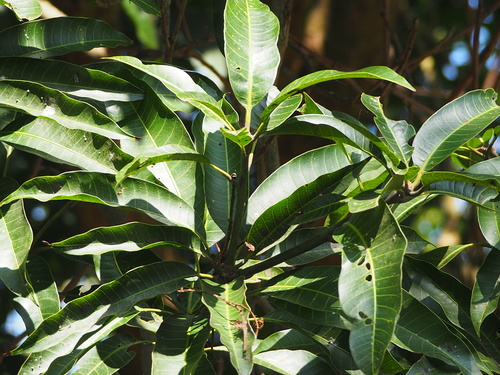
- Myristica fragrans
- Family
- Myristicaceae
- Native to
- Banda Islands, Maluku, Indonesia; cultivated in Indonesia, Grenada, India and Sri Lanka
- Habitat
- Tropical island rainforest, Spice gardens
Nutmeg
Myristica fragrans
Also calledJaiphal (Hindi/Urdu, nut) · Javitri (Hindi, mace) · Jawz al-ṭīb (Arabic) · Pala (Indonesian/Malay) · Ròudòukòu (Chinese) · Nuez moscada (Spanish) · Jathikka (Malayalam)
An evergreen tree endemic to the tiny Banda Islands of Indonesia that yields two spices: nutmeg, the seed, and mace, its scarlet lace-like aril. The Dutch East India Company massacred and enslaved the Bandanese in 1621 to seize the monopoly.
Myristica fragrans, commonly known as the nutmeg tree, is an evergreen species indigenous to the Maluku Islands of Indonesia. This aromatic tree is economically significant as the primary source of two distinct spices: nutmeg, derived from its seed, and mace, obtained from the seed's aril. Wikipedia
What it can do
- iProduces two different spices from one fruit — the seed (nutmeg) and the aril (mace)
- iiDioecious: about half of seedlings are male and fruitless
- iiiMyristicin and elemicin in the seed are psychoactive and toxic in large doses
- ivTrees can fruit for 60 years or more
At the table
Eatenseed (grated nutmeg) · aril (mace) · fruit flesh (candied, jams, Indonesian manisan pala)
Safe as a spice in culinary amounts. Eating about 5 g or more (one or two whole nuts) can cause nutmeg poisoning: nausea, palpitations, hallucinations and delirium lasting a day or more.
In the medicine cabinet
| Tradition | Use |
|---|---|
| Ayurveda | Jaiphal in small amounts for diarrhoea, insomnia and as a digestive |
| Unani / Arab medicine | Nutmeg for stomach complaints and as an aphrodisiac |
| Medieval European medicine | Carried in pomanders against plague |
Weight of evidence
Traditional. Long historical use; little or no modern clinical evidence.
Active compounds
myristicin, elemicin, safrole, sabinene, trimyristin (nutmeg butter)
Fruit & seed


Fruit
Drupe (fleshy, splitting)
Ripens: Year-round, peaks twice a year
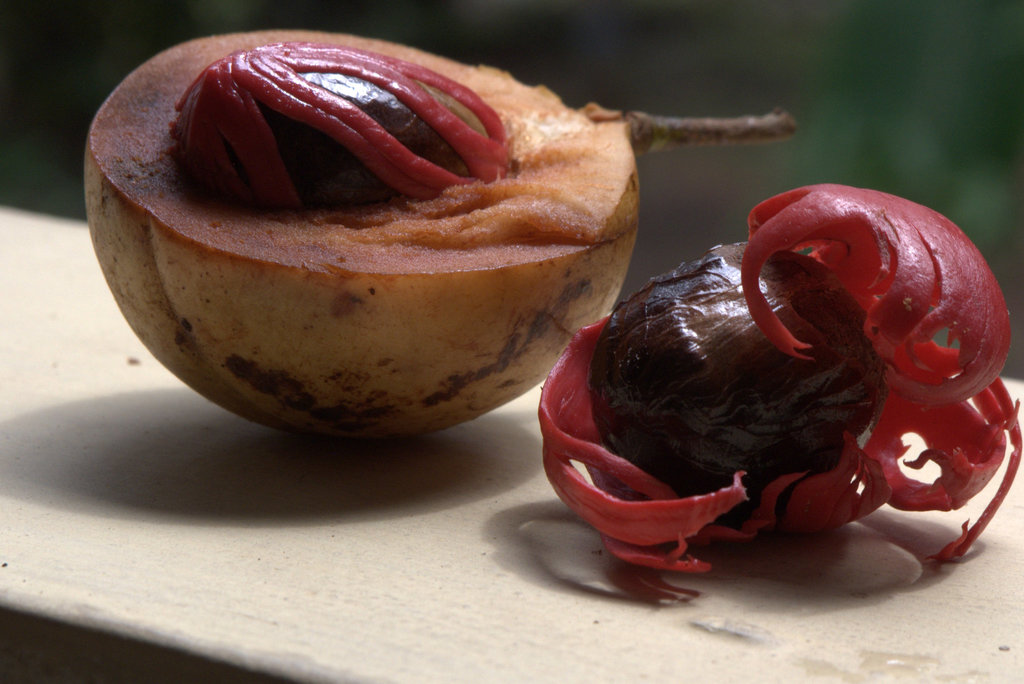
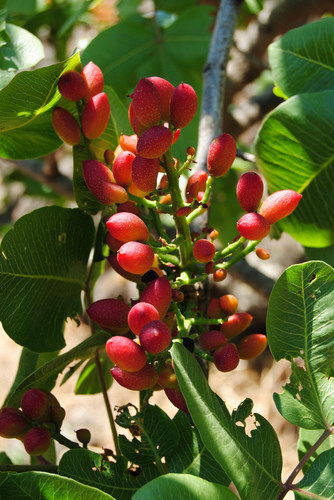
Pale-yellow, apricot-like fruit 5–8 cm that splits in two when ripe, revealing a glossy brown seed wrapped in a crimson, net-like aril.


Seed
2–3 cm
Egg-shaped, hard brown seed 2–3 cm with a dark, glossy, ridged shell; inside, the kernel (nutmeg) is grey-brown with cream marbling; when fresh it is wrapped in bright scarlet branching mace
- Dispersal
- Fruit pigeons (Ducula) swallow the seeds with their aril
- Germination
- Recalcitrant: sow fresh, in shell, 2 cm deep in shade at 25–30 °C; slow, 4–8 weeks
Photographs from Wikimedia Commons under open licences; hover for the photographer, click for the file.
How to grow it
Hardiness (USDA zones)
Tropical only (USDA 11–12). Survives winters down to about 4 °C.
- Light
- Partial shade when young; sun when mature
- Water
- High (over 2,000 mm rain)
- Soil
- Deep, fertile, well-drained volcanic or loamy soil, pH 6–7
- Propagation
- Seed (then select females), or grafting/approach-grafting female scions
- To harvest
- 5–8 years from seed; full crops after 15–20 years
- Climates
- Humid equatorial tropical, Tropical islands
- 1Sow fresh seeds in shaded nursery beds; plant out at 1–2 years, or plant grafted female trees to avoid fruitless males.
- 2Space trees about 9 m apart under light shade (e.g. bananas or coconuts), with one male per 10 females.
- 3Mulch thickly and keep moist; protect from strong winds.
- 4Collect fruit when it splits open; separate the mace from the seed by hand.
- 5Dry mace flat in the sun for a few days; dry seeds in the shell for 6–8 weeks until the kernel rattles, then crack and store.
Can it grow where you are?
Where it lives
Recorded sightings
—
geo-referenced records in GBIF, from museums, herbaria and field observers.
Native range
Banda Islands, Maluku, Indonesia; cultivated in Indonesia, Grenada, India and Sri Lanka
Drag the globe to turn it. Dots are where records exist, not a range map; darker means more records.
In the old herbals & bestiaries
Woodcuts and engravings matched from the Source Library’s scanned books by name. Plates marked “relative” show a close kin rather than this exact species. Click a plate to read the page it came from, with translation.

Tractado de las Drogas y Medicinas de las Indias Orientales
Cristóvão da Costa · 1578 · p.66

Sancai Tuhui (Vol. 97)
王圻, 王思義 · 1607 · p.58

The Great Herbary with all the figures of the herbs
1532 · p.227

Commentaries on the Six Books of Dioscorides on Medical Matter
Pietro Andrea Mattioli · 1563 · p.269

Illustrated Compendium of Materia Medica (Vol. 24)
吳其濬 · 1848 · p.117

Ortus sanitatis
1491 · p.251

The Embassy of the Dutch East India Company to the Tartar Cham
Johan Nieuhof · 1665 · p.434

Ortus sanitatis
1491 · p.287

Garden of Health
1507 · p.202

Commentaries on the Six Books of Dioscorides
Pietro Andrea Mattioli · 1560 · p.284
In the stacks
Searching the stacks…
Every page naming Myristica fragrans in the Biodiversity Heritage Library →
Marginalia
Under the 1667 Treaty of Breda, England and the Netherlands each kept what they had seized: the Dutch kept Run, a tiny nutmeg island in the Bandas, and the English kept New Amsterdam — Manhattan. Nutmeg remains so central to Grenada that it appears on the national flag.
Curiosity
Grenada's flag shows a nutmeg pod — the only national flag with a spice on it.
Kinship

Photographs: iNaturalist contributors under the licences shown. Records: GBIF.org. Historical plates: Source Library (CC BY-SA 4.0; originals public domain). Summary text: Nature Library editors and Wikipedia (CC BY-SA). Medicinal and edibility notes are historical and educational, not advice. iNaturalist taxon 122768.