 NL·0007
Herbarium of the Nature Library
- Name
- Pistacia vera
- Family
- Anacardiaceae
- Native to
- Central Asia: north-east Iran, Turkmenistan, Uzbekistan, Tajikistan, Afghanistan and Kyrgyzstan; cultivated in Iran, Turkey, the US, Syria and the Mediterranean
- Habitat
- Semi-arid foothills, Pistachio savanna woodland, Desert orchards
Pistachio
Pistacia vera
Also calledPista (Hindi/Urdu/Persian) · Fustuq (Arabic) · Fıstık (Turkish) · Kāixīnguǒ (Chinese, 'happy nut') · Pistacho (Spanish) · Bote (Hebrew) · Pistag (Armenian)
A tough desert tree of Central Asia, related to cashew and mango, whose nut shells split open as they ripen — the 'smiling nut' of Iran and 'happy nut' of China. Wild stands in Turkmenistan, Uzbekistan and Afghanistan are declining and assessed Near Threatened.
The pistachio is a small to medium-sized tree of the cashew family. The tree produces seeds that are widely consumed as food. Pistachios can be used as an ingredient in desserts, chocolate, candy, ice cream, and as a paste or butter. As a tree nut, pistachios are considered a priority allergen that may induce allergic reactions in susceptible people. Wikipedia
What it can do
- iSurvives summer heat above 40 °C and winter cold below −20 °C
- iiTolerates saline irrigation water better than most nut crops
- iiiDioecious and wind-pollinated: one male tree serves about 8–10 females
- ivBears in alternate heavy and light years
At the table
Eatenkernel (raw, roasted, in sweets like baklava)
Kernels are safe; pistachio is a tree-nut allergen and cross-reacts with cashew. Poorly stored or damaged nuts can carry aflatoxin, and bulk-stored nuts can self-heat and ignite.
In the medicine cabinet
| Tradition | Use |
|---|---|
| Unani / Persian medicine | Nuts as a tonic for the heart, liver and brain; resin of related species (mastic) for the stomach |
| Modern nutrition science | Pistachio intake associated in trials with improved blood lipids |
Weight of evidence
Moderate. Some clinical trials with promising but limited or mixed results.
Active compounds
lutein and zeaxanthin, γ-tocopherol, anthocyanins (skin), oleic acid
Fruit & seed
Fruit
Drupe
Ripens: Late summer to early autumn
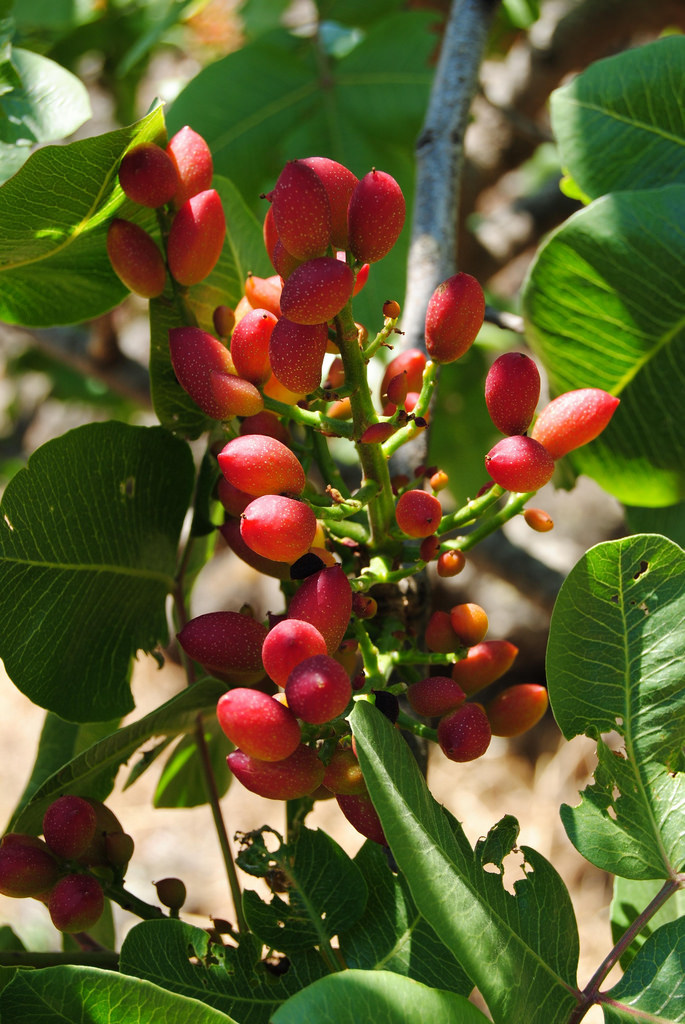
Oval drupe 2–2.5 cm in grape-like clusters, with a thin rosy-pink to red-tinged hull over a cream, hard shell that splits along its seam when ripe.
Seed
1.5–2 cm
Elongated, green to yellow-green kernel 1.5–2 cm with a thin purplish-red papery skin, inside a smooth beige shell that gapes open
- Dispersal
- Birds and rodents
- Germination
- Remove shell, soak 24 hours, cold-stratify 4–6 weeks, sow at 20–25 °C; 1–3 weeks
How to grow it
Hardiness (USDA zones)
USDA 7–10. Survives winters down to about -18 °C.
- Light
- Full sun
- Water
- Low; deep, infrequent irrigation improves yield
- Soil
- Deep, very well-drained sandy loam; tolerates alkaline and saline soils, pH 7–8
- Propagation
- Budding female cultivars ('Kerman', 'Ahmad Aghaei') and males ('Peters') onto P. atlantica, P. integerrima or UCB-1 rootstock
- To harvest
- 5–7 years; full production at 15–20 years
- Climates
- Hot arid, Semi-arid continental, Mediterranean (hot summers)
- 1Check that you have long, hot, dry summers (pistachios need heat to ripen) and at least 800 chill hours in winter.
- 2Plant one male tree for every 8–10 females, upwind, in deep, perfectly drained soil.
- 3Water deeply but rarely; mature trees need little water but crop better with irrigation.
- 4Train to an open vase in the first years, then prune lightly in winter.
- 5Shake ripe nuts from the tree when hulls slip easily from the shells, hull and dry within 24 hours to prevent staining and mould.
Can it grow where you are?
Where it lives
Recorded sightings
—
geo-referenced records in GBIF, from museums, herbaria and field observers.
Native range
Central Asia: north-east Iran, Turkmenistan, Uzbekistan, Tajikistan, Afghanistan and Kyrgyzstan; cultivated in Iran, Turkey, the US, Syria and the Mediterranean
Drag the globe to turn it. Dots are where records exist, not a range map; darker means more records.
In the old herbals & bestiaries
Woodcuts and engravings matched from the Source Library’s scanned books by name. Plates marked “relative” show a close kin rather than this exact species. Click a plate to read the page it came from, with translation.

Six Groups of the History of Plants
Rembert Dodoens · 1583 · p.826

Commentaries on the Six Books of Dioscorides
Pietro Andrea Mattioli · 1560 · p.187

Rariorum Plantarum Historia (with Fungorum Historia)
Carolus Clusius · 1601 · p.33

Garden of Health
1507 · p.265

The Great Herbary with all the figures of the herbs
1532 · p.256

Commentaries on the Six Books of Dioscorides
Pietro Andrea Mattioli · 1560 · p.282

History of Plants in Four Books
Valerius Cordus · 1561 · p.417

Commentaries on the Six Books of Pedanius Dioscorides on Medical Matter
Pietro Andrea Mattioli · 1565 · p.287

Commentaries on the Six Books of Pedanius Dioscorides on Medical Matter
Pietro Andrea Mattioli · 1565 · p.449

A New Herbal, or History of Plants
Rembert Dodoens (trans. Henry Lyte) · 1578 · p.759
In the stacks
Searching the stacks…
Every page naming Pistacia vera in the Biodiversity Heritage Library →
Marginalia
Pistachios were found at the Neolithic site of Jarmo in Iraq, about 6750 BCE, and legend says the Queen of Sheba reserved them for herself and her court. Iran's Rafsanjan region has been a famed pistachio centre for centuries.
Curiosity
Large stockpiles of pistachios can self-heat and even spontaneously combust, so shippers treat them as a fire risk in cargo holds.
Kinship

Fact-checked: 1 correction made to this sheet. Photographs: iNaturalist contributors under the licences shown. Records: GBIF.org. Historical plates: Source Library (CC BY-SA 4.0; originals public domain). Summary text: Nature Library editors and Wikipedia (CC BY-SA). Medicinal and edibility notes are historical and educational, not advice. iNaturalist taxon 122975.