 NL·0005
Herbarium of the Nature Library
- Name
- Anacardium occidentale
- Family
- Anacardiaceae
- Native to
- North-eastern Brazil; spread by the Portuguese to India and Africa in the 16th century; grown throughout the tropics
- Habitat
- Coastal restinga and dry savanna, Plantations
Cashew
Anacardium occidentale
Also calledCaju (Portuguese/Tupi 'acajú') · Kaju (Hindi/Urdu) · Marañón (Spanish) · Mundiri (Tamil) · Jambu mete / Gajus (Indonesian/Malay) · Korosho (Swahili) · Yāoguǒ (Chinese)
A sprawling tree from north-east Brazil whose kidney-shaped nut hangs beneath a juicy, swollen 'cashew apple'. The nut's shell holds a caustic oil related to poison ivy's urushiol, so every cashew sold must be roasted or steamed before shelling.
Cashew is the common name of a tropical evergreen tree Anacardium occidentale, in the family Anacardiaceae. It is the source of the cashew nut and the cashew apple. The tree can grow as tall as 14 meters. Wikipedia
What it can do
- iThe true fruit is the nut; the 'apple' is a swollen flower stalk (hypocarp)
- iiShell oil (CNSL) is rich in anacardic acid and cardol, which blister skin
- iiiThrives on poor sandy soils and resists drought
- ivThe Pirangi cashew tree in Brazil covers roughly 7,500–8,400 m², spreading from a single trunk
At the table
Eatenkernel (after roasting/steaming to remove shell oil) · cashew apple (fresh, juiced, fermented into feni)
Raw cashew nuts in the shell are not safe: the shell oil causes severe burns and dermatitis, and roasting fumes irritate the lungs. 'Raw' cashews in shops have already been steamed. Cashew is a common, sometimes severe, tree-nut allergen.
In the medicine cabinet
| Tradition | Use |
|---|---|
| Brazilian folk medicine | Bark tea for diarrhoea; cashew-apple juice for coughs and as a tonic |
| Ayurveda | Shell oil applied to warts and corns |
Weight of evidence
Traditional. Long historical use; little or no modern clinical evidence.
Active compounds
anacardic acid, cardol, cardanol, vitamin C (apple), tannins
Fruit & seed


Fruit
Drupe (nut) on an accessory 'apple'
Ripens: Dry season (e.g. February–May in India and West Africa)
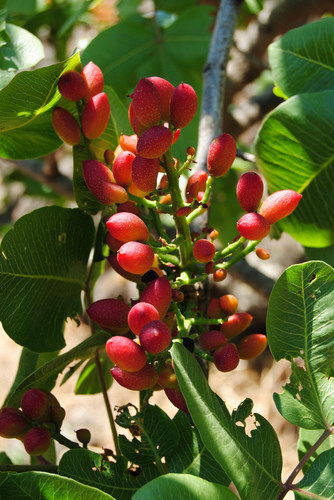
A pear-shaped, glossy red or yellow cashew apple 5–10 cm, juicy and astringent; from its tip hangs a single grey-green, kidney-shaped nut 3 cm long.


Seed
Nut 3 cm; kernel 2–3 cm
The kernel is pale ivory, curved, kidney-shaped, about 2.5–3 cm, inside a hard grey-brown double shell filled with dark caustic oil
- Dispersal
- Bats and birds carry the apple and drop the nut
- Germination
- Sow whole nuts (in shell) fresh, 3–5 cm deep, stalk-end up, at 25–30 °C; sprouts in 2–4 weeks. Wear gloves
Photographs from Wikimedia Commons under open licences; hover for the photographer, click for the file.
How to grow it
Hardiness (USDA zones)
USDA 10–12. Survives winters down to about -1 °C.
- Light
- Full sun
- Water
- Low–moderate; a dry season is needed for flowering
- Soil
- Deep sandy or lateritic soils, well-drained, pH 4.5–6.5
- Propagation
- Seed (nut), or softwood grafting of high-yielding clones
- To harvest
- 3 years from graft; 3–5 years from seed
- Climates
- Tropical with distinct dry season, Tropical coastal
- 1Sow nuts directly where the tree will grow (it dislikes transplanting), or plant a grafted dwarf clone.
- 2Space 7–10 m apart in full sun; keep weeds down around young plants.
- 3Water young trees during the first dry seasons only; mature trees need no irrigation.
- 4Prune low branches and dead wood after harvest.
- 5Collect fallen fruit, twist the nut from the apple, and sun-dry the nuts; roast or steam them in shells (outdoors, with gloves) before cracking.
Can it grow where you are?
Where it lives
Recorded sightings
—
geo-referenced records in GBIF, from museums, herbaria and field observers.
Native range
North-eastern Brazil; spread by the Portuguese to India and Africa in the 16th century; grown throughout the tropics
Drag the globe to turn it. Dots are where records exist, not a range map; darker means more records.
In the old herbals & bestiaries
Woodcuts and engravings matched from the Source Library’s scanned books by name. Plates marked “relative” show a close kin rather than this exact species. Click a plate to read the page it came from, with translation.

Tractado de las Drogas y Medicinas de las Indias Orientales
Cristóvão da Costa · 1578 · p.354

The natural history of Carolina, Florida, and the Bahama Islands : containing two hundred a...
Catesby, Mark, bioloog, kunstenaar · 1743 · p.383

Flora Sinensis (Chinese-Latin Natural History)
Michał Boym · 1656 · p.31

De Indiae utriusque re naturali et medica
Willem Piso · 1658 · p.149

The Natural History of Carolina Florida and Bahama Islands Vol. 2
Mark Catesby · 1743 · p.334

Mark Catesby — Piscium, serpentum, insectorum (pt. 2) (1777)
Mark Catesby · 1777 · p.102

Berthe Hoola van Nooten — Fleurs, fruits et feuillages choisis de la flore et de la pomone de Java (1863)
Berthe Hoola van Nooten · 1863 · p.115

A key to physic, and the occult sciences
Sibly, Ebenezer · 1810 · p.548

Metamorphosis Insectorum Surinamensium
Maria Sibylla Merian · 1705 · p.57

Itinerary, Voyage or Ship-travel to the East or Portuguese Indies
Jan Huyghen van Linschoten · 1595 · p.191
In the stacks
Searching the stacks…
Every page naming Anacardium occidentale in the Biodiversity Heritage Library →
Marginalia
The French monk André Thevet drew the cashew in 1558, and Portuguese traders introduced it to Goa, where cashew-apple juice is distilled into the spirit feni. The Pirangi tree near Natal, Brazil, planted around 1888, is billed as the world's largest cashew.
Curiosity
Cashews are almost never sold in their shells, because the shell is lined with a caustic resin related to poison ivy's urushiol.
Kinship


Fact-checked: 2 corrections made to this sheet. Photographs: iNaturalist contributors under the licences shown. Records: GBIF.org. Historical plates: Source Library (CC BY-SA 4.0; originals public domain). Summary text: Nature Library editors and Wikipedia (CC BY-SA). Medicinal and edibility notes are historical and educational, not advice. iNaturalist taxon 122988.