 NL·0024
Herbarium of the Nature Library
- Name
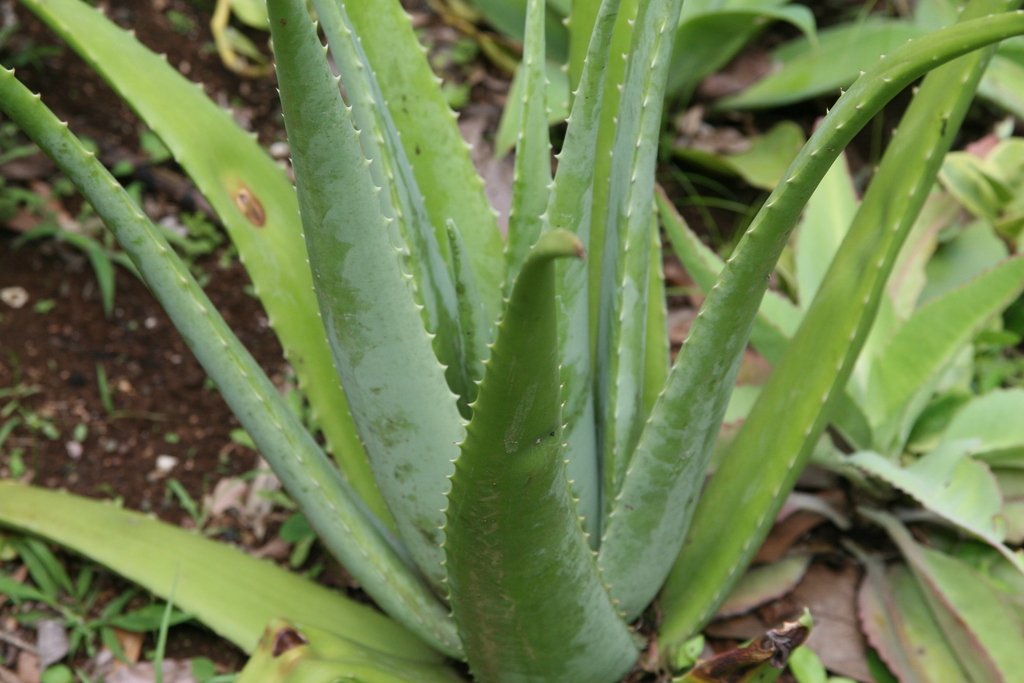
- Aloe vera
- Family
- Asphodelaceae
- Native to
- Probably originated in the Arabian Peninsula; known only in cultivation. Naturalised in arid regions worldwide
- Habitat
- Desert, Arid scrub
Aloe vera
Aloe vera
Also calledGhritakumari (Sanskrit) · Gwarpatha (Hindi) · Ṣabr صبر (Arabic) · Lúhuì 芦荟 (Chinese) · Sábila (Spanish) · Elwa / Musabbar (Unani, dried latex)
A stemless succulent whose plump leaves hold a cool, clear gel under a yellow, bitter latex, two quite different medicines in one leaf. It is grown on every continent but no longer known in the wild.
Aloe vera is a succulent plant species of the genus Aloe. It is widely distributed and is considered an invasive species in many regions of the world. Wikipedia
What it can do
- iUses CAM photosynthesis, opening its pores only at night to save water
- iiLeaf gel is mostly water bound in polysaccharides such as acemannan
- iiiYellow latex under the skin contains aloin, a strong purgative
- ivSurvives months of drought by drawing on water stored in its leaves
At the table
Eateninner leaf gel (washed)
The clear inner gel is eaten and drunk, for example in Asian aloe drinks, once the yellow latex has been rinsed off completely. The latex (aloin) is a harsh laxative and can cause cramping, diarrhoea and potassium loss.
In the medicine cabinet
| Tradition | Use |
|---|---|
| Ayurveda | Ghritakumari gel for burns, skin disease, liver disorders and as a female tonic (kumari asava) |
| Unani | Dried latex (sibr/musabbar) as a purgative and in pills for liver and skin complaints |
| Traditional Chinese Medicine | Luhui (dried latex) used to purge heat and for constipation and worms |
| Modern phytotherapy | Topical gel for minor burns, psoriasis and radiation skin reactions |
Weight of evidence
Moderate. Some clinical trials with promising but limited or mixed results.
Active compounds
aloin (barbaloin), aloe-emodin, acemannan, aloesin, anthraquinone glycosides
Fruit & seed
Fruit
Capsule
Ripens: Late winter–spring
Dry three-valved capsule; seldom sets seed in cultivation.

Seed
~5 mm
Flat, black, winged seeds (rarely produced)
- Dispersal
- Wind
- Germination
- Warm (above 21 °C), on gritty mix; 1–4 weeks
Photographs from Wikimedia Commons under open licences; hover for the photographer, click for the file.
How to grow it
Hardiness (USDA zones)
USDA 9–11. Survives winters down to about -7 °C.
- Light
- Full sun to bright shade
- Water
- Low
- Soil
- Sandy or gritty, sharply drained
- Propagation
- Offsets (pups)
- To harvest
- Leaves from plants 2–3 years old
- Climates
- Arid, Mediterranean, Tropical dry
- 1Pot offsets in cactus mix and wait a week before watering
- 2Water deeply only when the soil is dry; much less in winter
- 3Cut outer leaves at the base and stand upright to drain the yellow latex
- 4Bring indoors below about 5 °C
Can it grow where you are?
Where it lives
Recorded sightings
—
geo-referenced records in GBIF, from museums, herbaria and field observers.
Native range
Probably originated in the Arabian Peninsula; known only in cultivation. Naturalised in arid regions worldwide
Drag the globe to turn it. Dots are where records exist, not a range map; darker means more records.
In Gerard's Herball, 1597

Second Booke · Chap. 134 · p. 409 · read the page →
Of herbe Aloë, or Sea Houseleeke.
John Gerard, The Herball, or Generall Historie of Plantes, London, 1597. What England's best-known herbal said of aloe vera, in its own spelling.
- The place
- This plant groweth very plentifully in India, & in Arabia, Cœlosyria, & Egypt: from whence the iuice put into skins is brought into Europe. It groweth also, as Dioscorides writeth, in Asia on the sea coasts, and in Andros, but not verie fit for iuice to be drawne out.
- The time
- The herbe is alwaies greene, and likewise sendeth foorth braunches, though it remaine out of the earth, especially if the roote be couered with lome, & now & then watered: for so being hanged on the feelings and vpper posts of dining roomes, it doth …
Gerard wrote within Galenic humoral medicine, and his opinions, including about the peoples of the Americas and their crops, are those of 1590s London. His “vertues” are history, not advice. Transcription: Source Library (CC BY-SA 4.0). The whole chapter in the Herball Room.
In the old herbals & bestiaries
Woodcuts and engravings matched from the Source Library’s scanned books by name. Plates marked “relative” show a close kin rather than this exact species. Click a plate to read the page it came from, with translation.

Jan Moninckx; Maria Moninckx — Moninckx Atlas, vol. 3 (1686)
Jan Moninckx; Maria Moninckx · 1686 · p.17

Hortus Eystettensis
Basilius Besler · 1640 · p.377

Garden of Health
1507 · p.20

Medical and Philosophical Garden
Joachim Camerarius · 1588 · p.349

Rariorum Plantarum Historia (with Fungorum Historia)
Carolus Clusius · 1601 · p.542

Sancai Tuhui (Vol. 97)
王圻, 王思義 · 1607 · p.56

Garden of Health (Hortus Sanitatis)
Jacob Meydenbach · 1491 · p.23

The Great Herbary with all the figures of the herbs
1532 · p.46

The Great Herbary with all the figures of the herbs
1532 · p.48

Book of Herbs
Hieronymus Bock (Tragus) · 1546 · p.736
In the stacks
Searching the stacks…
Every page naming Aloe vera in the Biodiversity Heritage Library →
Marginalia
Dioscorides described aloe for wounds and purging in the 1st century CE, and dried aloe latex was traded from the Red Sea to India and China. In Arabic, sabr means both 'aloe' and 'patience'.
Curiosity
Barbados was long a leading exporter of dried aloe latex, sold as 'Barbados aloes', which is why the plant was once called Aloe barbadensis.
Kinship

Photographs: iNaturalist contributors under the licences shown. Records: GBIF.org. Historical plates: Source Library (CC BY-SA 4.0; originals public domain). Summary text: Nature Library editors and Wikipedia (CC BY-SA). Medicinal and edibility notes are historical and educational, not advice. iNaturalist taxon 126882.