- Animals
- ›Arthropods
- ›Hexapods
- ›Insects
- ›Winged and Once-winged Insects
- ›Butterflies and Moths
- ›Hawk, Sphinx, Silk, Emperor, and Allied Moths
- ›Sphinx Moths
- ›Sphinginae
- ›Sphingini
- ›Sphingina
- ›Sphinx
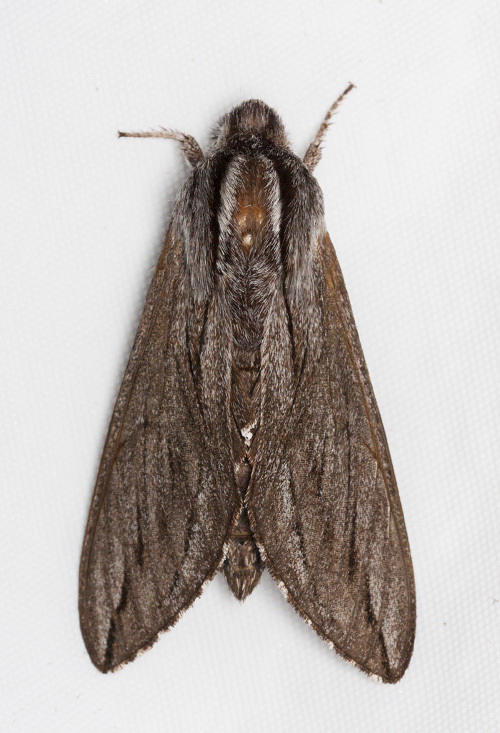
Sequoia Sphinx
Sphinx sequoiae
Sphinx sequoiae, the sequoia sphinx, is a moth of the family Sphingidae. It is found in the United States from Oregon south through California, Nevada, and south-eastern Utah to Arizona and further south into Mexico's northern Baja California. It is particularly common in juniper and cedar forests, like those east of the Cascade Range in the Pacific Northwest.
The species was first identified by Jean Baptiste Boisduval in 1868.
From the article Sphinx sequoiae on Wikipedia (CC BY-SA), quoted section by section
Description
The wingspan of the sequoia sphinx is 48–68 mm, with a forewing length of 24–26 mm. This makes it the smallest species of its genus other than Sphinx dollii, for which it is sometimes confused though they inhabit different regions. It has ash-gray, pointed forewings with several horizontal black dashes; its hindwings are a monotone ash-gray. The thorax and abdomen are likewise gray, and it has a white-and-brown checkered fringe. There is a single generation of adult moths per year which flies between May and August. Adults are nocturnal, and are attracted to light. They feed on nectar from the flowers of western chokecherry (Prunus virginiana) and California buckeye (Aesculus californica). The larvae are green with white, red-brown, and yellow-brown spots; they have a caudal horn that is short, blunt, and yellow-tipped, and white, black-rimmed spiracles. They are hosted by the California juniper (Juniperus californica), Utah juniper (Juniperus osteosperma), and California incense cedar (Calocedrus decurrens). Sphinx sequoiae eggs are roughly 2 mm in length and width, and have a light, bluish-green colour.
Listen
Looking for field recordings…
Where it lives
Recorded sightings
—
geo-referenced records in GBIF, from museums, herbaria and field observers.
Drag the globe to turn it. Dots are where records exist, not a range map; darker means more records.
In the stacks
Searching the stacks…
Every page naming Sphinx sequoiae in the Biodiversity Heritage Library →
This page is assembled live from iNaturalist, GBIF, Wikipedia, the Source Library and the Internet Archive. It is not yet part of the hand-edited codex. iNaturalist taxon 127168.