- Plants
- ›Vascular Plants
- ›flowering plants
- ›Dicots
- ›pinks, cactuses, and allies
- ›cacti
- ›globular cacti, moonlight cacti, torch cacti, and allies
- ›Globular Cactuses
- ›Astrophytum
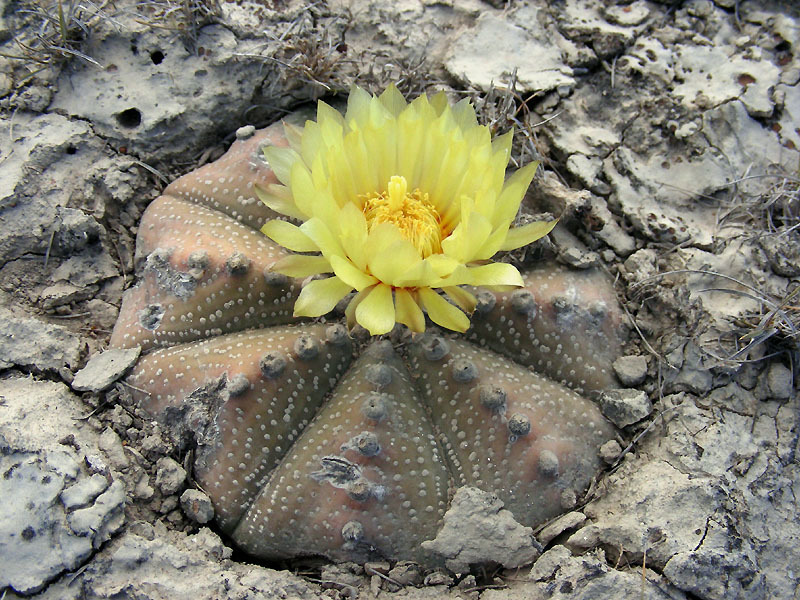
Sand-dollar Cactus
Astrophytum asterias
Astrophytum asterias is a species of cactus in the genus Astrophytum, and is native to small parts of Texas in the United States and Mexico. Common names include sand dollar cactus, sea urchin cactus, star cactus and star peyote.
From the article Astrophytum asterias on Wikipedia (CC BY-SA), quoted section by section
Description
A. asterias is small, round, spineless and squat, reaching a height of 2.5–6 cm (1–2 in) and a diameter of 5–15 cm (2–6 in). The disc-shaped body is divided into 7–10 sections, known as ribs; in the middle of each rib there are woolly areoles. The body is a greenish-brown colour and may appear speckled from its covering of white scales (trichomes). The flowers of this cactus are yellow with red bases and the outer parts are very woolly. Green to pink oval fruits are produced; the outside coat is covered with woolly hairs.
Range & habitat
Star cactus is native to the lower Rio Grande Valley of Texas in the United States and the states of Nuevo León and Tamaulipas in Mexico, to the east of the Sierra Madre Oriental mountain range. Previously more abundant, this species is today restricted to a small portion of Starr County, Texas, and a few localized sites in Tamaulipas. Today this species is associated with thorn scrub, amongst rocky ground; it may have previously occupied richer, flat grasslands that have since been developed. It has probably been extirpated from Nuevo León.
Wikipedia: “Distribution and habitat”
How it is grown
Sand Dollar Cactus has been grown as a houseplant since the 1840s, like other members of its genus and despite its rarity in the wild. It is readily propagated from seed, so most plants encountered in nurseries are seed grown. The popularity of this species among collectors and enthusiasts has ensured that a number of cultivars are available. One such cultivar is the 'Super Kabuto', a clonally propagated variety whose large trichomes congregate into dense spots, arranged in a striking pattern.
Wikipedia: “Cultivation”
Where it lives
Recorded sightings
—
geo-referenced records in GBIF, from museums, herbaria and field observers.
Drag the globe to turn it. Dots are where records exist, not a range map; darker means more records.
In the stacks
Searching the stacks…
Every page naming Astrophytum asterias in the Biodiversity Heritage Library →
This page is assembled live from iNaturalist, GBIF, Wikipedia, the Source Library and the Internet Archive. It is not yet part of the hand-edited codex. iNaturalist taxon 135434.