 NL·0565
Herbarium of the Nature Library
- Name
- Tirumala limniace
- Family
- Nymphalidae
- Native to
- South and Southeast Asia: India, Sri Lanka, Nepal, Myanmar, Thailand, southern China and Indochina
- Habitat
- Tropical forest, Scrub, Gardens, Grassland
Blue tiger
Tirumala limniace
Also calledQīng bāndié (Chinese)
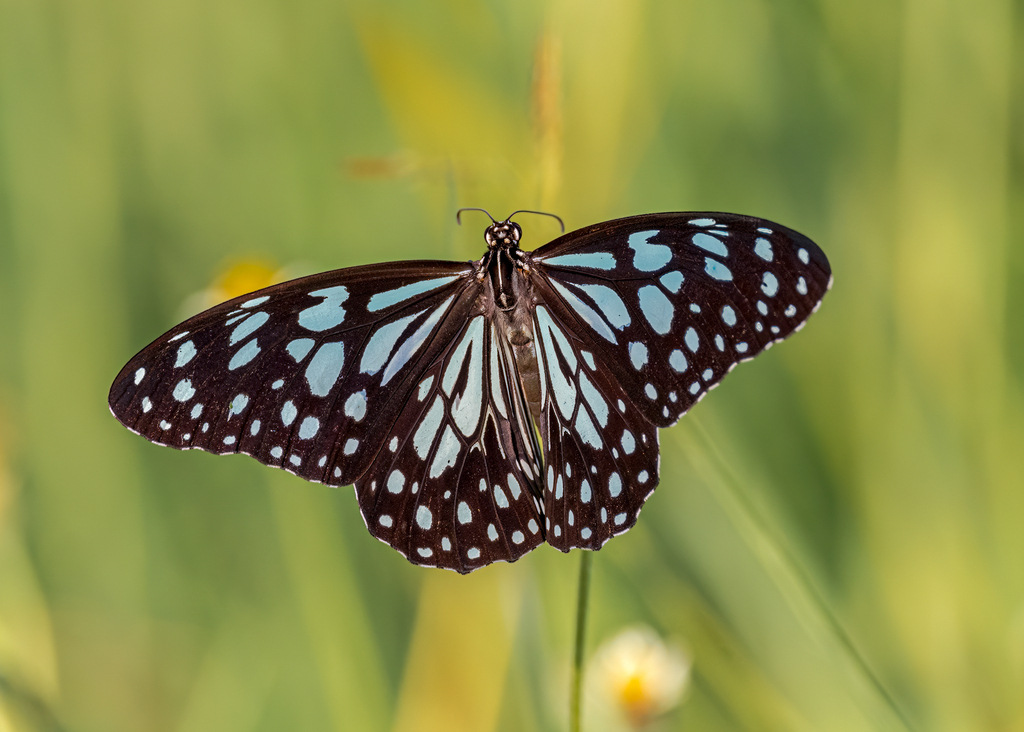
A black butterfly marked with pale blue, almost glassy streaks, common across tropical Asia. In southern India it joins huge seasonal migrations between the Western and Eastern Ghats.
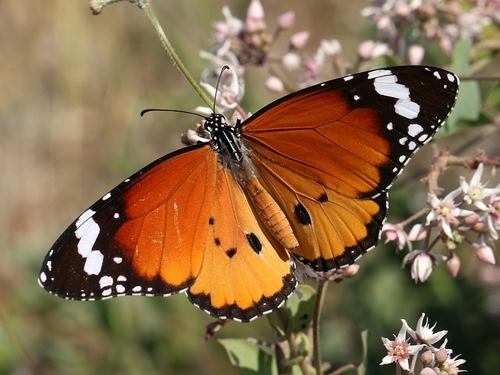
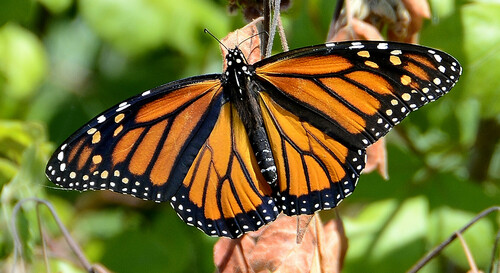
Tirumala limniace, the blue tiger, is a species of butterfly found in South Asia, and Southeast Asia that belongs to the brush-footed butterfly family, Nymphalidae. More specifically it is part of the crows and tigers or danaid group. This butterfly shows gregarious migratory behaviour in southern India. In some places, it may be found in congregations with Danaus genutia, Tirumala septentrionis, Euploea sylvester, Euploea core, Parantica aglea, and at high elevations, with Parantica nilgiriensis, on Crotalaria. Wikipedia
What it can do
- iMigrates in large numbers across peninsular India around the south-west monsoon; migrating swarms are almost all males
- iiMales gather alkaloids from Crotalaria and Heliotropium to make pheromones and boost their chemical defence
- iiiDistasteful to predators thanks to compounds sequestered from its milkweed-family host plants
In the field
Field marks
- aDark brown-black wings with many pale blue, semi-translucent spots and streaks
- bBroad pale streaks in the hindwing cell
- cSlow, gliding flight
- dBlack head and thorax dotted with white
- Not to be confused with
- Dark blue tiger (Tirumala septentrionis) has narrower, darker blue streaks. Glassy tiger (Parantica aglea) is smaller, with thinner, whiter streaks and a more delicate look.
- Where to see it
- Gardens and forest edges across India and Sri Lanka; migration corridors in Karnataka, Kerala and Tamil Nadu.
- When
- Year-round; in South India large migrations take place around the south-west monsoon
Listen
Looking for field recordings…
Life & habits
- Diet
- Adults visit flowers and withered plants rich in alkaloids; caterpillars feed on milkweed-family vines such as Dregea (Wattakaka) and Heterostemma
- Habitat
- Open forest, scrub, grassland and gardens from plains to hills
- Size
- Wingspan about 9–10 cm
Migrating blue tigers often travel with dark blue tigers and crows, and rest in large clusters on shrubs and dry twigs.
Where it lives
Recorded sightings
—
geo-referenced records in GBIF, from museums, herbaria and field observers.
Native range
South and Southeast Asia: India, Sri Lanka, Nepal, Myanmar, Thailand, southern China and Indochina
Drag the globe to turn it. Dots are where records exist, not a range map; darker means more records.
In the old herbals & bestiaries
No plate in the Source Library names this exact species, so these show its closest relatives as the old naturalists drew them: same genus, or the same kind of animal. Click a plate to read the page it came from, with translation.

The Tudor Pattern Book (Herbal-Bestiary)
Relative · Anonymous · 1525 · p.88

Cosmographey: das ist Beschreibung aller Laender
Relative · Münster, Sebastian · 1598 · p.1501

Valeriano: Hieroglyphica (1575)
Relative · Pierio Valeriano · 1556 · p.179

Sancai Tuhui (Vol. 92)
Relative · 王圻, 王思義 · 1609 · p.11

Sancai Tuhui, Juan 92 — Birds & Beasts (NCL Original)
Relative · 王圻、王思義 · 1609 · p.54

The Embassy of the Dutch East India Company to the Tartar Cham
Relative · Johan Nieuhof · 1665 · p.454

Ortus sanitatis
Relative · 1491 · p.594

Collected Illustrations of the Three Realms: Ceremonial Regulations
Relative · 王圻, 王思義 · 1609 · p.32

Compendium of Materia Medica: Illustrated Volume, Middle of the Lower Part
Relative · 李時珍 · 1596 · p.100

Collected Illustrations of the Three Realms: Birds and Beasts
Relative · 王圻, 王思義 · 1609 · p.18
In the stacks
Searching the stacks…
Every page naming Tirumala limniace in the Biodiversity Heritage Library →
Marginalia
Curiosity
The pale blue of its semi-transparent wing spots comes from pterobilin, a blue bile pigment.
Kinship


Fact-checked: 3 corrections made to this sheet. Photographs: iNaturalist contributors under the licences shown. Records: GBIF.org. Historical plates: Source Library (CC BY-SA 4.0; originals public domain). Summary text: Nature Library editors and Wikipedia (CC BY-SA). Medicinal and edibility notes are historical and educational, not advice. iNaturalist taxon 143257.