- Plants
- ›Vascular Plants
- ›flowering plants
- ›Dicots
- ›pinks, cactuses, and allies
- ›cacti
- ›globular cacti, moonlight cacti, torch cacti, and allies
- ›Rhipsalideae
- ›Hatiora
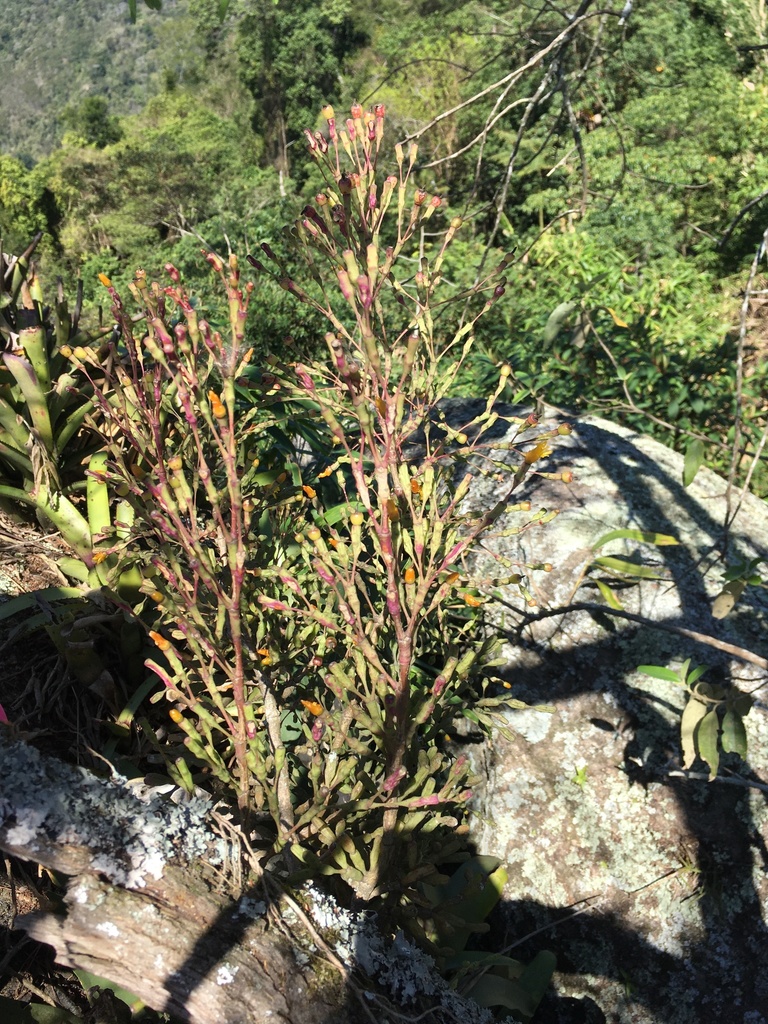
Drunkard's-dream
Hatiora salicornoides
Hatiora salicornoides, also spelt Hatiora salicornioides, the bottle cactus, dancing-bones, drunkard's-dream, or spice cactus, is a species of flowering plant in the cactus family. A member of the tribe Rhipsalideae, it often grows as an epiphyte, natively in eastern Brazil and ornamentally elsewhere.
From the article Hatiora salicornoides on Wikipedia (CC BY-SA), quoted section by section
Description
Hatiora salicornoides grows to about 1 m (3 ft) tall with an erect to pendent growth habit. Its stems are composed of segments 1.5–5 cm (0.6–2.0 in) long. Each segment is shaped like a club or bottle, with the narrower end at the base. The stems branch from the end of a segment, with up to six branches forming a whorl. The yellow to orange flowers are borne at the ends of younger stem segments, and are 1–2 cm (0.4–0.8 in) long and about the same across when open. Translucent white berries follow the flowers.
Range & habitat
Hatiora salicornoides is found along the coast (and slightly inland) of the Southeast Region of Brazil, in states that are parallel to the Atlantic Ocean—although the plant is not typically found growing directly at sea level. Primarily, the species is known from the states of Bahia, Espírito Santo, Minas Gerais, Rio de Janeiro, São Paulo and Paraná; cities and municipalities where it is known from include Belo Horizonte, Curitiba, São José dos Pinhais, and Tiradentes, among others; it may also be found in and around metro Rio de Janeiro and São Paulo, where it grows naturally among tall trees, parks and landscaping. Additionally, a number of large botanic gardens and national parks are situated close to—or directly inside of—the city limits of Río de Janeiro and São Paulo, such as Tijuca National Park and the Rio de Janeiro Botanical Garden, which help to provide a protected, natural habitat for these delicate epiphytic cacti in the middle of two of the planet's most densely populated megacities. The vast and fragile forested stretch of Southeastern Brazilian coastline, the Atlantic Forest ecoregion (or Mata Atlantico), contains dense, and relatively still-intact, forest habitat burgeoning with endemic flora and fauna, including a number of Hatiora species, among other jungle cacti. …
Wikipedia: “Distribution and habitat”
How it is grown
Hatiora salicornoides is grown as an ornamental plant. It requires some humidity, and is not frost-tolerant. Light shade and a minimum average temperature of 12 °C (54 °F) are recommended. Given these conditions, it has been successfully cultivated outside in Phoenix, Arizona. In climates with lower winter temperatures, it is cultivated in greenhouses or as a house plant. It is propagated by stem cuttings. In the UK Hatiora salicornoides has gained the Royal Horticultural Society's Award of Garden Merit.
Wikipedia: “Cultivation”
Where it lives
Recorded sightings
—
geo-referenced records in GBIF, from museums, herbaria and field observers.
Drag the globe to turn it. Dots are where records exist, not a range map; darker means more records.
In the stacks
Searching the stacks…
Every page naming Hatiora salicornoides in the Biodiversity Heritage Library →
This page is assembled live from iNaturalist, GBIF, Wikipedia, the Source Library and the Internet Archive. It is not yet part of the hand-edited codex. iNaturalist taxon 1453005.