- Plants
- ›Vascular Plants
- ›flowering plants
- ›Dicots
- ›pinks, cactuses, and allies
- ›cacti
- ›globular cacti, moonlight cacti, torch cacti, and allies
- ›Globular Cactuses
- ›Sclerocactus
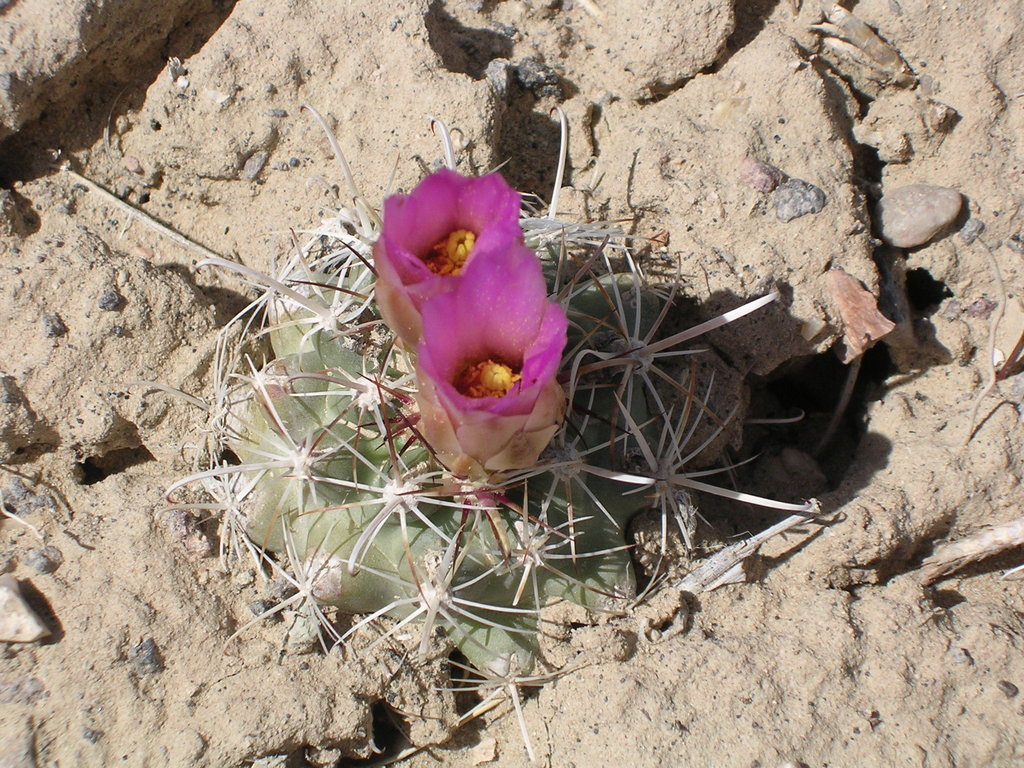
Wright's fishhook cactus
Sclerocactus wrightiae
Sclerocactus wrightiae is a rare species of cactus known by the common names Wright's little barrel cactus and Wright's fishhook cactus.
Dr. Lyman Benson named this species for North American cactus expert Dorde Wright Woodruff, who initially discovered it in 1961 and brought it to the attention of Dr. Benson. Dr. Benson and Ms. Woodruff later collaborated in connection with other Sclerocactus taxa in the Intermountain West.
From the article Sclerocactus wrightiae on Wikipedia (CC BY-SA), quoted section by section
Description
Sclerocactus wrightiae has stems 4–12 cm tall that are depressed-hemispheric to obovoid to short-cylindric (but not becoming tall-cylindric). Flowers are 2 to 3.5 cm long, yellowish to white or pink. Filaments are red-violet. Flower buds are reddish-brown and rounded prior to anthesis and elongating and becoming pointed just prior to flowering as with other smaller species of Scerocactus.
Range & habitat
It is endemic to Utah in the United States, where it is known only from Emery, Sevier, Wayne, and Garfield Counties. It occurs at Capitol Reef National Park and the San Rafael Swell. It is numerous threats and is federally listed as an endangered species of the United States (listed under the Endangered Species Act on October 11, 1979). This plant grows in shrublands on a specific type of soil. It is usually fine or sandy in texture and there is a large amount of material scattered on the land, including pebbles, gravel, and fossil oyster shells. An important component of the substrate is the cryptobiotic crust that lies on top. The cactus is absent from areas where this crust has been destroyed.
Wikipedia: “Distribution”
Where it lives
Recorded sightings
—
geo-referenced records in GBIF, from museums, herbaria and field observers.
Drag the globe to turn it. Dots are where records exist, not a range map; darker means more records.
In the stacks
Searching the stacks…
Every page naming Sclerocactus wrightiae in the Biodiversity Heritage Library →
This page is assembled live from iNaturalist, GBIF, Wikipedia, the Source Library and the Internet Archive. It is not yet part of the hand-edited codex. iNaturalist taxon 148303.