 NL·0729
Herbarium of the Nature Library
- Name
- Leucopsar rothschildi
- Family
- Sturnidae
- Native to
- Endemic to NW Bali, Indonesia (West Bali National Park); reintroduced to Nusa Penida and other Bali sites
- Habitat
- Dry monsoon forest, Savanna
On eBird ↗
Bali Myna
Live sightings near you, the range map, bar charts of when it is seen, and Macaulay Library photos and recordings.
Bali myna
Leucopsar rothschildi
Also calledJalak Bali (Indonesian/Balinese) · Bali starling · Rothschild's myna
A snow-white starling with black wingtips, a drooping crest and a patch of bare sky-blue skin around each eye, found wild only on Bali. Trapping for the cagebird trade pushed it to a handful of wild birds around 2000; releases have since rebuilt small populations.
The Bali myna, also known as Rothschild's mynah, Bali starling, or Bali mynah, locally known as jalak Bali, is a medium-sized, stocky myna native to northwest Bali in Indonesia. It is almost wholly white with a long, drooping crest, and black tips on the wings and tail. The bird has blue bare skin around the eyes, greyish legs and a brown and yellow bill. Both sexes are similar. It is critically endangered and in 2020, fewer than 50 adults were assumed to exist in the wild. Wikipedia
What it can do
- iRaises its long, lacy crest in display
- iiNests in tree holes, including old woodpecker and barbet holes
- iiiSurvives in a strongly seasonal dry forest
In the field
Field marks
- aAlmost entirely white starling
- bBlack tips to the wings and tail
- cBare bright blue skin around the eye
- dLong, drooping white crest; yellowish bill and blue-grey legs
- Voice
- Loud, varied chattering, harsh calls and whistles typical of starlings
- Not to be confused with
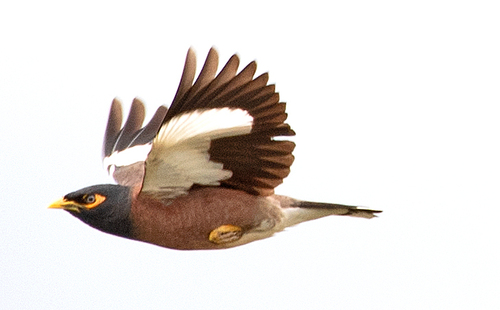
- Black-winged myna (Java, Bali) has extensive black wings and a black tail and a yellow face patch; Javan white-eyes are tiny and green.
- Where to see it
- West Bali National Park (Bali Barat), Nusa Penida island
- When
- Resident
Listen
Looking for field recordings…
Life & habits
- Diet
- Fruit, seeds, insects and other invertebrates
- Habitat
- Dry deciduous monsoon forest, acacia savanna and village edges
- Size
- About 25 cm long
Pairs and small groups move through the canopy and forest edge, raising their crests and calling loudly.
Where it lives
Recorded sightings
—
geo-referenced records in GBIF, from museums, herbaria and field observers.
Native range
Endemic to NW Bali, Indonesia (West Bali National Park); reintroduced to Nusa Penida and other Bali sites
Drag the globe to turn it. Dots are where records exist, not a range map; darker means more records.
In the stacks
Searching the stacks…
Every page naming Leucopsar rothschildi in the Biodiversity Heritage Library →
Marginalia
It is the official faunal symbol of Bali province. On Nusa Penida, Balinese villages agreed under traditional law (awig-awig) to protect released birds, a model for community-based conservation.
Curiosity
It was only described to science in 1912, and named after Walter Rothschild, the zoologist who owned the famous private museum at Tring.
Kinship



Photographs: iNaturalist contributors under the licences shown. Records: GBIF.org. Historical plates: Source Library (CC BY-SA 4.0; originals public domain). Summary text: Nature Library editors and Wikipedia (CC BY-SA). Medicinal and edibility notes are historical and educational, not advice. iNaturalist taxon 15041.