 NL·0197
Herbarium of the Nature Library
- Name
- Mycena chlorophos
- Family
- Mycenaceae
- Native to
- Subtropical and tropical Asia (Japan, Taiwan, Indonesia, Malaysia), Pacific islands, Australia, and Brazil
- Habitat
- Subtropical forest, Tropical rainforest
Glowing bonnet
Mycena chlorophos
Also calledYakōtake 夜光茸 (Japanese) · Ghost mushroom (English, loosely)
A tiny, pale bonnet mushroom of subtropical forests whose cap and gills glow eerie green in the dark. On Japan's Hachijō-jima it lights the forest floor after summer rain.
Mycena chlorophos is a species of agaric fungus in the family Mycenaceae. First described in 1860, the fungus is found in subtropical Asia, including India, Japan, Taiwan, Polynesia, Indonesia, and Sri Lanka, in Australia, and Brazil. Fruit bodies (mushrooms) have pale brownish-grey sticky caps up to 30 mm (1.2 in) in diameter atop stems 6–30 mm (0.2–1.2 in) long and up to a millimeter thick. The mushrooms are bioluminescent and emit a pale green light. Fruiting occurs in forests on fallen woody debris such as dead twigs, branches, and logs. The fungus can be made to grow and fruit in laboratory conditions, and the growth conditions affecting bioluminescence have been investigated. Wikipedia
What it can do
- iBioluminescent: the oxygen-dependent luciferin–luciferase reaction (fungal luciferin is 3-hydroxyhispidin) gives off green light near 520 nm
- iiGlows most strongly at about 27 °C and stops glowing in cold or dry conditions
- iiiDecomposes fallen twigs, bark and palm debris
- ivThe caps are only about 1–3 cm across
At the table
Not eaten; too small and its edibility is unknown. Many small Mycena species contain toxins.
Fruiting body & spores
Spores
Spore print white; spores ellipsoid, smooth, amyloid, about 7–9 × 5–6 µm
- Dispersal
- Wind-borne basidiospores; glowing may attract insects that spread spores
Where it lives
Recorded sightings
—
geo-referenced records in GBIF, from museums, herbaria and field observers.
Native range
Subtropical and tropical Asia (Japan, Taiwan, Indonesia, Malaysia), Pacific islands, Australia, and Brazil
Drag the globe to turn it. Dots are where records exist, not a range map; darker means more records.
In the old herbals & bestiaries
No plate in the Source Library names this exact species, so these show its closest relatives as the old naturalists drew them: same genus, or the same kind of plant. Click a plate to read the page it came from, with translation.

Illustrations of Fungi which Grow in Bavaria and the Palatinate around Ratisbon, Vols 1–2
Relative · Jacob Christian Schaeffer; C.H. Persoon (ed.) · 1800 · p.146

Illustrations of Fungi which Grow in Bavaria and the Palatinate around Ratisbon, Vols 1–2
Relative · Jacob Christian Schaeffer; C.H. Persoon (ed.) · 1800 · p.177

Coloured Figures of English Fungi or Mushrooms
Relative · James Sowerby · 1797 · p.554

Coloured Figures of English Fungi or Mushrooms
Relative · James Sowerby · 1797 · p.710

Jean Baptiste Audebert — Histoire naturelle des singes et des makis (1800)
Relative · Jean Baptiste Audebert · 1800 · p.148
In the stacks
Searching the stacks…
Every page naming Mycena chlorophos in the Biodiversity Heritage Library →
Marginalia
Hachijō-jima, south of Tokyo, has made its glowing yakōtake a tourist attraction. Researchers there cultivate them to study the fungal light reaction.
Curiosity
The fungal luciferin pathway was mapped in 2018. Its genes have since been used to make plants that glow on their own.
Kinship
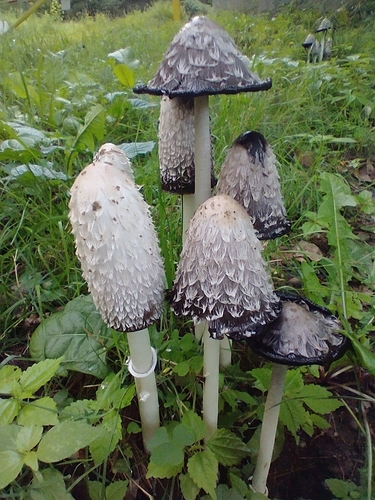

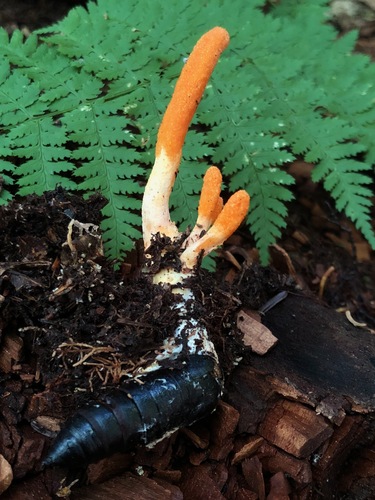
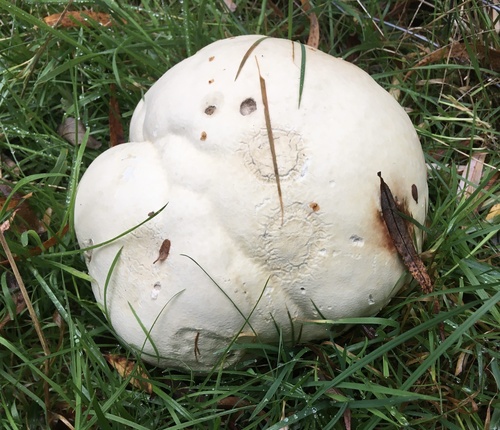
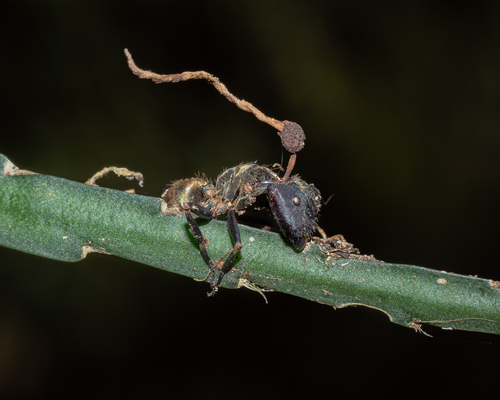

Photographs: iNaturalist contributors under the licences shown. Records: GBIF.org. Historical plates: Source Library (CC BY-SA 4.0; originals public domain). Summary text: Nature Library editors and Wikipedia (CC BY-SA). Medicinal and edibility notes are historical and educational, not advice. iNaturalist taxon 155173.