- Plants
- ›Vascular Plants
- ›flowering plants
- ›Dicots
- ›pinks, cactuses, and allies
- ›cacti
- ›globular cacti, moonlight cacti, torch cacti, and allies
- ›Pachycereae
- ›Echinocereus
- ›Echinocereus
- ›Echinocereus
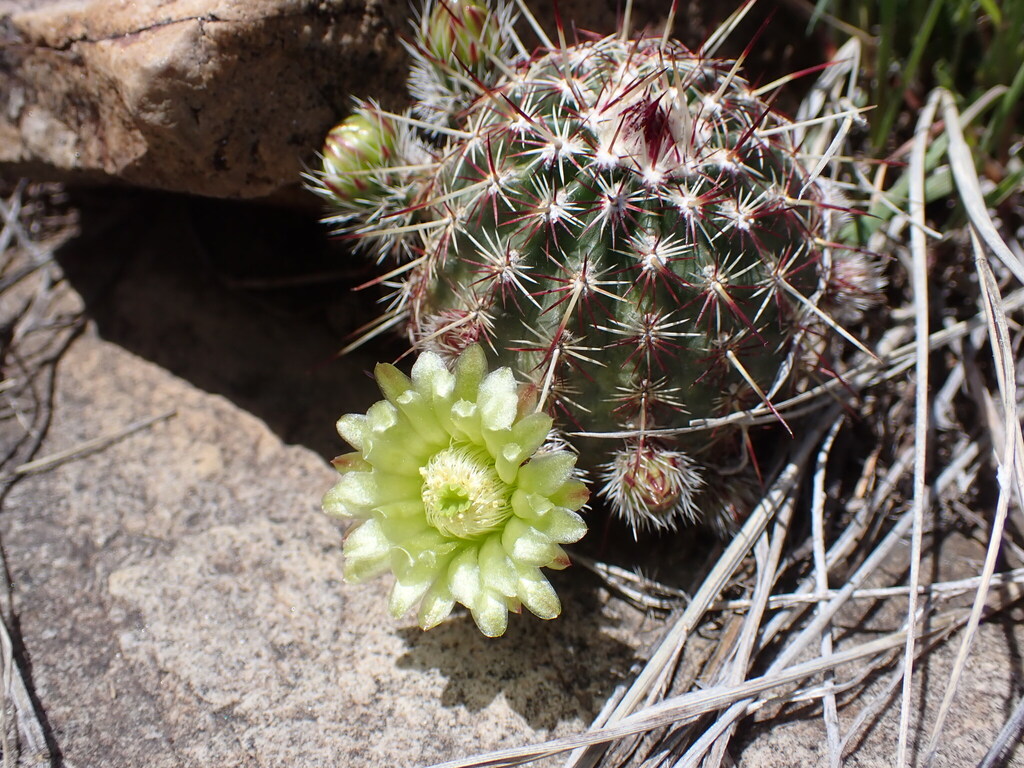
Green-flower Hedgehog Cactus
Echinocereus viridiflorus
Echinocereus viridiflorus is a species of cactus known by the common names nylon hedgehog cactus, green pitaya, and small-flowered hedgehog cactus. It is native to the central and south-central United States and northern Mexico, where it can be found in varied habitat types, including desert scrub, woodlands, dry grasslands, and short-grass prairie.
From the article Echinocereus viridiflorus on Wikipedia (CC BY-SA), quoted section by section
Description
This cactus has a small spherical to ovoid, sometimes elongated or cylindrical in shape, stem 3 cm (1.2 in) to over 30 cm (12 in) tall and up to 1 to 9 cm (0.39 to 3.54 in) wide. The 6 to 18 ribs are clearly humps. It is mostly unbranched but it may occur in squat clusters of several branches. The body of the plant is ridged and lined with many areoles bearing spines. The spines may be red, yellow, white, purplish, or bicolored, sometimes with darker tips and are up to 2.5 cm (0.98 in) long. The 8 to 24 marginal spines are also red, cream or brown and up to 1.8 cm (0.71 in) long. The flower is up to 3 cm (1.2 in) long and has tepals in shades of yellowish, brownish, greenish, or occasionally red, with darker reddish midstripes. The tepals are thin at the tips. They are usually wide open, funnel-shaped and green to yellow-green. They are 2.5 to 3.0 cm (0.98 to 1.18 in) long and large in diameter. The fruits are spherical, green and heavily thorny.
Range & habitat
Echinocereus viridiflorus is widespread in the US states of South Dakota, Wyoming, Colorado, Kansas, New Mexico, Oklahoma and Texas, as well as in the neighboring Mexican states of Coahuila and Chihuahua. It has yellow-green flowers. This rare variety is endemic to Brewster County, Texas, where it grows in beds of Selaginella in rocky soils of novaculite origin. There was only one population known as of 1984, and it probably will not expand its range because it is limited to a specific mineral substrate.
Wikipedia: “Distribution”
Where it lives
Recorded sightings
—
geo-referenced records in GBIF, from museums, herbaria and field observers.
Drag the globe to turn it. Dots are where records exist, not a range map; darker means more records.
In the stacks
Searching the stacks…
Every page naming Echinocereus viridiflorus in the Biodiversity Heritage Library →
This page is assembled live from iNaturalist, GBIF, Wikipedia, the Source Library and the Internet Archive. It is not yet part of the hand-edited codex. iNaturalist taxon 162190.