- Plants
- ›Vascular Plants
- ›flowering plants
- ›Dicots
- ›pinks, cactuses, and allies
- ›cacti
- ›globular cacti, moonlight cacti, torch cacti, and allies
- ›Globular Cactuses
- ›Pediocactus
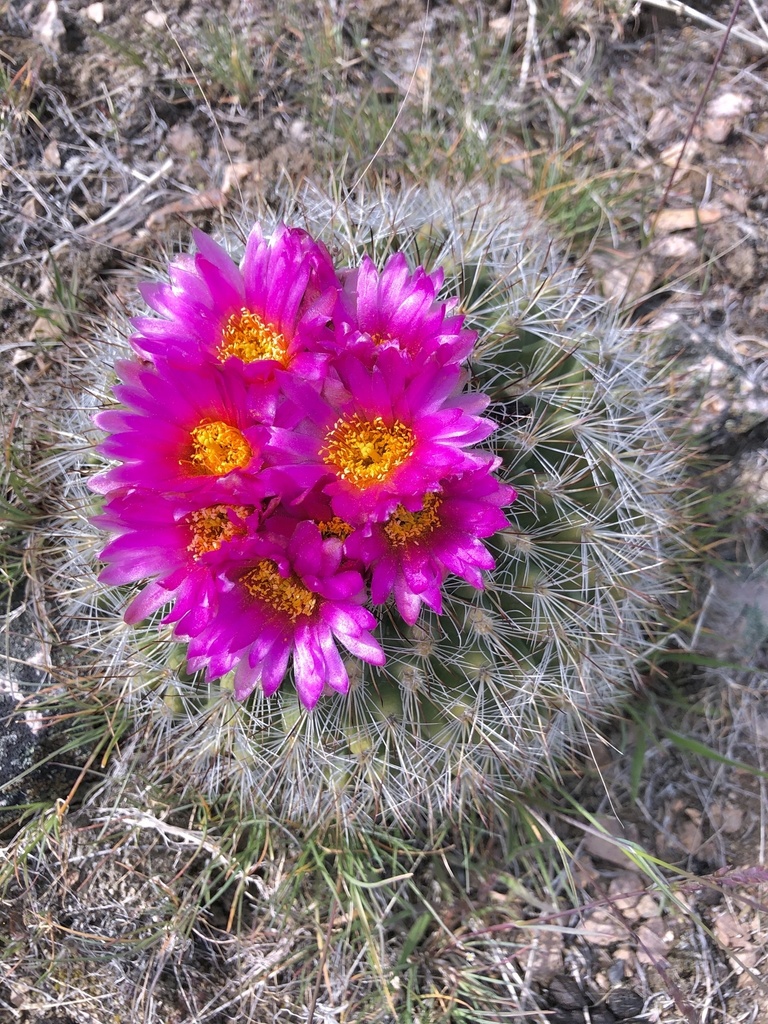
Columbia Plateau Cactus
Pediocactus nigrispinus
Pediocactus nigrispinus is a species in the cactus family with the common names snowball cactus, Columbia Plateau cactus, and basalt cactus. It is found in dry areas in Washington, Oregon, and Idaho. Proposals have tried to make it the Official State Cactus for Washington State.
From the article Pediocactus nigrispinus on Wikipedia (CC BY-SA), quoted section by section
Description
Initially spherical, the plant transforms into an egg-shaped configuration as it matures into a densely spiny (often flattened) ovoid form. It grows to 25 centimetres (10 in) tall and from 5 to 15 cm (2 to 6 in) wide. It usually develops into a cluster of ribbed stems, which are 7.5–12.5 cm (3–5 in) wide and green to grayish-blue. There is a characteristic dense arrangement of 4 to 11 large central spines, measuring 1.5 to 2.5 cm (1⁄2 to 1 in) long and yellowish to reddish-brown. There are 15–35 smaller, whitish spines up to 1.5 cm long. The showy pink to magenta flowers appear in the spring and form a cluster near the apex of each stem.
Range & habitat
The Columbia Plateau cactus grows in big sagebrush and lower montane dry habitats in eastern Washington and Oregon and extending into Idaho in dry regions, steppes and semi-deserts on hills or rocky outcrops at altitudes between 260 and 1,200 metres (850 and 3,940 ft). It grows in scattered locations but is often locally abundant. Other plants in the habitat include Opuntia polyacantha and O. fragilis.
Wikipedia: “Distribution and habitat”
Where it lives
Recorded sightings
—
geo-referenced records in GBIF, from museums, herbaria and field observers.
Drag the globe to turn it. Dots are where records exist, not a range map; darker means more records.
In the stacks
Searching the stacks…
Every page naming Pediocactus nigrispinus in the Biodiversity Heritage Library →
This page is assembled live from iNaturalist, GBIF, Wikipedia, the Source Library and the Internet Archive. It is not yet part of the hand-edited codex. iNaturalist taxon 166258.