- Plants
- ›Vascular Plants
- ›flowering plants
- ›Dicots
- ›Nances, Willows, and Allies
- ›Spurge Family
- ›Euphorbioideae
- ›Euphorbieae
- ›Euphorbiinae
- ›Euphorbia
- ›Esula
- ›Patellares
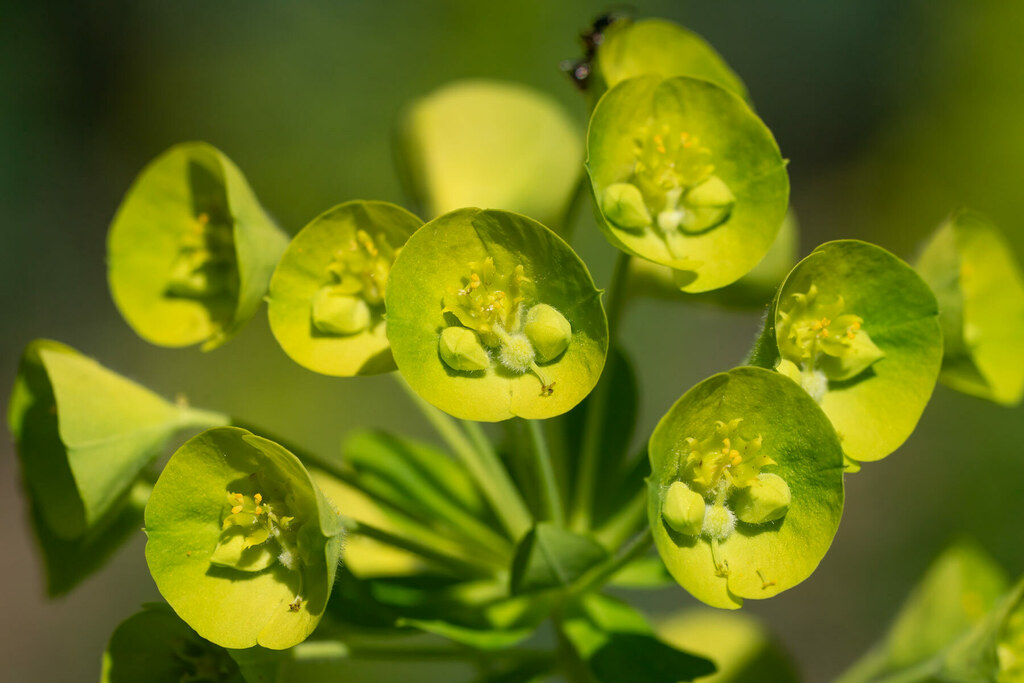
Mediterranean spurge
Euphorbia characias
Euphorbia characias, the Mediterranean spurge or Albanian spurge, is a species of flowering plant in the Euphorbiaceae family typical of the Mediterranean vegetation. It is an upright, compact evergreen shrub growing to 1.2 m (3 ft 11 in) tall and wide.
From the article Euphorbia characias on Wikipedia (CC BY-SA), quoted section by section
Description
It has many medium to tall unbranched stems with long narrow leaves, clothed densely in short hair (tomentose), and dark (ssp characias) or yellow (ssp wulfenii) floral nectar glands within the yellow cup-like cyathia, which are borne in large dense spherical to oblong clusters, from spring to early summer. The fruits are smooth densely-hairy capsules. It is a tough plant, capable of resisting long periods of drought. It grows preferably in dry areas, often far away from the water table, both in flat as well as in mountainous terrain. This plant can also resist high salinity. Similar species include E. kotschyana (leaf uppersides shiny) and E. thompsonii (leaves hairy but upper leaves unexpectedly very short).
At the table
This plant also has uses in traditional medicine; like many other species of genus Euphorbia its toxic white and sticky sap has been used to treat skin excrescences, like cancers, tumors, and warts, since ancient times.
Wikipedia: “Uses”
How it is grown
Euphorbia characias is valued as an ornamental plant for its ability to survive drought and its groundcovering capabilities. It is suitable for any location, sheltered or exposed, in light soil in full sun. It is fully hardy down to −10 °C (14 °F).
Cultivars. Garden cultivars are sold under the names ‘Black Pearl’, ‘Thelma's Giant’, ‘Lambrook Gold’, ‘Silver Swan’ and ‘Tasmanian Tiger’, among others. They come in a variety of colors, from silvery grey and bluish green to greenish yellow. These garden varieties are valued in Mediterranean or desert landscaping for not being highly demanding and for looking good despite lack of watering in sunny areas. The following cultivars have gained the Royal Horticultural Society's Award of Garden Merit:-
Wikipedia: “Cultivation”
Where it lives
Recorded sightings
—
geo-referenced records in GBIF, from museums, herbaria and field observers.
Drag the globe to turn it. Dots are where records exist, not a range map; darker means more records.
In the old herbals & bestiaries

Commentaries on the Six Books of Pedanius Dioscorides on Medical Matter
Pietro Andrea Mattioli · 1565 · p.1422

Commentaries on the Six Books of Dioscorides on Medical Matter
Pietro Andrea Mattioli · 1563 · p.708

Discourses on the Six Books of Dioscorides
Dioscorides; Pietro Andrea Mattioli (comm.) · 1568 · p.1493
In the stacks
Searching the stacks…
Every page naming Euphorbia characias in the Biodiversity Heritage Library →
This page is assembled live from iNaturalist, GBIF, Wikipedia, the Source Library and the Internet Archive. It is not yet part of the hand-edited codex. iNaturalist taxon 181594.