- Plants
- ›Vascular Plants
- ›flowering plants
- ›Dicots
- ›pinks, cactuses, and allies
- ›cacti
- ›globular cacti, moonlight cacti, torch cacti, and allies
- ›Trichocereeae
- ›Brachycereus
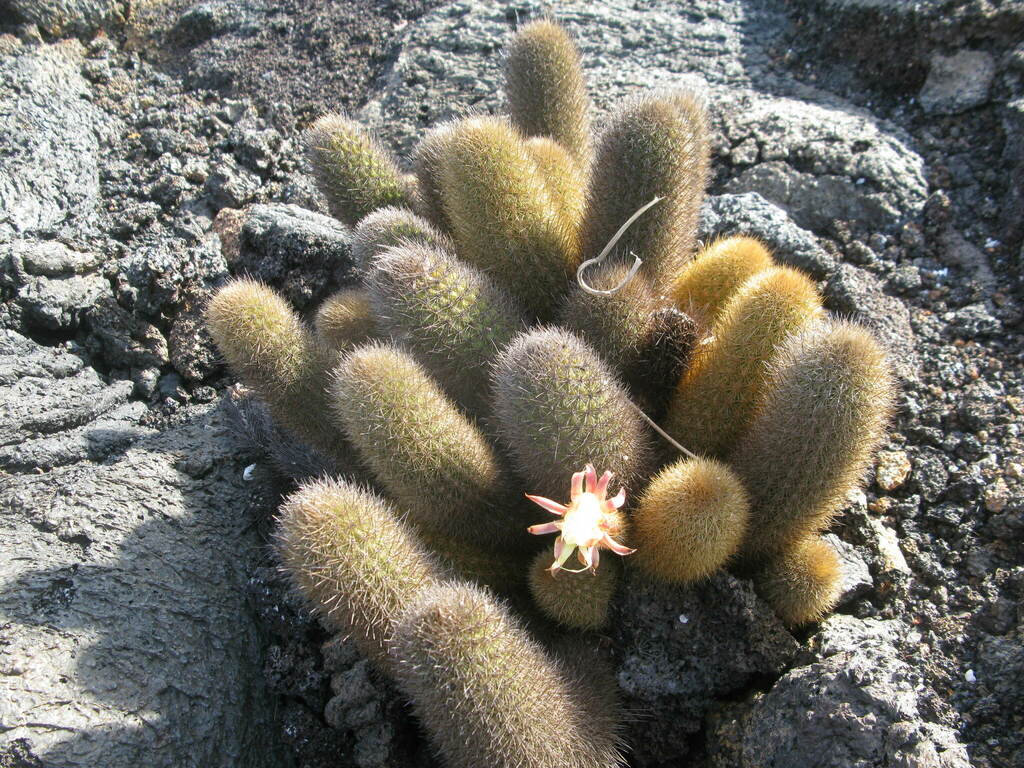
Lava Cactus
Brachycereus nesioticus
The lava cactus is a species of cactus, Brachycereus nesioticus, the sole species of the genus Brachycereus. The plant is a colonizer of lava fields – hence its common name – where it forms spiny clumps up to 60 cm (24 in) tall. Its solitary white or yellowish white flowers open in the daytime. It is endemic to the Galápagos Islands.
From the article Lava cactus on Wikipedia (CC BY-SA), quoted section by section
Description
The lava cactus is a leafless clump-forming species, with cylindrical stems typically up to 50–60 cm (20–24 in) tall in formations that can be as much as 2 m (6 ft 7 in) across. The stems have 16–22 ribs and are yellow, with green or brown tones. Each areole has up to 40 spines, up to 5 cm (2 in) long, initially yellowish, but becoming darker with age. The flowers are borne singly, and are narrowly funnel-shaped, up to 11 cm (4+3⁄8 in) long and 5.5 cm (2+1⁄8 in) across, with many spines on the lower part of the flower. They open in the daytime and are white to yellowish white inside. The remains of the flower stay attached to the fruit, which is a berry, red to brown in colour, covered with yellow spines and filled with many black seeds.
Range & habitat
The lava cactus is endemic to the Galápagos, where it is found on Fernandina, Genovesa, Isabela, Pinta, Santa Cruz, and Santiago, as well as some smaller islands, including Bartolomé. It grows on barren lava flows, both pāhoehoe and ʻaʻā. It is one of the first species to grow on new lava flows.
Wikipedia: “Distribution and habitat”
Where it lives
Recorded sightings
—
geo-referenced records in GBIF, from museums, herbaria and field observers.
Drag the globe to turn it. Dots are where records exist, not a range map; darker means more records.
In the stacks
Searching the stacks…
Every page naming Brachycereus nesioticus in the Biodiversity Heritage Library →
This page is assembled live from iNaturalist, GBIF, Wikipedia, the Source Library and the Internet Archive. It is not yet part of the hand-edited codex. iNaturalist taxon 184574.