- Plants
- ›Vascular Plants
- ›flowering plants
- ›Dicots
- ›pinks, cactuses, and allies
- ›cacti
- ›globular cacti, moonlight cacti, torch cacti, and allies
- ›Globular Cactuses
- ›Coryphantha
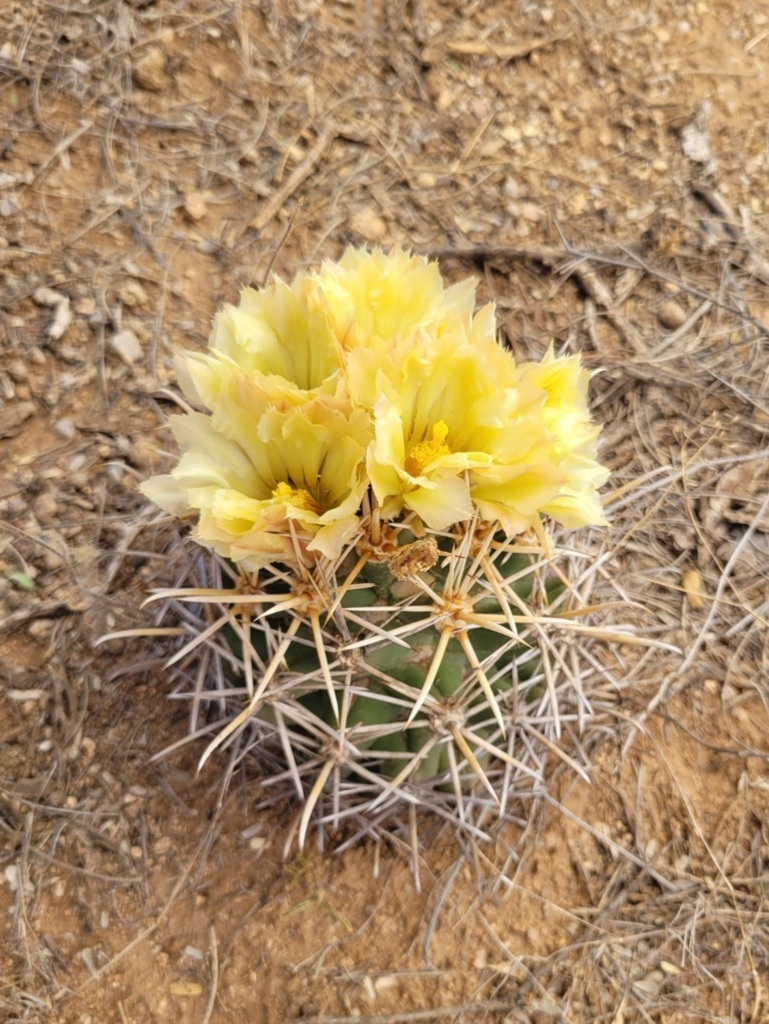
Long-tubercled Cory Cactus
Coryphantha robustispina
Coryphantha robustispina, commonly called the Pima pineapple, is a federally protected cactus of the Sonoran Desert. It is commonly found in Pima County, Arizona although it is also found throughout New Mexico and as far east as Texas.
From the article Coryphantha robustispina on Wikipedia (CC BY-SA), quoted section by section
Description
Coryphantha robustispina grows mostly solitarily with an ovoid shape. It has a clean greyish-greenish color and reaches 5–9 cm tall and 5–15 cm in diameter although larger plants are frequently found. The areolas are oval or cylindrical in shape with a deep furrow and one or two nectar glads. It has 1-4 central spines curved or hooked. They are white or grey with the tip being darker. They measure between 1 and 5 cm in length. The 6-16 radial spines are off-white between 1 and 3 cm in length. Their flowers are golden yellow, pale green or opaque yellow. The seed pods are cylindrical and green up to 5 cm.
Range & habitat
Coryphantha robustispina is found in Arizona, New Mexico and Texas in the United States. It also is in Mexico in the states of Chihuahua and Sonora. It is rare. Coryphantha robustispina var. robustispina is on the Federal Endangered Species list, where it is identified using the former nomenclature of Coryphantha scheeri var. robustispina.
Wikipedia: “Distribution and habitat”
What it does
Coryphantha robustispina has a complicated life cycle: 1) It flowers after a monsoon rain, usually in July. 2) A certain type of bee fertilizes it a couple of days later since the flowers only last a short time. 3) The pods are often eaten by a jack rabbit. 4) The seeds go through the intestines of the jack rabbit and are deposited on the ground in its excrement; and 5) The scat protects the seeds until a special termite eats them and causes the seeds to germinate and then to propagate. This does not apply to cottontail rabbit, as their teeth will damage the seeds. It is an extremely complicated life cycle and if any one of the steps is interrupted, the plant does not reproduce. While the above is a typical cycle for the species, seeds collected directly from fruits and not subjected to passing through the intestines of a jackrabbit or other animal can have a high germination rate and be successfully grown into mature plants.
Wikipedia: “Ecology”
In human culture
The generic name Coryphantha is derived from the Greek--coryphe="head", anthos="flower"; that is to say the plant with a flower on its head. Robustispina means robust spines and needles.
Wikipedia: “Etymology”
Where it lives
Recorded sightings
—
geo-referenced records in GBIF, from museums, herbaria and field observers.
Drag the globe to turn it. Dots are where records exist, not a range map; darker means more records.
In the stacks
Searching the stacks…
Every page naming Coryphantha robustispina in the Biodiversity Heritage Library →
This page is assembled live from iNaturalist, GBIF, Wikipedia, the Source Library and the Internet Archive. It is not yet part of the hand-edited codex. iNaturalist taxon 190941.