- Animals
- ›Arthropods
- ›Hexapods
- ›Insects
- ›Winged and Once-winged Insects
- ›Ants, Bees, Wasps, and Sawflies
- ›Narrow-waisted Wasps, Ants, and Bees
- ›Ants, Bees, and Stinging Wasps
- ›Formicoidea
- ›Ants
- ›Formicine Ants
- ›Camponotine Ants
- ›Camponotus
- ›Myrmophyma
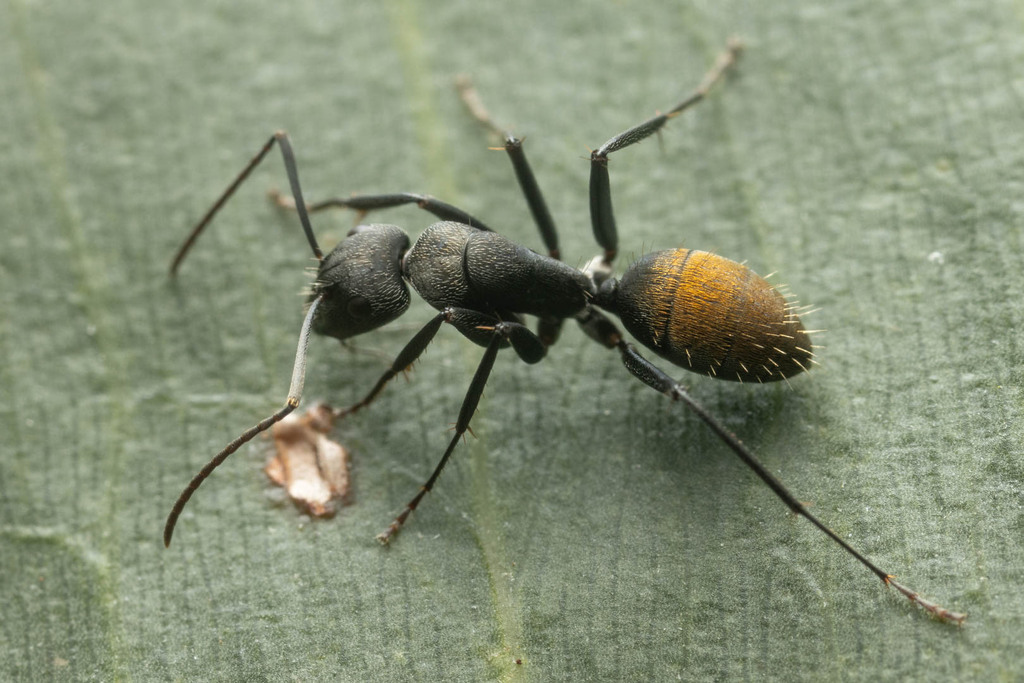
Golden-tailed Sugar Ant
Camponotus aeneopilosus
The Golden tail sugar ant (Camponotus aeneopilosus or also commonly known as the golden black sugar ant) is a species of ant in the genus Camponotus. It is native to eastern Australia and was described by Gustav Mayr in 1862.
From the article Golden tail sugar ant on Wikipedia (CC BY-SA), quoted section by section
Description
The golden tail sugar ant is a polymorphic species, meaning that workers vary in size. It is a relatively small species, with lengths ranging from 5 to 9 millimetres (0.20 to 0.35 in). The ants are almost entirely black, with the exception of their gaster which has a covering of golden hairs, and also resembles some species of spiny ants, but they lack the spines that are on the mesosoma.
Range & habitat
The golden tail sugar ant is commonly found in forests and woodlands in eastern Australia, where they are found nesting under soil, rocks and sometimes logs. They are only active during the day. CSIRO claims these ants have only been known from New South Wales and the Australian Capital Territory, while their presence in other states and territories are yet to be verified.
Wikipedia: “Distribution”
Listen
Looking for field recordings…
Where it lives
Recorded sightings
—
geo-referenced records in GBIF, from museums, herbaria and field observers.
Drag the globe to turn it. Dots are where records exist, not a range map; darker means more records.
In the stacks
Searching the stacks…
Every page naming Camponotus aeneopilosus in the Biodiversity Heritage Library →
This page is assembled live from iNaturalist, GBIF, Wikipedia, the Source Library and the Internet Archive. It is not yet part of the hand-edited codex. iNaturalist taxon 201982.