- Animals
- ›Arthropods
- ›Hexapods
- ›Insects
- ›Winged and Once-winged Insects
- ›Butterflies and Moths
- ›Hawk, Sphinx, Silk, Emperor, and Allied Moths
- ›Sphinx Moths
- ›Macroglossine Sphinx Moths
- ›Macroglossini
- ›Macroglossina
- ›Macroglossum
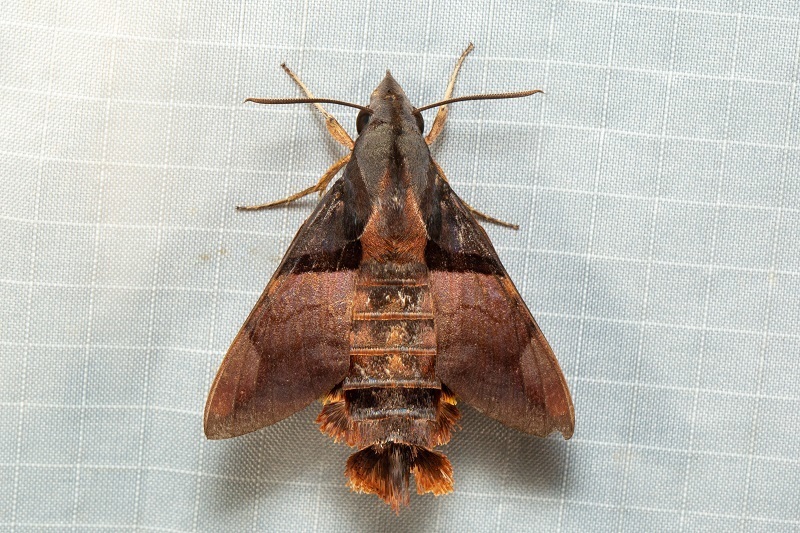
Black-based Hummingbird Hawkmoth
Macroglossum passalus
Macroglossum passalus, the black-based hummingbird hawkmoth, is a moth of the family Sphingidae described by Dru Drury in 1773. It is known from Sri Lanka, India, Thailand, south-eastern China, Taiwan, southern Japan, Indonesia (Sumatra, Java) and the Philippines.
The wingspan is 52–62 mm. Adults are attracted to the flowers of Duranta erecta and Lantana camara. They are on wing at dawn and dusk.
From the article Macroglossum passalus on Wikipedia (CC BY-SA), quoted section by section
Description
Upperside: antennae brown, and thickest near their extremities. Head and thorax greyish brown, with a dark line running down the middle. Abdomen red brown, with two yellow spots on each side. Tail broad and hairy. Anterior wings, next the body, dark chocolate, occupying a third part; next to this they are of a light red brown, growing darker as it approaches the tips. Inferior wings yellow next the shoulders; the apical half being of a fine dark chocolate. Underside: head white. Tongue curled up. Breast and thighs yellow clay coloured. Legs, sides, and abdomen dark clay coloured. Wings, next the body, yellow clay coloured; the remaining parts being red brown, with a faint darker border along the external edges. Wingspan 2 inches (50 mm).
== References ==
Listen
Looking for field recordings…
Where it lives
Recorded sightings
—
geo-referenced records in GBIF, from museums, herbaria and field observers.
Drag the globe to turn it. Dots are where records exist, not a range map; darker means more records.
In the stacks
Searching the stacks…
Every page naming Macroglossum passalus in the Biodiversity Heritage Library →
This page is assembled live from iNaturalist, GBIF, Wikipedia, the Source Library and the Internet Archive. It is not yet part of the hand-edited codex. iNaturalist taxon 202131.