- Animals
- ›Arthropods
- ›Hexapods
- ›Insects
- ›Winged and Once-winged Insects
- ›Butterflies and Moths
- ›Butterflies
- ›Whites, Yellows, and Sulphurs
- ›Yellows and Sulphurs
- ›Euremini
- ›Kricogonina
- ›Kricogonia
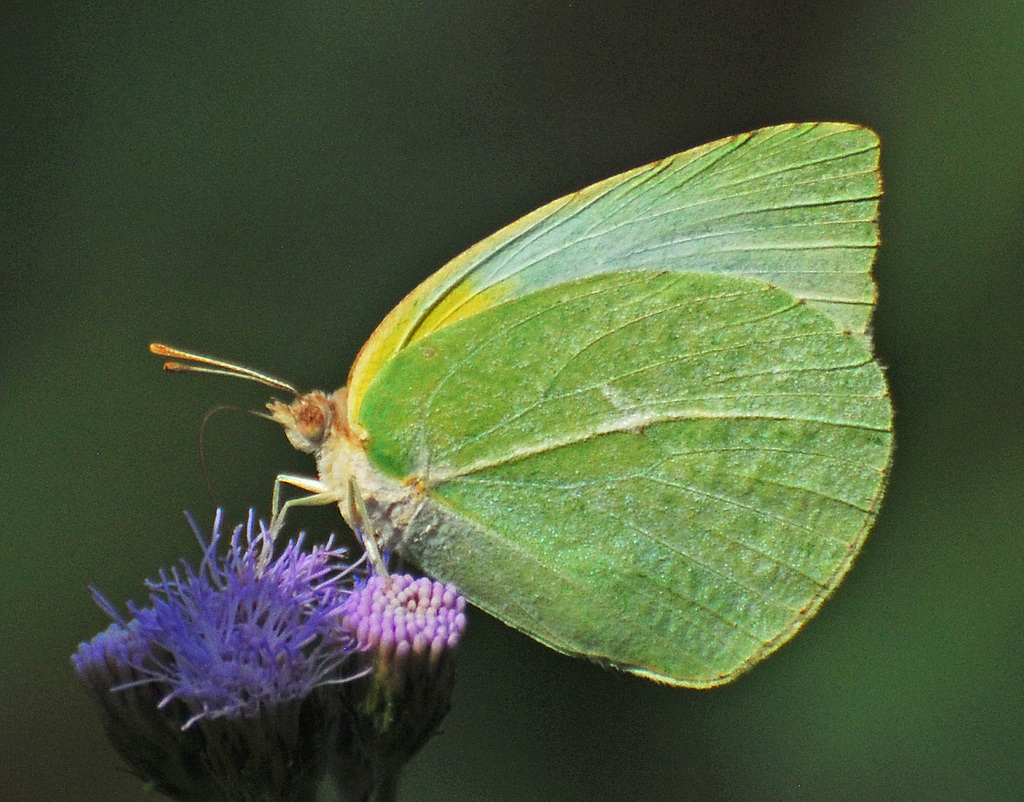
Lyside Sulphur
Kricogonia lyside
Kricogonia lyside, the lyside sulphur or guayacan sulphur, is a North American, Caribbean, and South American butterfly in the family Pieridae.
In seasons with heavy monsoons, this butterfly is seen in massive migrations which are frequent in Texas but more rare in the southwest. It is also an occasional resident in southern Florida.
From the article Kricogonia lyside on Wikipedia (CC BY-SA), quoted section by section
Description
The lyside sulphur is variable. The upperside of the wings is pale yellow, usually with a black bar on the leading edge of the hindwing and a bright yellow patch near the base of the forewing. Some individuals also have black borders along the costa and apex of the forewing. The underside of the wings varies from a greenish color to bright yellow to almost white. Greener individuals have a whitish vein in the center of the hindwing and a bright yellow forewing basal patch. It has a wingspan of 3.8 to 6 cm (1.5 to 2.4 in).
What it does
The larva is highly variable. It ranges in color from grass green to blackish green. It may have markings or may be unmarked. Marked individuals usually have dorsal and spiracular silvery stripes. It is the only caterpillar to feed on plants in the family Zygophyllaceae. Apparently they feed exclusively on the leaves of three Guaiacum species: G. sanctum and G. angustifolium in Central and North America and G. officinale in South America and the Caribbean. The chrysalis is a bluish-green color. The lyside sulphur can grow from egg to adult in as little as 13 days. It has three or more broods per year in southern Texas.
== References ==
Wikipedia: “Life cycle”
Listen
Looking for field recordings…
Where it lives
Recorded sightings
—
geo-referenced records in GBIF, from museums, herbaria and field observers.
Drag the globe to turn it. Dots are where records exist, not a range map; darker means more records.
In the stacks
Searching the stacks…
Every page naming Kricogonia lyside in the Biodiversity Heritage Library →
This page is assembled live from iNaturalist, GBIF, Wikipedia, the Source Library and the Internet Archive. It is not yet part of the hand-edited codex. iNaturalist taxon 204775.