- Plants
- ›Vascular Plants
- ›flowering plants
- ›Dicots
- ›pinks, cactuses, and allies
- ›cacti
- ›globular cacti, moonlight cacti, torch cacti, and allies
- ›Pachycereae
- ›Lophocereus
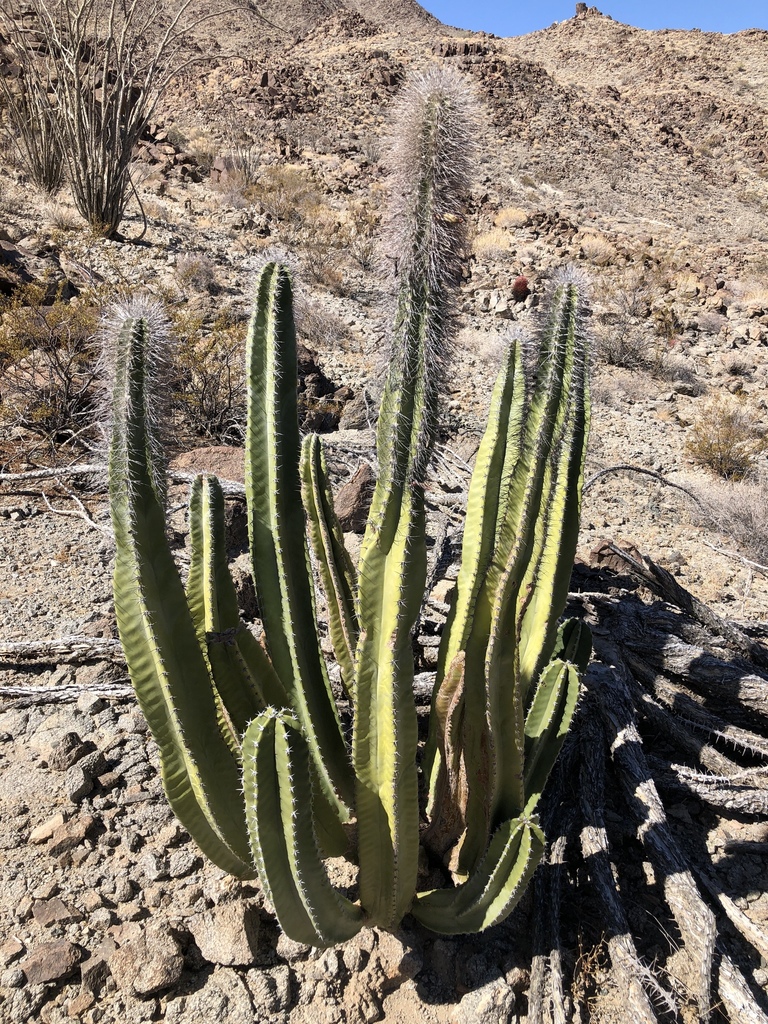
senita cactus
Lophocereus schottii
Pachycereus schottii, the senita cactus, is a species of cactus from southern Arizona and north-western Mexico, particularly Baja California and Sonora. Synonyms include Pilocereus schottii and Lophocereus schottii.
From the article Lophocereus schottii on Wikipedia (CC BY-SA), quoted section by section
Description
Lophocereus schottii grows tree-shaped to shrub-like with yellow-green, more or less upright shoots, which often develop into thickets with more than 100 shoots. It reaches heights of 1 to 3 meters and shoot diameters of 5 to 10 cm (2.0 to 3.9 in). A tribe is rarely formed. There are 4 to 13 clearly defined ribs. The 1 to 3 strong, gray central spines are 1 to 3 cm (0.39 to 1.18 in) long. The 3 to 5 marginal spines are gray and 0.5 to 1.5 cm (0.20 to 0.59 in) long. The terminal pseudocephalium consists of bristly, flexible, gray spines. It occasionally grows to be more than 100 cm (39 in) long. The funnel-shaped flowers appear laterally from the pseudocephalium and open at night. They are white to deep pink, up to 5 cm (2.0 in) long and reach a diameter of 3 cm (1.2 in). Its pericarpel and flower tube are covered with scales and hairs. The spherical, red fruits contain red pulp and reach a diameter of 1 to 3 cm (0.39 to 1.18 in). They are edible, but are rarely used as food.
Range & habitat
The distribution area of Lophocereus schottii extends from the south of the US state of Arizona to the northwest of Mexico and includes the states of Baja California and Sonora. The species grows at altitudes from 0 to 800 meters.
Wikipedia: “Distribution”
What it does
The senita cactus exhibits mutualism with the senita moth. The senita moth is the only nocturnal pollinator of the cactus, and the moth relies on the cactus as a host for reproduction.
Wikipedia: “Ecology”
In medicine
Tetrahydroisoquinoline alkaloids were identified; one of them, lophocerine, is a substituted salsolinol, as well as a trimer of lophocerine—pilocereine. Among other compounds, phytosterols such as lophenol, schottenol, lathosterol, spinasterol, locereol, and other compounds. Salsolidine, peyonine, peyophorine and anhalotine were also isolated; among the flavonoids, myricetin, epicatechin, quercetin derivatives, and kaempferol were isolated.
Wikipedia: “Phytochemistry”
Where it lives
Recorded sightings
—
geo-referenced records in GBIF, from museums, herbaria and field observers.
Drag the globe to turn it. Dots are where records exist, not a range map; darker means more records.
In the stacks
Searching the stacks…
Every page naming Lophocereus schottii in the Biodiversity Heritage Library →
This page is assembled live from iNaturalist, GBIF, Wikipedia, the Source Library and the Internet Archive. It is not yet part of the hand-edited codex. iNaturalist taxon 208681.