- Animals
- ›Arthropods
- ›Hexapods
- ›Insects
- ›Winged and Once-winged Insects
- ›Butterflies and Moths
- ›Owlet Moths and Allies
- ›Underwing, Tiger, Tussock, and Allied Moths
- ›Erebinae
- ›Omopterini
- ›Euparthenos
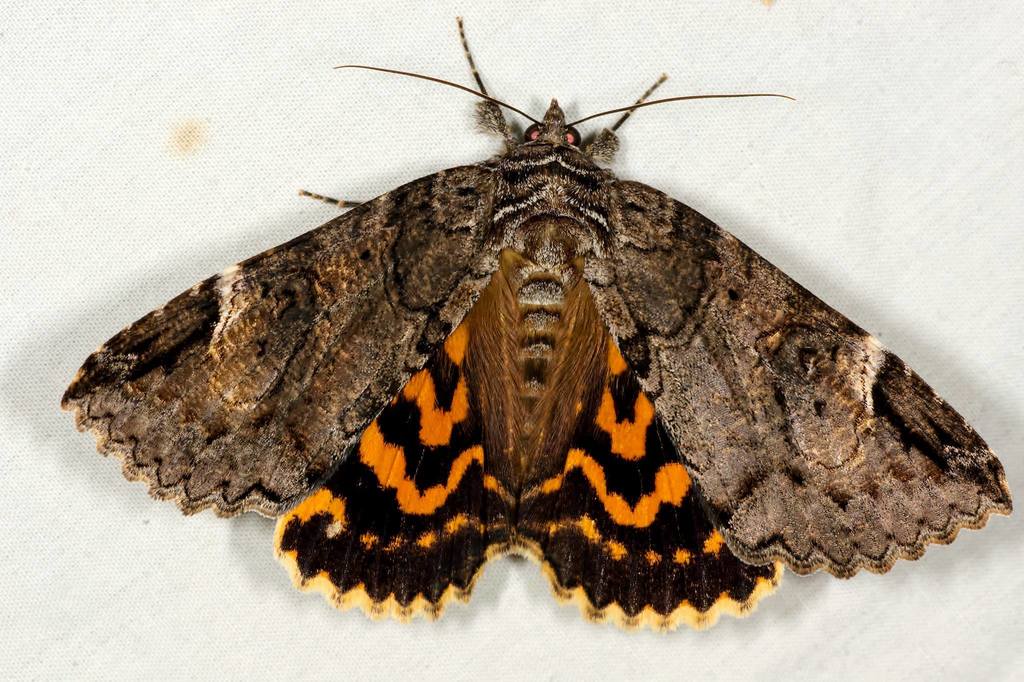
Locust Underwing
Euparthenos nubilis
Euparthenos is a monotypic genus of moth in the family Erebidae erected by Augustus Radcliffe Grote in 1876. Its only species, Euparthenos nubilis, the locust underwing, was first described by Jacob Hübner in 1823. The adults resemble some of the underwing moths of genus Catocala, which are fairly close relatives, in color, pattern, and the habit of resting on tree trunks. But E. nubilis can usually be immediately recognized by the four concentric black bands per hindwing, as opposed to one or two (at most three) in Catocala. Color morphs of E. nubilis with altered pattern are known, however, and these may be hard to recognize without detailed examination.
This moth has light grey forewings with a pattern of darker grey and brown lines and shading. The hindwings are yellow orange with the aforementioned four black bands each. The wingspan is 56–70 mm (over 2 to almost 3 inches.
Listen
Looking for field recordings…
Where it lives
Recorded sightings
—
geo-referenced records in GBIF, from museums, herbaria and field observers.
Drag the globe to turn it. Dots are where records exist, not a range map; darker means more records.
In the stacks
Searching the stacks…
Every page naming Euparthenos nubilis in the Biodiversity Heritage Library →
This page is assembled live from iNaturalist, GBIF, Wikipedia, the Source Library and the Internet Archive. It is not yet part of the hand-edited codex. iNaturalist taxon 219768.