- Plants
- ›Vascular Plants
- ›flowering plants
- ›monocots
- ›Agaves, Orchids, Irises, and Allies
- ›Orchids
- ›Higher Epidendroid Orchids
- ›Cymbidieae
- ›Oncidium Alliance Orchids
- ›Erycina
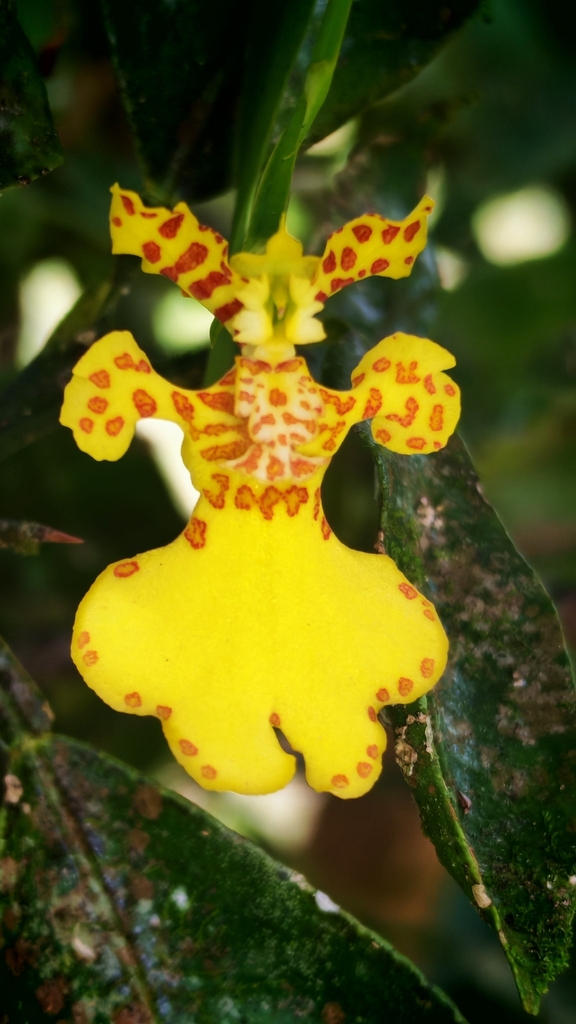
Dwarf Erycina
Erycina pusilla
Erycina pusilla is a species of flowering plants, which is a tiny orchid with an overall size of 2.5 to 3.5 cm from the orchid family, Orchidaceae. Its species are native to Mexico, Belize, Central America, South America and Trinidad.
The leaves are shaped like a lance head (lanceolate) and arranged in a fan. Unlike other similar orchids, E. pusilla never develops lengthwise folded leaves (conduplicate leaves) or extra storage organs (pseudobulbs).
From the article Erycina pusilla on Wikipedia (CC BY-SA), quoted section by section
Range & habitat
Erycina pusilla can be found in the neotropical region, including South and Central America, the southern Mexican lowlands, the Caribbean islands and southern Florida. Its habitat consists of humid forests at elevations of 500 to 950 metres (1,640 to 3,120 ft) with temperatures varying from warm to hot. Like many orchids, E. pusilla grows harmlessly upon other plants. It gets moisture and nutrients from the surroundings without affecting the host plant (commensalism). Its quick development permits this orchid to grow on relatively short-lasting sites such as twigs or even leaves of bushes and trees, such as coffee plant or hibiscus. For this reason, it is usually classified as a twig epiphyte.
Wikipedia: “Distribution and habitat”
How it is grown
Sporadic flowering in flasks was first reported by Livingston (1962), although the in vitro cultivation was just established (2007). The primary culture of E. pusilla becomes a callus after about one month of cultivation. Three months later it reaches leaf stage and after eight months the flowering stage begins. After two and half months E. pusilla produces fruits. A new cycle can start from a new primary culture: protocorm-like body (PLB) in vitro.
Wikipedia: “In vitro cultivation”
Where it lives
Recorded sightings
—
geo-referenced records in GBIF, from museums, herbaria and field observers.
Drag the globe to turn it. Dots are where records exist, not a range map; darker means more records.
In the stacks
Searching the stacks…
Every page naming Erycina pusilla in the Biodiversity Heritage Library →
This page is assembled live from iNaturalist, GBIF, Wikipedia, the Source Library and the Internet Archive. It is not yet part of the hand-edited codex. iNaturalist taxon 317973.