- Plants
- ›Vascular Plants
- ›flowering plants
- ›monocots
- ›Agaves, Orchids, Irises, and Allies
- ›Orchids
- ›Orchidoid Orchids
- ›Diurideae
- ›Drakaeinae
- ›Caleana
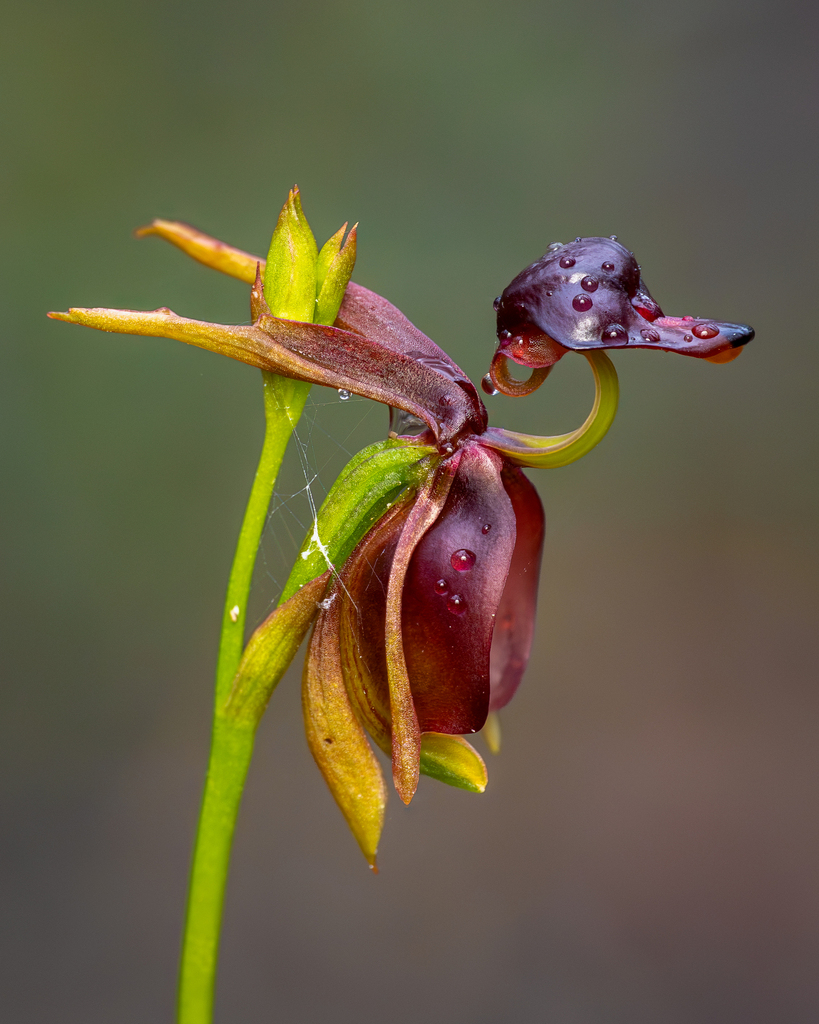
Large Flying Duck Orchid
Caleana major
Caleana major, commonly known as the large duck orchid, is a small orchid found in eastern and southern Australia. This terrestrial plant features a remarkable flower, resembling a duck in flight. The flower is an attractant to insects, such as male sawflies, which pollinate the flower in a process known as pseudocopulation. In 1986, this orchid was featured on an Australian postage stamp.
Caleana major is the emblem of the Latrobe Valley Field Naturalists Club.
From the article Caleana major on Wikipedia (CC BY-SA), quoted section by section
Description
Caleana major is a tuberous, perennial herb, usually growing to a height of 200–400 mm (8–20 in) with a single reddish, narrowly lance-shaped leaf, 40–130 mm (2–5 in) long, 4–8 mm (0.2–0.3 in) wide and often spotted, emerging at its base. Up to five shiny reddish brown flowers, 20–25 mm (0.8–1 in) long and 6–7 mm (0.2–0.3 in) wide are borne on a thin, wiry flowering stem. (In rare cases, the flower can be greenish with dark spots.) The sepals and petals are 12–15 mm (0.5–0.6 in) long and have pointed tips. The column has broad wings which the dorsal sepal and petals almost touch and the lateral sepals turn back wing-like behind the flower. The labellum is 6–8 mm (0.2–0.3 in) long and 5–6 mm (0.20–0.24 in) wide and resembles the head of a duck on a strap-like "neck". Flowering occurs from September to January.
Range & habitat
The flying duck orchid occurs in Queensland, New South Wales, Victoria, South Australia and Tasmania, growing in eucalyptus woodland, coastal or swampy shrubland and heathland. It mostly grows near the coast, occasionally at higher altitudes.
Wikipedia: “Distribution and habitat”
What it does
The plant is pollinated by insects. The labellum is held above the flower by a sensitive strap-like stalk. When touched, the labellum turns rapidly downward, trapping a visiting insect between the labellum and column wings.
Wikipedia: “Ecology”
How it is grown
Caleana major has been difficult to maintain in cultivation. Plants flower for one or sometimes two years, but progressively weaken until they die.
Wikipedia: “Cultivation”
Where it lives
Recorded sightings
—
geo-referenced records in GBIF, from museums, herbaria and field observers.
Drag the globe to turn it. Dots are where records exist, not a range map; darker means more records.
In the stacks
Searching the stacks…
Every page naming Caleana major in the Biodiversity Heritage Library →
This page is assembled live from iNaturalist, GBIF, Wikipedia, the Source Library and the Internet Archive. It is not yet part of the hand-edited codex. iNaturalist taxon 321088.