- Animals
- ›Arthropods
- ›Hexapods
- ›Insects
- ›Winged and Once-winged Insects
- ›Ants, Bees, Wasps, and Sawflies
- ›Narrow-waisted Wasps, Ants, and Bees
- ›Ants, Bees, and Stinging Wasps
- ›Formicoidea
- ›Ants
- ›Formicine Ants
- ›Camponotine Ants
- ›Camponotus
- ›Camponotus
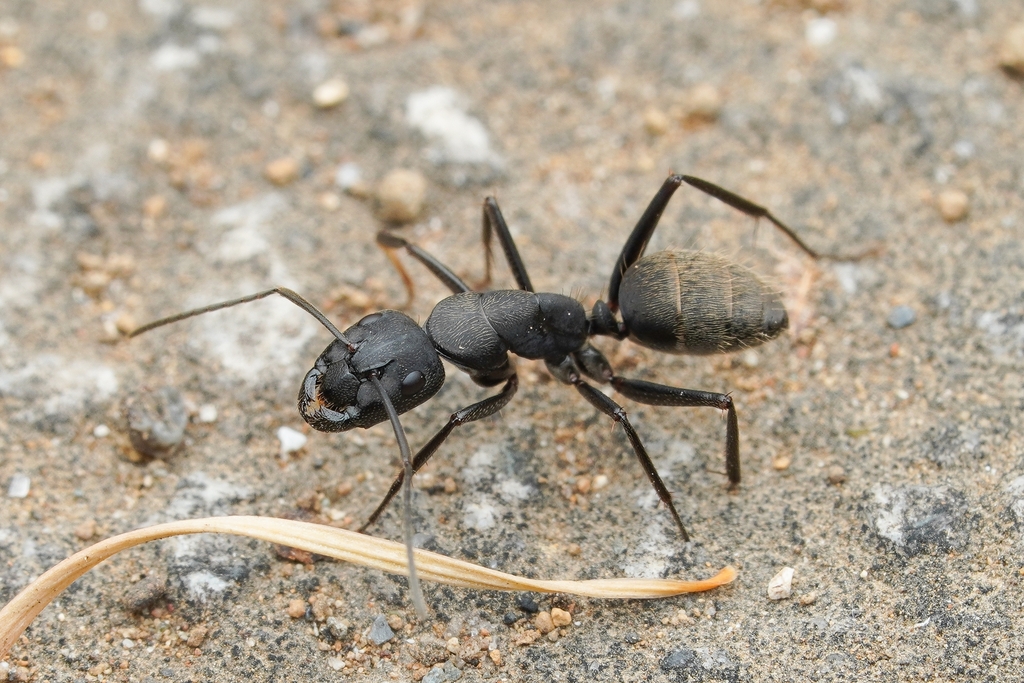
Japanese Carpenter Ant
Camponotus japonicus
Camponotus japonicus, more often known under the common name Japanese carpenter ant, is a species of ant native to East Asia. It is black, and one of the largest ants. A nest has about ten to thousands of individuals, and it can be a pest when it enters households or protects aphids. There are several subspecies of this ant in different areas of Asia, with the largest of the species being located in Northern China.
From the article Camponotus japonicus on Wikipedia (CC BY-SA), quoted section by section
Description
The queen is black but has microscopic brown hair protruding from the thorax and abdomen. They are 17 millimeters long. Before mating, the queen has four transparent brown wings supported by brown veins. The 12-millimeter-long male has a longer and straighter antennae and a slimmer body. Unlike the workers, both the queen and the male have three ocelli. The workers are divided into three subcastes based on their size, which varies from 6 to 15 millimeters. The largest subcaste of workers is also called the soldier.
Wikipedia: “Appearance”
Range & habitat
Camponotus japonicus inhabits a wide range, including Japan, Korea, Pakistan, Iran, the Philippines, China, Mongolia and Russia (Siberia). It was first identified in India in the state of Arunachal Pradesh in the Tawang district near Kitpi Lake, at an elevation of 1700 meters.
Wikipedia: “Range”
Listen
Looking for field recordings…
Where it lives
Recorded sightings
—
geo-referenced records in GBIF, from museums, herbaria and field observers.
Drag the globe to turn it. Dots are where records exist, not a range map; darker means more records.
In the stacks
Searching the stacks…
Every page naming Camponotus japonicus in the Biodiversity Heritage Library →
This page is assembled live from iNaturalist, GBIF, Wikipedia, the Source Library and the Internet Archive. It is not yet part of the hand-edited codex. iNaturalist taxon 321673.