- Plants
- ›Vascular Plants
- ›flowering plants
- ›Dicots
- ›pinks, cactuses, and allies
- ›cacti
- ›globular cacti, moonlight cacti, torch cacti, and allies
- ›Globular Cactuses
- ›Epithelantha
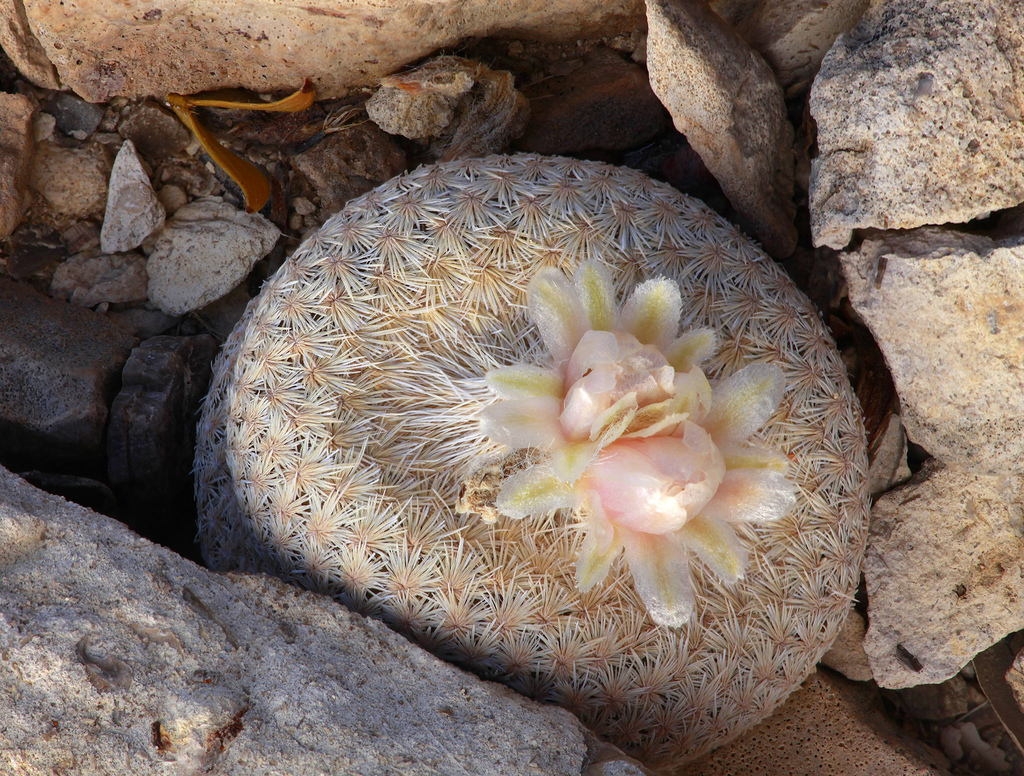
Boke's Button Cactus
Epithelantha bokei
Epithelantha bokei is a species of cactus known by the common names pingpong ball cactus and button-cactus. It is native to Texas in the United States and Coahuila in Mexico.
From the article Epithelantha bokei on Wikipedia (CC BY-SA), quoted section by section
Description
Epithelantha bokei is a small, disc-shaped or cylindrical cactus that usually measures 2 to 5 centimeters in width. It is typically unbranched, with a flat or slightly concave top. Most of the plant remains below ground, with only a few centimeters visible above the surface. During dry periods, it contracts into the soil for protection. The stems are thickly covered in dense, pale-colored spines, giving the plant a white or yellowish appearance. The spines are short, with the longest reaching about 7 mm. Each areole can bear up to 90 spines, which lie flat against the stem and form dense clusters. The plant almost always grows solitary, with small, smooth, glossy stems. When dried out or losing turgor, sunken rings may appear on the surface. Young plants look very similar to mature ones, making early identification challenging. The flowers are delicate, pale pink to silvery white, protruding above the spines at the stem apex. They measure 1 to 1.7 cm long and wide, with 13 to 21 translucent inner tepals marked by pink, pinkish-tan, or greenish-yellow lines, and 8 to 13 outer tepals with scalloped edges. The flowers contain 20 to 40 stamens and white stigma lobes. …
Range & habitat
The species' native range extends from Texas in the United States to northeastern Mexico, specifically within the states of Coahuila and Chihuahua in desert or dry scrubland environments at elevations between 700 and 1,500 meters above sea level. The species is a soil specialist, often forming dense clusters on specific calcareous substrates. It is commonly found on elevated limestone hills, mountain summits, and rocky ledges within xerophytic scrublands. Additionally, the species can occur on plains, where it grows on soils composed of gravel mixed with organic-rich earth resulting from leaf decomposition. These conditions provide localized nutrients and enable the species to thrive in extremely dry environments. Plants are found growing along with Coryphantha difficilis, Ariocarpus fissuratus, Echinocereus pectinatus, Sclerocactus scheeri, Mammillaria heyderi. Threats to the species include poaching and habitat degradation. It is in cultivation at the Desert Botanical Garden in Phoenix, Arizona.
Wikipedia: “Distribution”
Where it lives
Recorded sightings
—
geo-referenced records in GBIF, from museums, herbaria and field observers.
Drag the globe to turn it. Dots are where records exist, not a range map; darker means more records.
In the stacks
Searching the stacks…
Every page naming Epithelantha bokei in the Biodiversity Heritage Library →
This page is assembled live from iNaturalist, GBIF, Wikipedia, the Source Library and the Internet Archive. It is not yet part of the hand-edited codex. iNaturalist taxon 325046.