- Animals
- ›Arthropods
- ›Hexapods
- ›Insects
- ›Winged and Once-winged Insects
- ›Butterflies and Moths
- ›Butterflies
- ›Whites, Yellows, and Sulphurs
- ›Yellows and Sulphurs
- ›Euremini
- ›Euremina
- ›Eurema
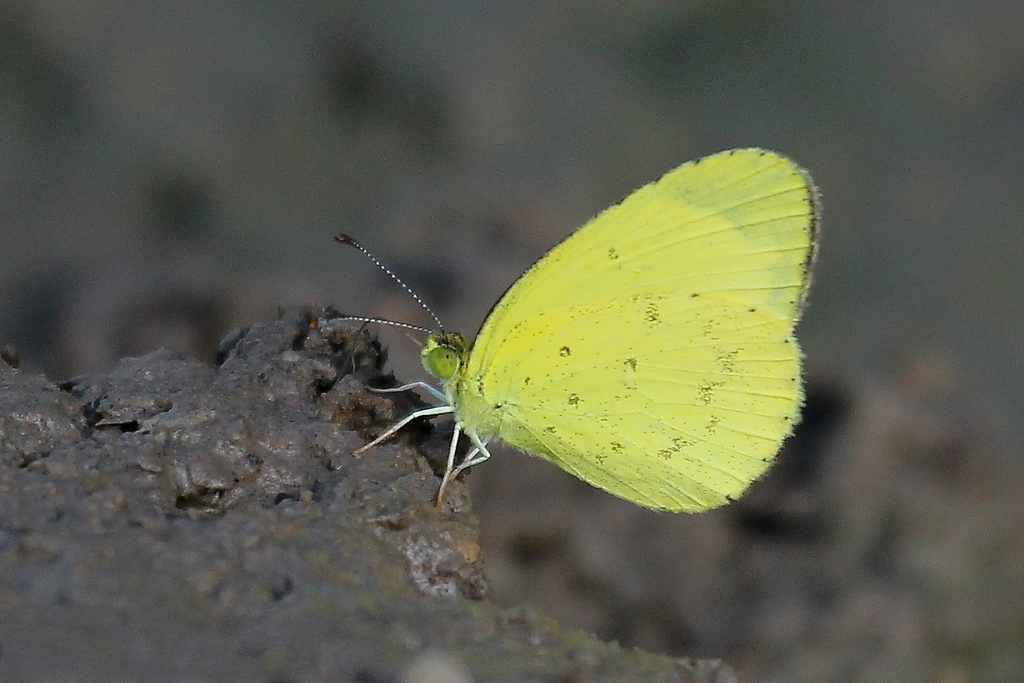
Small Grass-yellow
Eurema smilax
Eurema smilax, the small grass yellow, is a small pierid butterfly species found in Australia, with some additional records from India, Indonesia and Niger.
The wingspan is about 30 mm.
From the article Eurema smilax on Wikipedia (CC BY-SA), quoted section by section
Description
Eurema smilax adults have a wingspan of 30–34 mm, with females being slightly larger than males. They are yellow, with black tips on the upper surface of the forewings. This colouration can vary depending on flight period. In southern Australia, the summer flying forms are usually pale yellow, with few or no brown markings on the wing undersides. The winter forms are a brighter yellow, with pronounced brown markings on the wing undersides. The males are generally a brighter yellow than the females. The eggs are initially white, later turning yellowish. They are spindle-shaped, with a height of about 1.2 mm, and laid singly on a host plant. They hatch in about 7–11 days during spring. The caterpillar is initially pale yellow, soon becoming greenish. Third and fourth instars develop a darker dorsal line and a yellow lateral line. Mature larvae are 18–22 mm long. All larval stages have specialised hairs which secrete poison, visible at the ends of the hairs as clear droplets. Pupae are green, about 15 mm long, and attached to the host plant via a cremaster and central silken girdle. The head may be pointing either upwards or downwards. The pupal period lasts about 8–13 days.
Range & habitat
This butterfly can be found over the whole of mainland Australia, with occasional records from Kangaroo Island, Lord Howe Island and Tasmania. There are also records from India, Java and Niger. E. smilax has been recorded using the following species as larval host plants:
Senna acclinis Senna coronilloides Senna gaudichaudii Senna artemisioides Senna odorata Senna petiolaris Senna surattensis Senna alata Senna auriculata Cassia fistula Neptunia gracilis Neptunia monosperma Paraserianthes lophantha
Wikipedia: “Distribution and Host Plants”
What it does
E. smilax exhibits both migrant and vagrant habits. In South Australia, they will fly south from northern breeding grounds in spring, aided by hot northerly winds. During these migrations they fly in a steady, direct manner below head height, with the females being gravid and fertile. The females seem to prefer laying eggs on small plants growing in full sun.
== References ==
Wikipedia: “Behaviour”
Listen
Looking for field recordings…
Where it lives
Recorded sightings
—
geo-referenced records in GBIF, from museums, herbaria and field observers.
Drag the globe to turn it. Dots are where records exist, not a range map; darker means more records.
In the stacks
Searching the stacks…
Every page naming Eurema smilax in the Biodiversity Heritage Library →
This page is assembled live from iNaturalist, GBIF, Wikipedia, the Source Library and the Internet Archive. It is not yet part of the hand-edited codex. iNaturalist taxon 355178.