 NL·0118
Herbarium of the Nature Library
- Name
- Harpagophytum procumbens
- Family
- Pedaliaceae
- Native to
- Kalahari sands of Namibia, Botswana and South Africa, extending to southern Angola and Zimbabwe
- Habitat
- Kalahari savanna, Semi-desert, Sandy grassland
Devil's claw
Harpagophytum procumbens
Also calledDuiwelsklou (Afrikaans) · Sengaparile (Setswana) · Grapple plant (English) · Teufelskralle (German) · Garra del diablo (Spanish)
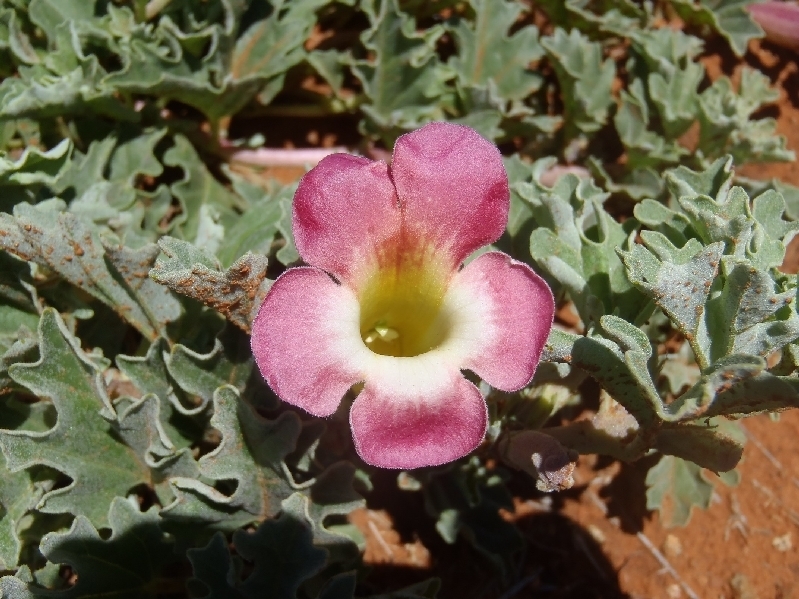
A trailing Kalahari herb with pink trumpet flowers and a fearsome woody fruit armed with hooked arms that clamp onto animals' feet. Its secondary tubers are a major European pain remedy and an important income for San and other Kalahari harvesters.
Harpagophytum, also called grapple plant, wood spider, and most commonly devil's claw, is a genus of plants in the sesame family, native to southern Africa. Plants of the genus owe their common name "devil's claw" to the peculiar appearance of their hooked fruit. Several species of North American plants in the genus Proboscidea and certain species of Pisonia, however, are also known by this name. Devil's claw's tuberous roots are used in folk medicine to reduce pain. Wikipedia
What it can do
- iStorage tubers survive the dry season and send up new stems after rain
- iiWoody fruits with grapple hooks lodge in hooves and fur, spreading the seed widely
- iiiTubers contain iridoid glycosides (harpagoside) with anti-inflammatory activity
At the table
Not a food. The bitter dried tubers are used as tea or extract.
In the medicine cabinet
| Tradition | Use |
|---|---|
| Southern African traditional medicine (San, Khoikhoi, Tswana) | Tuber for pain, fevers, digestive complaints and in childbirth; ointments for sores and boils |
| European phytotherapy | Standardised extracts for low back pain, osteoarthritis and loss of appetite; EMA traditional-use monograph |
Weight of evidence
Moderate. Some clinical trials with promising but limited or mixed results.
Active compounds
harpagoside, harpagide, procumbide, 8-p-coumaroylharpagide, verbascoside
Fruit & seed
Fruit
Woody capsule
Ripens: After summer rains
Hard, flattened capsule 7–20 cm across, with long arms ending in sharp hooks.
Seed
~6–8 mm
Dark, rough, oblong seeds inside the woody fruit
- Dispersal
- Fruits hook onto the feet and fur of animals
- Germination
- Deeply dormant; erratic; needs warmth and rain
How to grow it
Hardiness (USDA zones)
USDA 9–11. Survives winters down to about -7 °C.
- Light
- Full sun
- Water
- Low; summer rain, dry winter
- Soil
- Deep, loose sand
- Propagation
- Seed or tuber cuttings
- To harvest
- Secondary tubers at 2–3 years
- Climates
- Semi-arid, Arid
- 1Sow in deep containers of pure sand in warmth
- 2Water in summer only and keep dry in winter
- 3Harvest only secondary (side) tubers, leaving the central taproot
- 4Slice and sun-dry quickly
Can it grow where you are?
Where it lives
Recorded sightings
—
geo-referenced records in GBIF, from museums, herbaria and field observers.
Native range
Kalahari sands of Namibia, Botswana and South Africa, extending to southern Angola and Zimbabwe
Drag the globe to turn it. Dots are where records exist, not a range map; darker means more records.
In the stacks
Searching the stacks…
Every page naming Harpagophytum procumbens in the Biodiversity Heritage Library →
Marginalia
In the early 1900s G. H. Mehnert, a German settler in Namibia, learned of its use from local healers and introduced it to Europe. Today it is harvested from the wild in Namibia under community-based permit schemes.
Curiosity
The genus name means 'grappling-hook plant' in Greek. Its fruits can lame antelope and sheep by clamping onto their feet or mouths.
Kinship

Photographs: iNaturalist contributors under the licences shown. Records: GBIF.org. Historical plates: Source Library (CC BY-SA 4.0; originals public domain). Summary text: Nature Library editors and Wikipedia (CC BY-SA). Medicinal and edibility notes are historical and educational, not advice. iNaturalist taxon 356056.