- Animals
- ›Arthropods
- ›Hexapods
- ›Insects
- ›Winged and Once-winged Insects
- ›Butterflies and Moths
- ›Butterflies
- ›Brush-footed Butterflies
- ›Leafwing Butterflies
- ›Dragon-headed Caterpillars
- ›Charaxes
- ›Charaxes
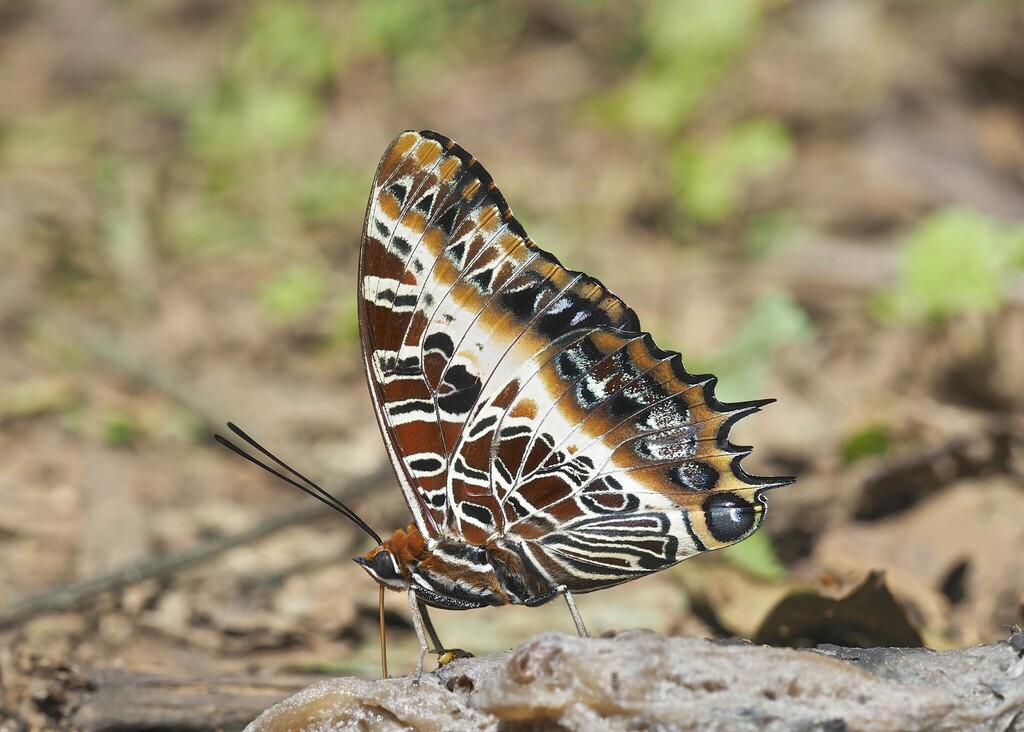
Black-bordered Charaxes
Charaxes pollux
Charaxes pollux, the black-bordered charaxes, is a butterfly in the family Nymphalidae.
From the article Charaxes pollux on Wikipedia (CC BY-SA), quoted section by section
Description
In Charaxes pollux forewings can reach a length of 36–45 millimetres (1.4–1.8 in) in males, of 41–51 millimetres (1.6–2.0 in) in females. The upperside of the forewings is tawny in the basal area, with a broad ochraceous orange post-discal band and a black wide border. The upperside of the hindwings is rather similar, but it has a whitish discal area and pale blue submarginal spots. The underside is red-chestnut, with a white discal band and a series of black bars bordered with white. The edge of the wings is sharply dentate. Seitz-The discal band of the upper surface is dark orange-yellow; the tails of the hind wing only 3–4 mm. in length; the hindwing above with a deep black, unspotted marginal band, 9–10 mm. in breadth; the forewing with small brown marginal spots. On the under surface the black, white-bordered spots are almost as numerous as in hansali and on the hindwing there are three in cellule 8 and two in cellule 7. Sierra Leone to Angola and Uganda. — geminus Rothsch. differs in having small brown marginal spots on the hindwing above, at least in cellules 4—6. Manicaland, Nyassaland, Kilimandjaro. Similar to Charaxes ansorgei but male lacking a white band on the hindwing upperside.
Range & habitat
Charaxes pollux can be found in Guinea, Sierra Leone, Liberia, Ivory Coast, Ghana, Nigeria, Cameroon, Equatorial Guinea, the Central African Republic, Gabon, Angola, the Republic of the Congo, the Democratic Republic of the Congo, Zambia, Rwanda, Burundi, Sudan, Uganda, Kenya, Tanzania, Malawi, Mozambique and Zimbabwe. The habitat consists of Afrotropical forests, gallery forests and heavy woodland.
Wikipedia: “Distribution and habitat”
In human culture
Life-sized colour plates and description of the larval and pupal stages of C. pollux and additional related species, illustrated by Dr. V. G. L. van Someren, are readily available. The larvae feed on Sorindeia species, Bersama abyssinica, Deinbollia kilimandsharica, Deinbollia borbonica, Fluggia microcarpa, Securinega virosa and Fluggia virosa. Adults are probably on wing year round. Notes on the biology of pollux are given by Pringle et al (1994), Larsen (1991), Larsen (2005) and Kielland (1990).
Wikipedia: “Natural history”
Listen
Looking for field recordings…
Where it lives
Recorded sightings
—
geo-referenced records in GBIF, from museums, herbaria and field observers.
Drag the globe to turn it. Dots are where records exist, not a range map; darker means more records.
In the stacks
Searching the stacks…
Every page naming Charaxes pollux in the Biodiversity Heritage Library →
This page is assembled live from iNaturalist, GBIF, Wikipedia, the Source Library and the Internet Archive. It is not yet part of the hand-edited codex. iNaturalist taxon 357501.