- Plants
- ›Vascular Plants
- ›flowering plants
- ›Dicots
- ›pinks, cactuses, and allies
- ›cacti
- ›globular cacti, moonlight cacti, torch cacti, and allies
- ›Trichocereeae
- ›Espostoa
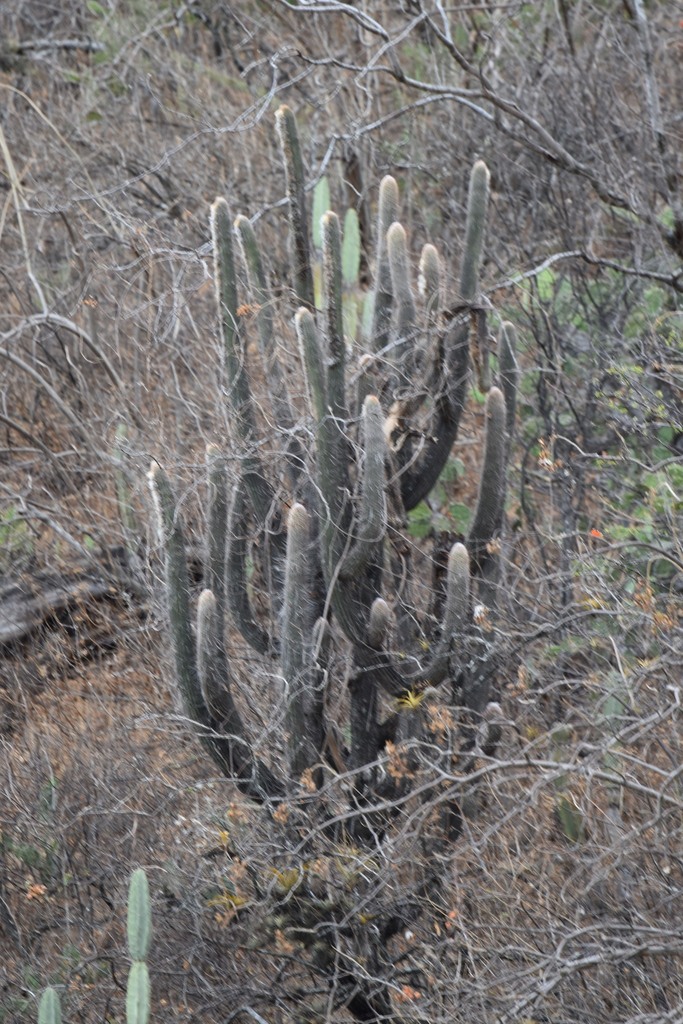
Cottonball Cactus
Espostoa lanata
Espostoa lanata is a species of flowering plant in the family Cactaceae.
Its common names include Peruvian old man cactus, cotton ball cactus, snowball cactus, and snowball old man cactus.
From the article Espostoa lanata on Wikipedia (CC BY-SA), quoted section by section
Description
Espostoa lanata is a columnar cactus. It closely resembles Cephalocereus senilis from Mexico: it is a densely hairy species, covered by a warm woolly coat and well adapted to high altitudes. It is widespread in its habitat, and is quite variable in size and spines; for this reason it has received several names. The plant is columnar in habit and can grow to be up to 7 meters tall in the wild, but only 3 meters when cultivated. The diameter is from 5 to 20 cm. There are 18 to 25 ribs. The ribs and the sharp central spines are mainly hidden by the woolly radial spines. It branches only after several years. It flowers at night from a lateral cephalium after several years. Woolly hairs have been used for pillow filling in Peru.
Range & habitat
Espostoa lanata is native to southern Ecuador and northern Peru on the western slopes of the Andes mountains.
Subspecies. Espostoa lanata subsp. lanata Espostoa lanata subsp. huanucoensis (H.Johnson ex F.Ritter) G.J.Charles synonym Espostoa huanucoensis F.Ritter Espostoa lanata subsp. lanianuligera (F.Ritter) G.J.Charles synonym Espostoa lanianuligera F.Ritter Espostoa lanata subsp. ruficeps (F.Ritter) G.J.Charles synonym Espostoa ruficeps F.Ritter
Wikipedia: “Distribution”
How it is grown
Espostoa lanata is easy to grow. It needs fertile and well-drained soil. In summer, water the plants well but allow them to dry before watering again. Fertilize monthly with a balanced fertilizer. In winter, keep it dry. This species is hardy to temperatures as low as −12 °C (10.4 ºF). The exposure must be sunny in summer and at least luminous in winter. In favorable conditions, it can grow 20 cm per year.
== References ==
Wikipedia: “Cultivation”
Where it lives
Recorded sightings
—
geo-referenced records in GBIF, from museums, herbaria and field observers.
Drag the globe to turn it. Dots are where records exist, not a range map; darker means more records.
In the stacks
Searching the stacks…
Every page naming Espostoa lanata in the Biodiversity Heritage Library →
This page is assembled live from iNaturalist, GBIF, Wikipedia, the Source Library and the Internet Archive. It is not yet part of the hand-edited codex. iNaturalist taxon 363436.