 NL·0018
Herbarium of the Nature Library
- Name
- Panax ginseng
- Family
- Araliaceae
- Native to
- Mixed and broadleaf forests of north-eastern China, the Korean Peninsula and the Russian Far East; now almost entirely cultivated
- Habitat
- Temperate mixed forest, Montane forest
Asian ginseng
Panax ginseng
Also calledRénshēn 人参 (Chinese, 'man root') · Insam 인삼 (Korean) · Chōsen ninjin 朝鮮人参 (Japanese) · Zhen'shen' Женьшень (Russian) · Koreanischer Ginseng (German)
A slow-growing forest herb whose forked, human-shaped root has been the most prized tonic of East Asian medicine for two thousand years. Wild roots have been dug almost to extinction, and old specimens fetch extraordinary prices.
Panax ginseng, ginseng, also known as Asian ginseng, Chinese ginseng or Korean ginseng, is a species of plant whose root is the original source of ginseng. It is a perennial plant that grows in the mountains of East Asia. It is mainly cultivated in China, Korea, Russia, and Japan. Wikipedia
What it can do
- iMakes ginsenosides, triterpene saponins studied for effects on fatigue, immunity and blood sugar
- iiCan live for decades, adding one stem scar to the root neck each year
- iiiSeeds have a double dormancy and take about 18–22 months to germinate
- ivNeeds deep forest shade; leaves scorch in full sun
At the table
Eatenroot (fresh, dried, steamed 'red ginseng')
Eaten in Korean dishes such as samgyetang (ginseng chicken soup) and taken as tea or extract. Large or long-term doses can cause insomnia, raised blood pressure and nervousness.
In the medicine cabinet
| Tradition | Use |
|---|---|
| Traditional Chinese Medicine | Renshen strongly tonifies yuan qi; used for exhaustion, shortness of breath, collapse and as a superior longevity herb |
| Korean traditional medicine | Steamed red ginseng (hongsam) used as a daily restorative and for fatigue and immunity |
| Modern phytotherapy | Extracts trialled for fatigue, cognition, erectile dysfunction and blood sugar control |
Weight of evidence
Moderate. Some clinical trials with promising but limited or mixed results.
Active compounds
ginsenoside Rb1, ginsenoside Rg1, ginsenoside Rg3, panaxynol, polysaccharides
Fruit & seed


Fruit
Drupe-like berry
Ripens: Late summer
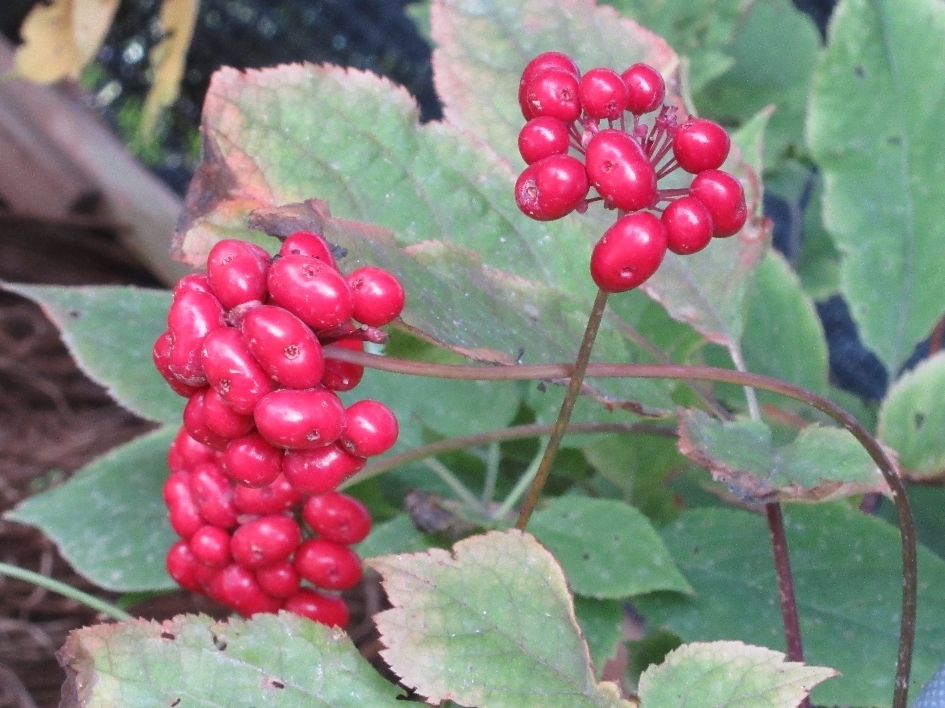
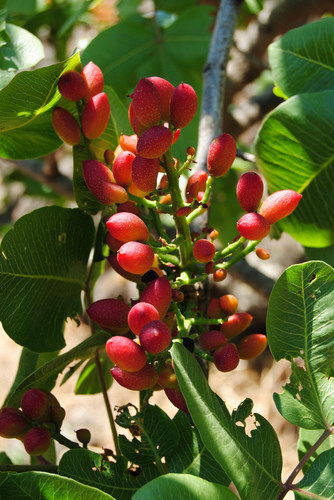
Bright red, two-seeded berries in a single round cluster above the leaves.

Seed
~4–5 mm
Cream-white, flattened, wrinkled seeds
- Dispersal
- Birds and gravity
- Germination
- Needs warm then cold stratification over 18–22 months; usually sold pre-stratified
Photographs from Wikimedia Commons under open licences; hover for the photographer, click for the file.
How to grow it
Hardiness (USDA zones)
USDA 3–7. Survives winters down to about -40 °C.
- Light
- Deep shade (70–80%)
- Water
- Moderate; never waterlogged
- Soil
- Loose, humus-rich forest loam, slightly acidic
- Propagation
- Stratified seed or rootlets
- To harvest
- Roots at 4–6 years (field), 10+ years (woods-grown)
- Climates
- Temperate, Continental
- 1Plant stratified seed 2 cm deep in autumn under a hardwood canopy or 70–80% shade cloth
- 2Mulch with leaf litter and keep weeds down
- 3Watch for slugs and fungal rots in wet years
- 4Dig carefully in autumn of year 4–6, keeping the fine root hairs intact
Can it grow where you are?
Where it lives
Recorded sightings
—
geo-referenced records in GBIF, from museums, herbaria and field observers.
Native range
Mixed and broadleaf forests of north-eastern China, the Korean Peninsula and the Russian Far East; now almost entirely cultivated
Drag the globe to turn it. Dots are where records exist, not a range map; darker means more records.
In the old herbals & bestiaries
Woodcuts and engravings matched from the Source Library’s scanned books by name. Plates marked “relative” show a close kin rather than this exact species. Click a plate to read the page it came from, with translation.

Bencao Gangmu, Volume Upper-Middle
李時珍 · 1596 · p.7

Superstitions anciennes et modernes
[Picard, Bernhard] · 1733 · p.315

Description of China, Korea, and Tibet
Du Halde · 1738 · p.382

Superstitions anciennes et modernes
[Picard, Bernhard] · 1733 · p.-158

Christoph Jakob Trew — Uitgezochte planten (1771)
Christoph Jakob Trew · 1771 · p.104

Exotic Pleasures (Persia and Asia observations)
Engelbert Kaempfer · 1712 · p.909

De Indiae utriusque re naturali et medica
Willem Piso · 1658 · p.596

Illustrated Investigation of the Names and Realities of Plants, Volume 7
吳其濬 · 1848 · p.5

Complete Treatise on Agricultural Administration
Xu Guangqi · 1909 · p.727
In the stacks
Searching the stacks…
Every page naming Panax ginseng in the Biodiversity Heritage Library →
Marginalia
The Shennong Bencao Jing (c. 1st–2nd century CE) ranks ginseng among the 'superior' herbs that nourish life. In 1716 the Jesuit Joseph-François Lafitau found its relative, American ginseng, near Montreal after reading a colleague's description of the Chinese plant, and started a transpacific root trade.
Curiosity
Panax comes from the Greek panakeia, 'all-healing', the same root as panacea.
Kinship

Photographs: iNaturalist contributors under the licences shown. Records: GBIF.org. Historical plates: Source Library (CC BY-SA 4.0; originals public domain). Summary text: Nature Library editors and Wikipedia (CC BY-SA). Medicinal and edibility notes are historical and educational, not advice. iNaturalist taxon 366498.