- Animals
- ›Arthropods
- ›Hexapods
- ›Insects
- ›Winged and Once-winged Insects
- ›Butterflies and Moths
- ›Butterflies
- ›Whites, Yellows, and Sulphurs
- ›Whites
- ›Teracolini
- ›Colotis
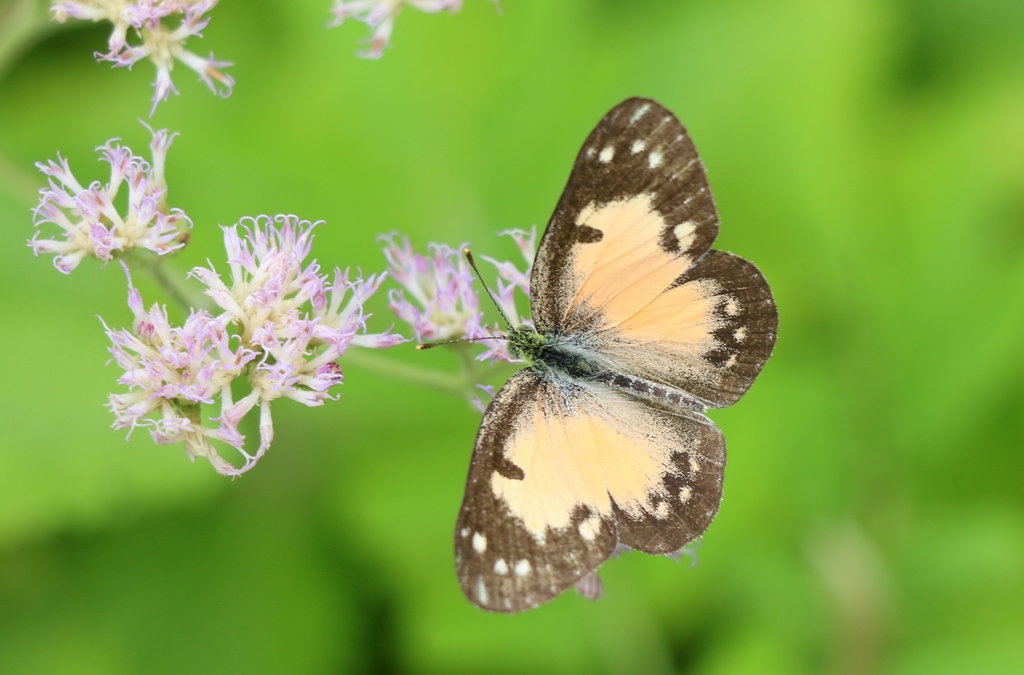
Small Salmon Arab
Colotis amata
Colotis amata, the Small Salmon Arab, is a small butterfly in the family Pieridae. It is primarily found in South Asia in countries like India, Pakistan and Sri Lanka.
Similar populations across Arabian Peninsula, Africa and Madagascar were earlier treated as being conspecific. However, based on later studies, they have been split and now regarded as a different species Colotis calais.
From the article Colotis amata on Wikipedia (CC BY-SA), quoted section by section
Description
The male's upperside has a salmon-pink ground colour. The costa on the forewing is black and thickly overlaid with greyish or pinkish scales; a black spot at apex of cell, which may be large and quadrate or smaller and lunate; termen broadly black, with an enclosed double transverse series of spots of the ground colour the inner series consists of a large spot in interspace 1, two very small spots in interspaces 2 and 3, one in each, and four larger anterior spots placed in a curve; the spots in the outer series are variable in number, but generally there is one in each interspace, these are more or less linear in shape. Hindwing: a band on costal margin extended to just within the upper margin of the cell, covered with dense black specialized scales; this black band joined onto a broad similarly coloured terminal band of ordinary scales, that becomes more or less diffuse and powdery posteriorly, and encloses a double series of small spots of the ground colour the inner series often obsolescent, in some specimens entirely absent; dorsum heavily irrorated with fuscous scales, the irroration extended onto the disc, which has therefore generally a greyish appearance.
Underside: greenish yellow; an anteciliary fine black line on both forewing and hindwings; the black markings of the upperside show through by transparency. …
What it does
Small Salmon Arabs mainly use various species from the family salvadoraceae as their host plant. Species like Salvadora persica grow readily in saline lands across Indian subcontinent, often making these butterflies abundant along the coastal areas of elevated soil-salinity and tidal mudflats. Small Salmon Arabs are also common inland in arid, semi-arid or seasonally dry landscapes where host species like S. persica, S. oleoides and Azima tetracantha are present. In northwestern India (Gujarat, Rajasthan, Haryana, Punjab and Delhi) and Pakistan it shares its range with White Arab (Colotis vestalis) which is another Salvadora-dependent species. Small Salmon Arab has also been noted to use Zanthoxylum asiaticum (syn. Toddalia asiatica) as its host plant, despite the plant belonging to the family rutaceae (citrus family) as opposed to the usually preferred salvadoraceae. Adult butterflies are fond of smaller flowers for nectar and often fly low along the ground in search of wildflowers.
Wikipedia: “Ecology”
In human culture
Eggs: The female seeks out the host plant – usually a Salvadora shrub or tree – and settles on a suitable leaf where oviposition takes place. This species is gregarious ovipositor – meaning it lays eggs in clutches as opposed to many other butterfly species that lay their eggs singly on each leaf or shoot. The number of eggs in a clutch can consist of only a couple of eggs to as many as around 60. Females usually visit multiple host plants and oviposit multiple such clutches of varying sizes in their lifetime. Larva: "Very like that of Eurema, cylindrical or slightly depressed with a rough surface due to minute tubercles, from each of which grows a very small bristle. The colour is a uniform grass-green, with a blue dorsal line more or less distinct, and a yellowish lateral line dividing the colour of the back from the paler green of the underparts." (Davidson & Aitken quoted in Bingham). The caterpillars feed on Salvadora trees.
Pupa: "Compressed; wing-cases produced into a keel like that of Eurema. It is suspended in the same manner by the tail and a moderately long band. The colour is usually some shade of dingy whitish brown or dirty green." (Davidson & Aitken quoted in Bingham)
Wikipedia: “Life history”
Listen
Looking for field recordings…
Where it lives
Recorded sightings
—
geo-referenced records in GBIF, from museums, herbaria and field observers.
Drag the globe to turn it. Dots are where records exist, not a range map; darker means more records.
In the stacks
Searching the stacks…
Every page naming Colotis amata in the Biodiversity Heritage Library →
This page is assembled live from iNaturalist, GBIF, Wikipedia, the Source Library and the Internet Archive. It is not yet part of the hand-edited codex. iNaturalist taxon 372213.