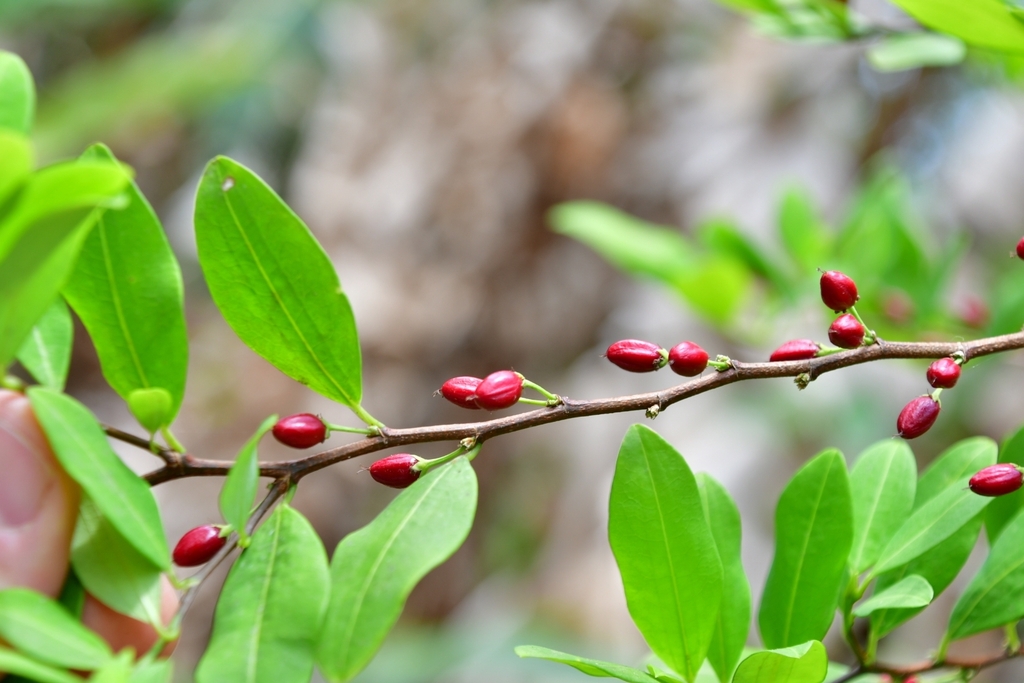
Erythroxylum novogranatense
Erythroxylum novogranatense, also known as Colombian Coca, is a species of shrub or small tree in the family Erythroxylaceae native to Colombia, Ecuador, Peru, Trinidad-Tobago, and Venezuela. It is used medicinally and as a narcotic. Erythroxylum novogranatense is one of the primary species of cultivated Coca, despite being less widely cultivated than Erythroxylum coca.
From the article Erythroxylum novogranatense on Wikipedia (CC BY-SA), quoted section by section
Range & habitat
Erythroxylum novogranatense is native to Colombia, Ecuador, Peru, Trinidad-Tobago, and Venezuela. It is only known from cultivation and Erythroxylum novogranatense would not persist in the wild without human intervention. It tolerates non-acidic soils. It has been Introduced to South-Central and Southeastern China, Hainan, Java, Leeward Islands, Sulawesi, Taiwan, Vietnam, and the Windward Islands.
Wikipedia: “Distribution and habitat”
What it does
Erythroxylum novogranatense is a highland variety that is utilized in lowland areas. It is cultivated in drier regions in South America, where it requires irrigation.
Wikipedia: “Ecology”
Toxicity
The cocaine content in leaves of E. novogranatense var. novogranatense is 0.55-0.93%, with an average of 0.77% and in E. novogranatense var. truxillense the cocaine content is 0.42-1.02%, with a mean of 0.72%. The foliage also contains cinnamoylcocaine. The plants also contain methyl salicylate.
In human culture
The specific epithet novogranatense, from the Latin novus meaning new and granatensis meaning of Granada, refers to the geographic origin of the plant in Colombia, which was formerly known as Nueva Granada.
Wikipedia: “Etymology”
Where it lives
Recorded sightings
—
geo-referenced records in GBIF, from museums, herbaria and field observers.
Drag the globe to turn it. Dots are where records exist, not a range map; darker means more records.
In the stacks
Searching the stacks…
Every page naming Erythroxylum novogranatense in the Biodiversity Heritage Library →
This page is assembled live from iNaturalist, GBIF, Wikipedia, the Source Library and the Internet Archive. It is not yet part of the hand-edited codex. iNaturalist taxon 416639.