- Animals
- ›Arthropods
- ›Chelicerates
- ›Arachnids
- ›Spiders
- ›Typical Spiders
- ›Entelegyne Spiders
- ›RTA Clade Spiders
- ›Meshweavers and Allies
- ›desid spiders
- ›Desinae
- ›Phryganoporus
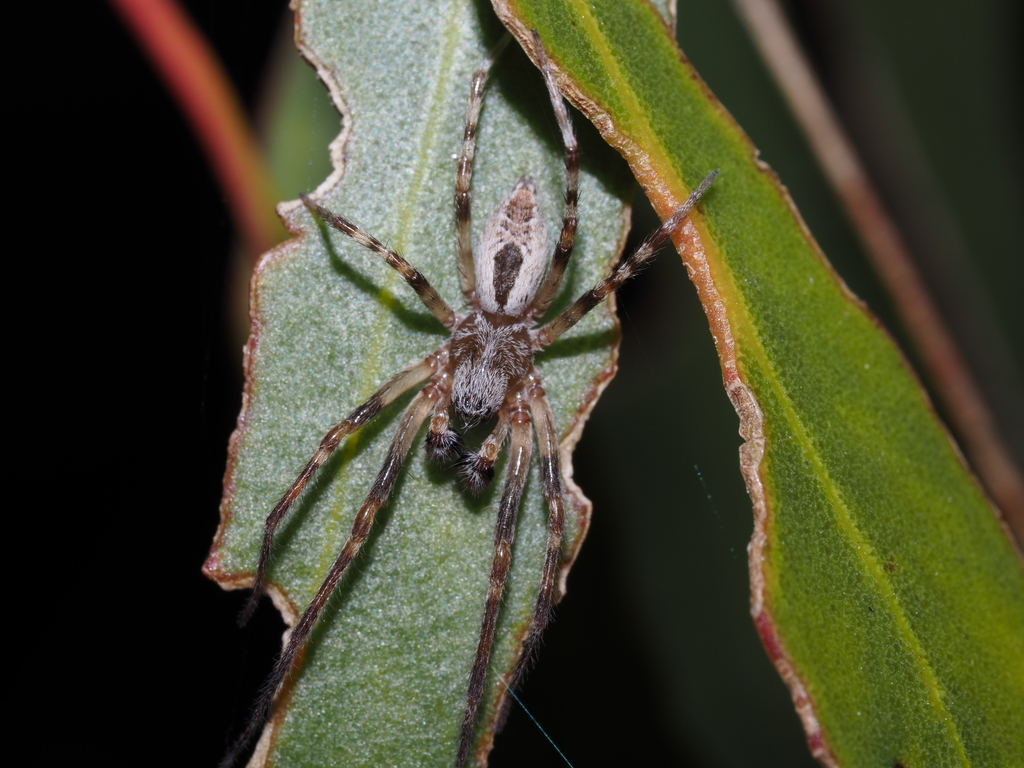
Foliage Webbing Spider
Phryganoporus candidus
Phryganoporus candidus, also known as the foliage web spider, is a small, subsocial jumping spider endemic to Australia. On average, they are 6–10 mm long and are a mottled brown colour, covered in silvery grey hair. They typically reside in arid and semi-arid locations, building their nests in various trees, bushes, and other plant-life. They have a mutualistic relationship with Acacia ligulata, and therefore prefer to build their nests in these trees.
Pregnant P. candidus females build their nests and their offspring live, hunt, and grow there until maturity. These nests are multidimensional and are full of tunnels which act both offensively and defensively. The tunnels keep predators away and help to keep prey trapped inside.
From the article Phryganoporus candidus on Wikipedia (CC BY-SA), quoted section by section
Description
Phryganoporus candidus is a small spider, with both males and females typically measuring 6–10 mm long. Their main body colouration is brown, but they have patterning across their bodies in lighter shades of brown. Additionally, P. candidus are covered in a fine silvery grey hair and the density of the hair varies from spider to spider. Females can be identified by their rounded spermathecal lobes. Males, unlike other closely related spiders, have palps without any easily apparent patellar offshoots.
Range & habitat
P. candidus are widespread throughout the Australian mainland, typically residing in arid and semi-arid locations. They prefer to build their nests in open forest, open scrub, or open woodlands. As P. candidus has a mutualistic relationship with Acacia ligulata, they tend to build their nests on those trees, but are not exclusive to them.
Wikipedia: “Habitat and distribution”
What it does
P. candidus consume a large variety of arthropods, including Elateridae (beetles), blattidae (cockroaches), and coccinellidae (lady bugs). They are fairly general feeders, however, and will typically eat whatever manages to get caught in their webbing, even other types of spiders that are trying to consume their eggs. Most feeding occurs in the evening after they have made any necessary repairs to their nest. Mealybugs, which can be found scavenging in their nests and would make a very opportune prey for P. candidus, are immune to their predation. No exact reason is known why, but it is assumed to be due to the waxy filament that covers their body and their defensive secretions.
Wikipedia: “Diet”
Toxicity
Phryganoporus candidus uses its venom to capture its prey. It does so by releasing its venom through the chelicerae. After it captures its prey, it is known to wrap the prey in silk whilst it is paralyzed for later consumption. However, the venom is not dangerous to humans. There have been no known cases of humans being bit by the spider. The reason why it can paralyze prey but not humans is likely that the venom is injected in low quantities that can only effect small organisms.
== References ==
Wikipedia: “Venom”
Where it lives
Recorded sightings
—
geo-referenced records in GBIF, from museums, herbaria and field observers.
Drag the globe to turn it. Dots are where records exist, not a range map; darker means more records.
In the stacks
Searching the stacks…
Every page naming Phryganoporus candidus in the Biodiversity Heritage Library →
This page is assembled live from iNaturalist, GBIF, Wikipedia, the Source Library and the Internet Archive. It is not yet part of the hand-edited codex. iNaturalist taxon 416707.