- Plants
- ›Vascular Plants
- ›flowering plants
- ›Dicots
- ›pinks, cactuses, and allies
- ›cacti
- ›globular cacti, moonlight cacti, torch cacti, and allies
- ›Cereeae
- ›Cereus
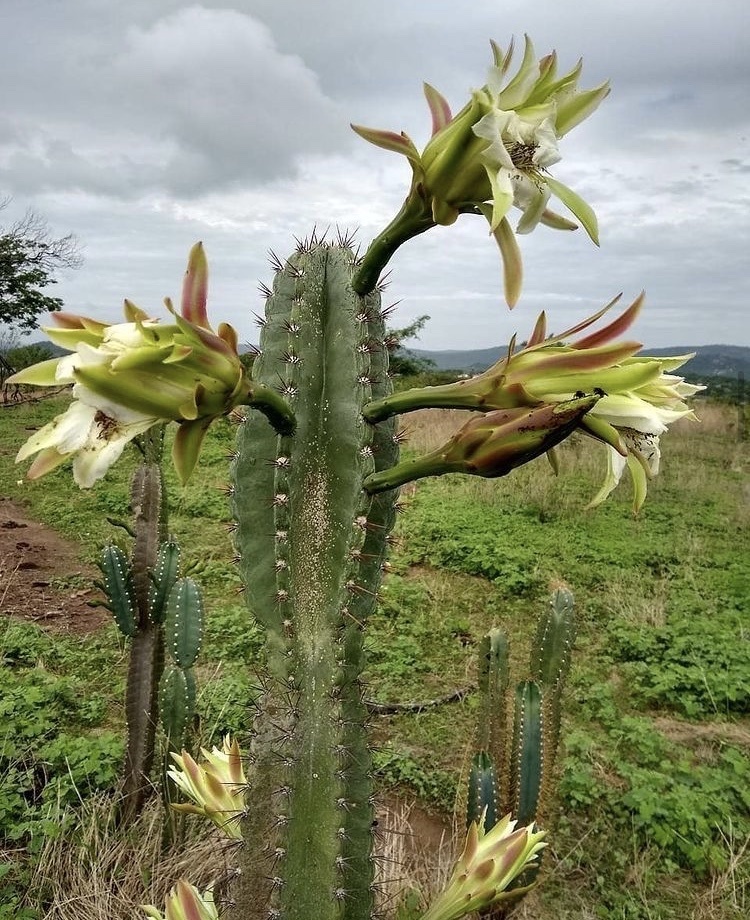
Queen-of-the-night
Cereus jamacaru
Cereus jamacaru, known as mandacaru or cardeiro, is a cactus native to central and eastern Brazil. and naturalized in South Africa. It often grows up to 5 m (16 ft) high.
From the article Cereus jamacaru on Wikipedia (CC BY-SA), quoted section by section
Description
The plants are succulent trees with woody stem that reach about 9 m (up to 15 m) in height with segmented stems and form large crowns. The trunks reach a diameter of 45 cm with 4 to 6 slightly wavy notches and more in old age. The segmented twigs have four to six ribs 8 to 20 cm long and 5 to 7 radials 1.5 cm long, sometimes up to ten ribs due to ribs that have been pushed in with age. The ribs, which are initially about 3.5 cm high, become higher with advancing age. Yellow to brown areoles stand on them at a distance of 2 to 4 cm. These carry about 15 to 20 yellowish to brownish spines, which are divided into 7 to 9 radial spines and 6 to 13 central spines. It is not uncommon for the total number of thorns to be reached over the course of many years. The thorns that form later are particularly tough and up to 10 cm long, rarely up to 20 cm, long.
The flowers are white open at night, and are about 30 cm (10 in) long, with green and white outside the petals with a brown outer edge. The outer bracts are brownish to light green, the inner ones are white. The flower buds usually appear in the middle of spring and each flower lasts only for a night. They open at dusk and wither by the morning. After fertilization, the fruits are egg- to pear-shaped, about 6 cm in diameter and 12 cm long. These turn carmine to coral red when ripe and tear open lengthwise. …
Range & habitat
It is endemic to the Brazilian states of Alagoas, Bahia, Ceará, Goiás, Maranhão, Minas Gerais, Paraíba, Pernambuco, Piauí and Rio Grande do Norte. It is a very common species in the semi-arid caatinga habitats. Many birds feed on the fruit, like the white-naped jay, "gralha-cancã" and the Caatinga parakeet "periquito-da-caatinga."
Wikipedia: “Distribution”
At the table
A thorn-less kind is used for animal feed. The most common kind is very thorny but is also used for animal feed, after burning or cutting off the thorns. Mandacaru is highly drought-resistant. The mandacaru is featured on the flag of the city of Petrolina in the state of Pernambuco.
Wikipedia: “Uses”
Where it lives
Recorded sightings
—
geo-referenced records in GBIF, from museums, herbaria and field observers.
Drag the globe to turn it. Dots are where records exist, not a range map; darker means more records.
In the stacks
Searching the stacks…
Every page naming Cereus jamacaru in the Biodiversity Heritage Library →
This page is assembled live from iNaturalist, GBIF, Wikipedia, the Source Library and the Internet Archive. It is not yet part of the hand-edited codex. iNaturalist taxon 418237.