- Animals
- ›Arthropods
- ›Hexapods
- ›Insects
- ›Winged and Once-winged Insects
- ›Ants, Bees, Wasps, and Sawflies
- ›Narrow-waisted Wasps, Ants, and Bees
- ›Ants, Bees, and Stinging Wasps
- ›Formicoidea
- ›Ants
- ›Formicine Ants
- ›Camponotine Ants
- ›Camponotus
- ›Myrmophyma
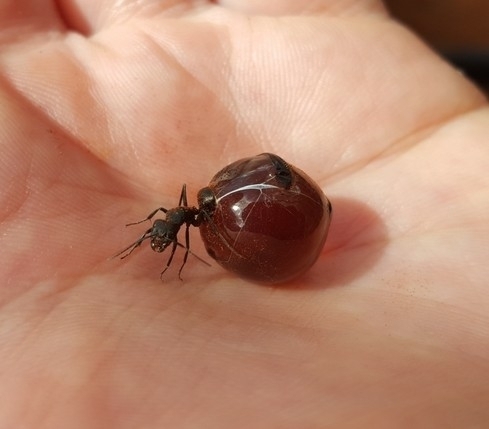
Australian Honeypot Ant
Camponotus inflatus
Honeypot ants, also called honey ants, are ants which have specialized workers (repletes, plerergates, or rotunds) that are gorged with food by workers to the point that their abdomens swell enormously. Other ants then extract nourishment from them, through the process of trophallaxis. They function as living larders. Honeypot ants belong to any of several genera, including Myrmecocystus and Camponotus. They were first documented in 1881 by Henry C. McCook, and described further in 1908 by...
From the article Camponotus inflatus on Wikipedia (CC BY-SA), quoted section by section
Description
C. inflatus is part of the genus Camponotus, a diverse genus distributed globally containing over 1,500 species commonly called carpenter ants or sugar ants. The species itself is part of the subgenus Myrmophyma, the bladder-head carpenter ants. The worker ants range from five to eight millimetres (0.20 to 0.31 in), but repletes can swell up to seventeen millimetres (0.67 in). The size of the queen and male are unpublished, but their physical characteristics are described by Lubbock (1896). They are black with paler legs and antennae. Their nest entrances have no surrounding mound and are 0.25 inches (0.64 cm) wide and one inch (2.5 cm) deep. The nests consist of a central shaft measuring five to six feet (150 to 180 cm) and many chambers branching out. Most repletes are gathered in the bottom chamber, which is often the largest. The nests are located in a variety of sandy biomes. The repletes form half of the entire colony population.
Range & habitat
C. inflatus is found in all seven states of mainland Australia, however most common in the deserts of central Australia. They typically nest at the base of mulga trees.
Wikipedia: “Distribution”
In medicine
Aboriginal Australians have been harvesting these ants' honey for thousands of years to treat minor ailments like sore throats or infections. Called "Yarumpa" by the Arrernte people, many tribes of the Aboriginal Australians harvest the repletes in large amounts, often digging large chunks out of the sand to locate the nests. They are valued as a rare source of sugar during the dry months. Traditionally, only the women would harvest these ants while the men would go out and hunt; it was also viewed as a valuable opportunity for children to learn. This species has heavily influenced the Aboriginal Australians' culture, and many of their traditions revolve around this ant.
== References ==
Wikipedia: “Traditional use”
Listen
Looking for field recordings…
Where it lives
Recorded sightings
—
geo-referenced records in GBIF, from museums, herbaria and field observers.
Drag the globe to turn it. Dots are where records exist, not a range map; darker means more records.
In the stacks
Searching the stacks…
Every page naming Camponotus inflatus in the Biodiversity Heritage Library →
This page is assembled live from iNaturalist, GBIF, Wikipedia, the Source Library and the Internet Archive. It is not yet part of the hand-edited codex. iNaturalist taxon 423599.