 NL·0294
Herbarium of the Nature Library
- Name
- Ovibos moschatus
- Family
- Bovidae
- Native to
- Arctic Canada and Greenland; reintroduced or introduced to Alaska, Norway (Dovrefjell), Sweden, Siberia (Taymyr, Wrangel Island)
- Habitat
- Tundra, Polar desert
Musk ox
Ovibos moschatus
Also calledUmingmak (Inuktitut, 'the bearded one') · Moskusokse (Norwegian/Danish) · Ovtsebyk (Russian) · Buey almizclero (Spanish) · Boi-almiscarado (Portuguese)
An Ice Age survivor of the high Arctic, a shaggy, short-legged bovid more closely related to goats than to cattle. Its underwool, qiviut, is among the warmest natural fibres. Facing wolves, herds form a tight circle with calves in the middle and horns outward.
The muskox is a hoofed mammal of the family Bovidae. Native to the Arctic, it is noted for its thick coat and for the strong odor emitted by males during the seasonal rut, from which its name derives. This musky odor has the effect of attracting females during mating season. Its Inuktitut name umingmak translates to "the bearded one". Wikipedia
What it can do
- iQiviut underwool is warmer than sheep's wool by weight and is shed each spring
- iiDefensive ring formation repels wolves, though not human hunters
- iiiSurvives winters of −40 °C on frozen sedges and willows dug from snow
In the field
Field marks
- aSilhouette: low, boxy dark-brown animal with long skirt of guard hair reaching near the ground
- bHorns with a massive central 'boss' across the forehead, curving down then up beside the face
- cPale saddle and pale lower legs
- dSigns: tufts of shed qiviut on willows and rocks in early summer; rounded hoofprints
- Not to be confused with
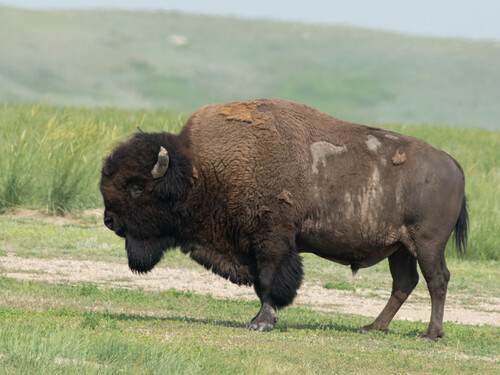
- Bison (not in Arctic) has a tall hump and short upturned horns. Reindeer are slimmer with antlers. Takin (Himalaya) is golden with differently curved horns.
- Where to see it
- Dovrefjell–Sunndalsfjella National Park (Norway); Kangerlussuaq (Greenland); Nunivak Island and Nome (Alaska); Banks Island, Aulavik National Park (Canada); Wrangel Island (Russia)
- When
- Resident year-round; summer is best for access
Listen
Looking for field recordings…
Life & habits
- Diet
- Grasses, sedges, Arctic willow, herbs and lichens
- Habitat
- Arctic tundra and river valleys with thin snow cover
- Size
- Shoulder height 1.1–1.5 m; bulls 270–410 kg
- Lifespan
- About 12–20 years
Bulls charge each other head-on in the late-summer rut, colliding with a crash audible far away. Herds of 10–30 are typical.
Where it lives
Recorded sightings
—
geo-referenced records in GBIF, from museums, herbaria and field observers.
Native range
Arctic Canada and Greenland; reintroduced or introduced to Alaska, Norway (Dovrefjell), Sweden, Siberia (Taymyr, Wrangel Island)
Drag the globe to turn it. Dots are where records exist, not a range map; darker means more records.
In the stacks
Searching the stacks…
Every page naming Ovibos moschatus in the Biodiversity Heritage Library →
Marginalia
Musk oxen were hunted out of Alaska by the early 1900s; a few dozen animals brought from Greenland and released on Nunivak Island in 1935–36 founded most of today's Alaskan herds. Inuit traditionally used the horns for ladles, bows and fish spears.
Curiosity
Despite its name, the musk ox is not an ox: it is a goat-antelope, closer to sheep and goats than to cattle, and its nearest living relatives appear to be the gorals of Asia's mountains.
Kinship

Photographs: iNaturalist contributors under the licences shown. Records: GBIF.org. Historical plates: Source Library (CC BY-SA 4.0; originals public domain). Summary text: Nature Library editors and Wikipedia (CC BY-SA). Medicinal and edibility notes are historical and educational, not advice. iNaturalist taxon 42412.