 NL·0138
Herbarium of the Nature Library
- Name
- Ziziphus jujuba
- Family
- Rhamnaceae
- Native to
- Northern China (probably the middle Yellow River valley); cultivated across East, Central and West Asia, the Mediterranean and North America
- Habitat
- Semi-arid hills, Loess plateaux, Orchards
Jujube
Ziziphus jujuba
Also calledZǎo / Hóngzǎo (Chinese, 'red date') · Daechu (Korean) · Unnab (Persian/Arabic/Urdu) · Ber (Hindi, also for Z. mauritiana) · Natsume (Japanese) · Azufaifo (Spanish) · Hünnap (Turkish)
A thorny, zigzag-branched small tree cultivated in northern China for over 4,000 years. Its fruit, eaten crisp like an apple or dried into chewy 'red dates', is a cornerstone of Chinese cooking and medicine.
Jujube, jujuba, Chinese jujube, red date or Chinese date is a species in the genus Ziziphus in the buckthorn family Rhamnaceae. It is often confused with the closely related Indian jujube, Z. mauritiana. The jujube tolerates a diverse range of climates, from temperate to tropical. Its origin is thought to be in eastern Asia, but it has been widely dispersed through cultivation, and is today cultivated in gardens as a shrub as well as in agriculture as a food crop. Its fruit is eaten freshly harvested as well as dried and candied. Wikipedia
What it can do
- iSurvives extreme heat, cold to about −28 °C, drought and alkaline or saline soil
- iiLeafs out late in spring, so it escapes frost damage to flowers
- iiiPaired spines, one straight and one hooked, guard each node in wild forms
- ivSpreads by root suckers into thickets
At the table
Eatenfruit (fresh, dried, candied) · leaves (tea)
Fruit is safe and widely eaten. Seeds are used only medicinally.
In the medicine cabinet
| Tradition | Use |
|---|---|
| Traditional Chinese Medicine | Dried fruit (dà zǎo) to tonify qi and blood and harmonise herbal formulas; seed (suān zǎo rén, from the sour jujube) for insomnia and anxiety |
| Persian / Unani medicine | Unnab fruit decoction for coughs, sore throat and as a blood purifier |
Weight of evidence
Traditional. Long historical use; little or no modern clinical evidence.
Active compounds
jujubosides (saponins), cyclic AMP, vitamin C, betulinic acid
Fruit & seed


Fruit
Drupe
Ripens: Late summer to autumn
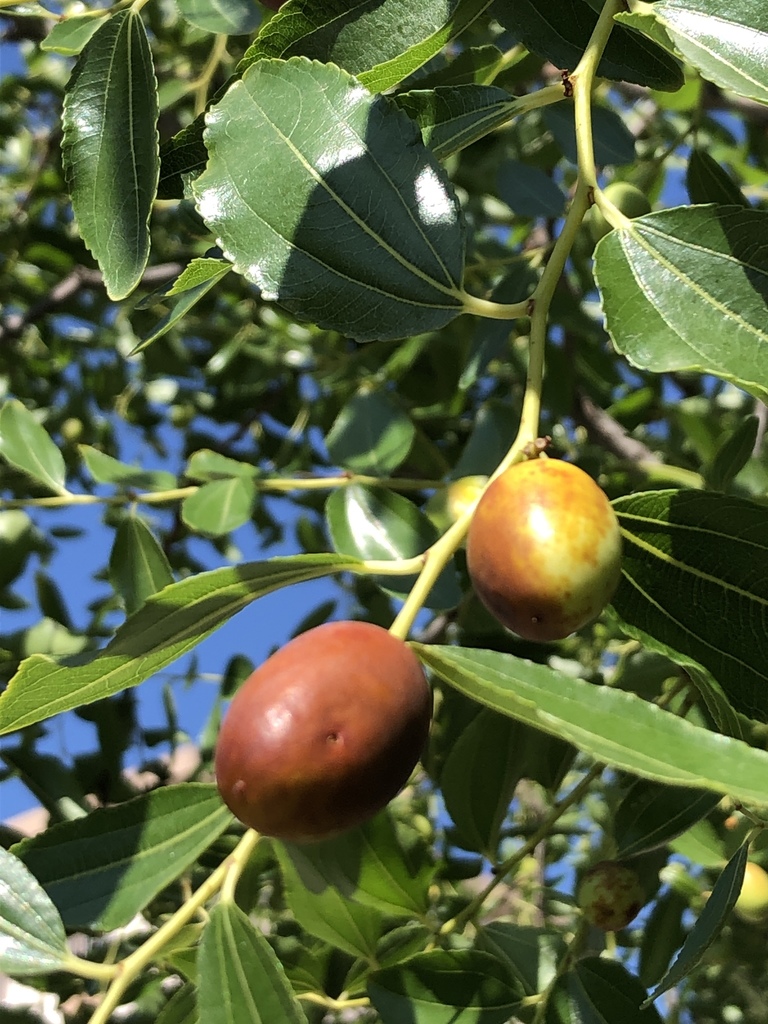
Oval to round drupe 2–5 cm, glossy green ripening to mahogany-red; crisp, sweet, apple-like white flesh that wrinkles and turns date-like when dried, around a single stone.

Seed
1–2 cm (stone)
Hard, elongated, pointed-oval stone 1–2 cm, reddish-brown and roughly ridged, holding one or two small flat brown seeds
- Dispersal
- Birds and mammals
- Germination
- Crack or scarify the stone, cold-stratify 60–90 days, sow at 20–25 °C; erratic. Named varieties are grafted
Photographs from Wikimedia Commons under open licences; hover for the photographer, click for the file.
How to grow it
Hardiness (USDA zones)
USDA 5–10. Survives winters down to about -29 °C.
- Light
- Full sun; needs summer heat to fruit well
- Water
- Low once established
- Soil
- Any well-drained soil, including alkaline, saline or poor, pH 5.5–8.5
- Propagation
- Grafting named cultivars ('Li', 'Lang', 'Sugar Cane') onto seedling or sour-jujube rootstock; root suckers
- To harvest
- 1–3 years from a grafted tree
- Climates
- Continental, Semi-arid, Mediterranean, Subtropical
- 1Plant a grafted tree in the hottest, sunniest spot available; most varieties set fruit alone, but two varieties improve the crop.
- 2Water for the first year, then rely on rain except in severe drought.
- 3Remove suckers from the rootstock below the graft regularly.
- 4Prune lightly in winter to thin crowding; fruit grows on short, deciduous branchlets each year.
- 5Pick crisp when half to fully red for fresh eating, or leave on the tree until wrinkled to dry.
Can it grow where you are?
Where it lives
Recorded sightings
—
geo-referenced records in GBIF, from museums, herbaria and field observers.
Native range
Northern China (probably the middle Yellow River valley); cultivated across East, Central and West Asia, the Mediterranean and North America
Drag the globe to turn it. Dots are where records exist, not a range map; darker means more records.
In the old herbals & bestiaries
Woodcuts and engravings matched from the Source Library’s scanned books by name. Plates marked “relative” show a close kin rather than this exact species. Click a plate to read the page it came from, with translation.

On the Names of Plants
Hieronymus Bock (Tragus) · 1552 · p.1095

Compendium of Materia Medica
李時珍 · 1596 · p.21

Sancai Tuhui (Vol. 105)
王圻, 王思義 · 1609 · p.32

Illustrated Investigation of the Names and Realities of Plants
吳其濬 · 1848 · p.5

Complete Treatise on Agricultural Administration
Xu Guangqi · 1909 · p.823

Herbarium Portatile, Oder Behendes Kräuter- und Gewächs-Buch: Darinn nicht allein 1363. so wol Einheimische als Außländndische Kräuter mit Lateinisch und Deutscher Benennung abgebildet, sondern auch die meisten, so in der Medicin gebräuchlich, kürtzlich erkläret werden
Panckow, Thomas · 1656 · p.352

Commentaries on the Six Books of Dioscorides
Pietro Andrea Mattioli · 1560 · p.279

Jan Moninckx; Maria Moninckx — Moninckx Atlas, vol. 5 (1686)
Jan Moninckx; Maria Moninckx · 1686 · p.21

The Great Herbary with all the figures of the herbs
1532 · p.183

History of Plants in Four Books
Valerius Cordus · 1561 · p.418
In the stacks
Searching the stacks…
Every page naming Ziziphus jujuba in the Biodiversity Heritage Library →
Marginalia
The jujube is one of China's traditional 'five fruits', and jujubes and chestnuts were a bride's ritual gift in the classical rites; red dates are still scattered on wedding beds to wish couples early children — 'zǎo' sounds like 'early'. Ziziphus is also the 'lote tree' (sidr) of the Qur'an, though that is mainly Z. spina-christi.
Curiosity
China grows about 90% of the world's jujubes, and some trees in Shanxi are said to be over 1,000 years old.
Kinship



Fact-checked: 1 correction made to this sheet. Photographs: iNaturalist contributors under the licences shown. Records: GBIF.org. Historical plates: Source Library (CC BY-SA 4.0; originals public domain). Summary text: Nature Library editors and Wikipedia (CC BY-SA). Medicinal and edibility notes are historical and educational, not advice. iNaturalist taxon 428365.