- Plants
- ›Vascular Plants
- ›flowering plants
- ›Dicots
- ›pinks, cactuses, and allies
- ›cacti
- ›globular cacti, moonlight cacti, torch cacti, and allies
- ›Trichocereeae
- ›Arthrocereus
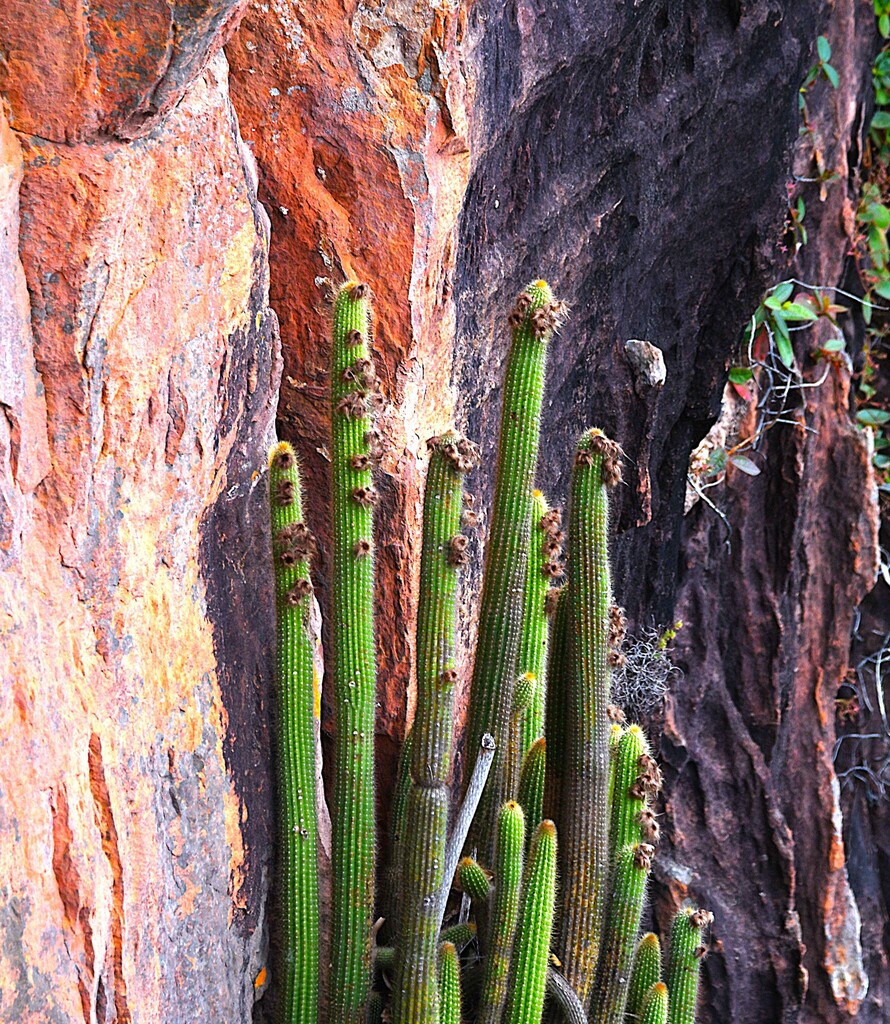
Arthrocereus spinosissimus
Arthrocereus spinosissimus is a species of cactus in the subfamily Cactoideae from Brazil.
From the article Arthrocereus spinosissimus on Wikipedia (CC BY-SA), quoted section by section
Description
Arthrocereus spinosissimus grows upright with basally branching shoots. The up to one meter long, green to bright green shoots reach a diameter of 5 to 6 cm (2.0 to 2.4 in). The 16 (or more) ribs are 4 to 5 mm (0.16 to 0.20 in) high. Numerous, thin, yellowish thorns emerge from the closely spaced areoles. There are 6 to 8 central spines that are usually 2 to 2.8 cm (0.79 to 1.10 in), occasionally up to 4.5 cm (1.8 in) in length, and about 20 radial spines of 0.7 to 0.8 cm (0.28 to 0.31 in) in length. The white flowers are between 6 and 7 cm (2.4 and 2.8 in) long, the fruits between 2.5 and 3 cm (0.98 and 1.18 in).
Range & habitat
Arthrocereus spinosissimus is restricted to the Chapada dos Guimarães National Park in the Brazilian state of Mato Grosso at altitudes of 800 to 900 meters.
Wikipedia: “Distribution”
Where it lives
Recorded sightings
—
geo-referenced records in GBIF, from museums, herbaria and field observers.
Drag the globe to turn it. Dots are where records exist, not a range map; darker means more records.
In the stacks
Searching the stacks…
Every page naming Arthrocereus spinosissimus in the Biodiversity Heritage Library →
This page is assembled live from iNaturalist, GBIF, Wikipedia, the Source Library and the Internet Archive. It is not yet part of the hand-edited codex. iNaturalist taxon 437302.