- Plants
- ›Vascular Plants
- ›flowering plants
- ›Dicots
- ›pinks, cactuses, and allies
- ›cacti
- ›globular cacti, moonlight cacti, torch cacti, and allies
- ›Cereeae
- ›Brasilicereus
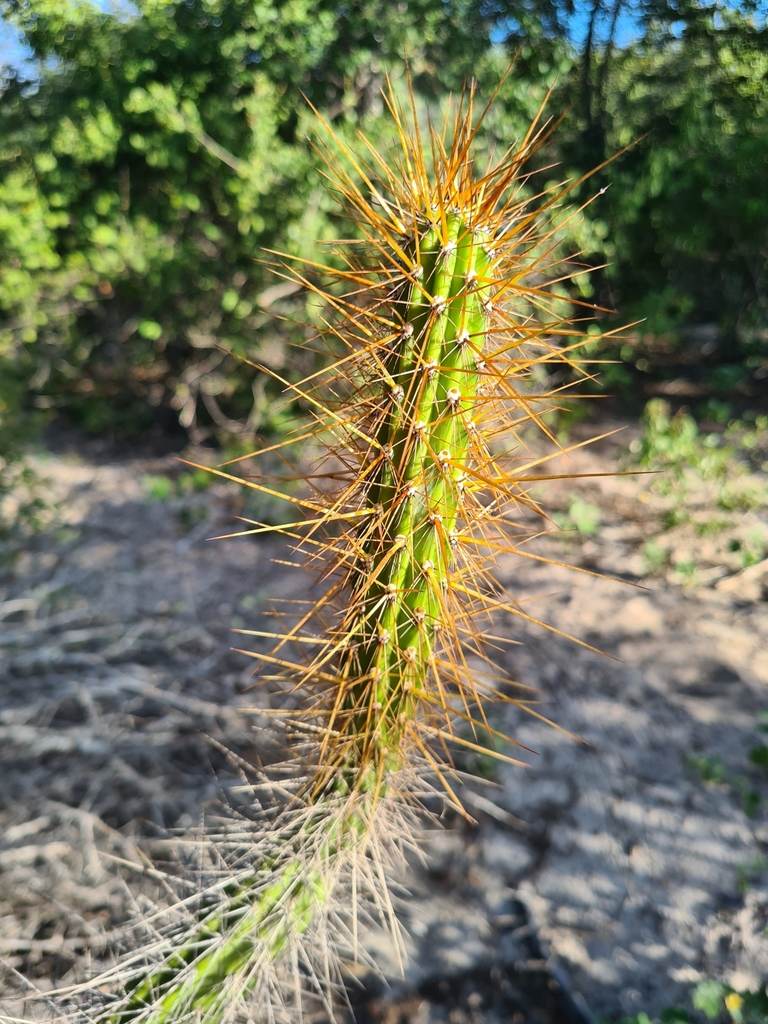
Brasilicereus estevesii
Bragaia is a genus of cacti (family Cactaceae) with the sole species Bragaia estevesii. It is found in Brazil.
From the article Bragaia on Wikipedia (CC BY-SA), quoted section by section
Description
Bragaia estevesii typically grows as a weakly branched, upright shrub with a slightly woody base. Its green, cylindrical shoots can reach up to 4 meters long but usually stay shorter. These shoots have 10–12 blunt ribs and are sometimes covered in needle-like, yellowish-brown thorns. The flowers, which open at night and are pollinated by bats, form laterally in the upper part of the shoot. They are slender, funnel-shaped, and lightly scaled, with extrafloral nectar glands, and can be green, yellow, or red. The petals range from greenish-white to white. A noticeable feature is the strong constriction above the pericarpel. The fruit is small, spherical to slightly oval, measuring 15–19 mm long and 6–8 mm wide, with transparent pulp and no exterior spines. The helmet-shaped black seeds are relatively large at 1.5–1.8 mm.
Range & habitat
Bragaia estevesii is found in northeast Brazil, specifically in the Caatinga region of northwestern Bahia.
Wikipedia: “Distribution”
Where it lives
Recorded sightings
—
geo-referenced records in GBIF, from museums, herbaria and field observers.
Drag the globe to turn it. Dots are where records exist, not a range map; darker means more records.
In the stacks
Searching the stacks…
Every page naming Brasilicereus estevesii in the Biodiversity Heritage Library →
This page is assembled live from iNaturalist, GBIF, Wikipedia, the Source Library and the Internet Archive. It is not yet part of the hand-edited codex. iNaturalist taxon 438074.