- Plants
- ›Vascular Plants
- ›flowering plants
- ›Dicots
- ›pinks, cactuses, and allies
- ›cacti
- ›globular cacti, moonlight cacti, torch cacti, and allies
- ›Cereeae
- ›Coleocephalocereus
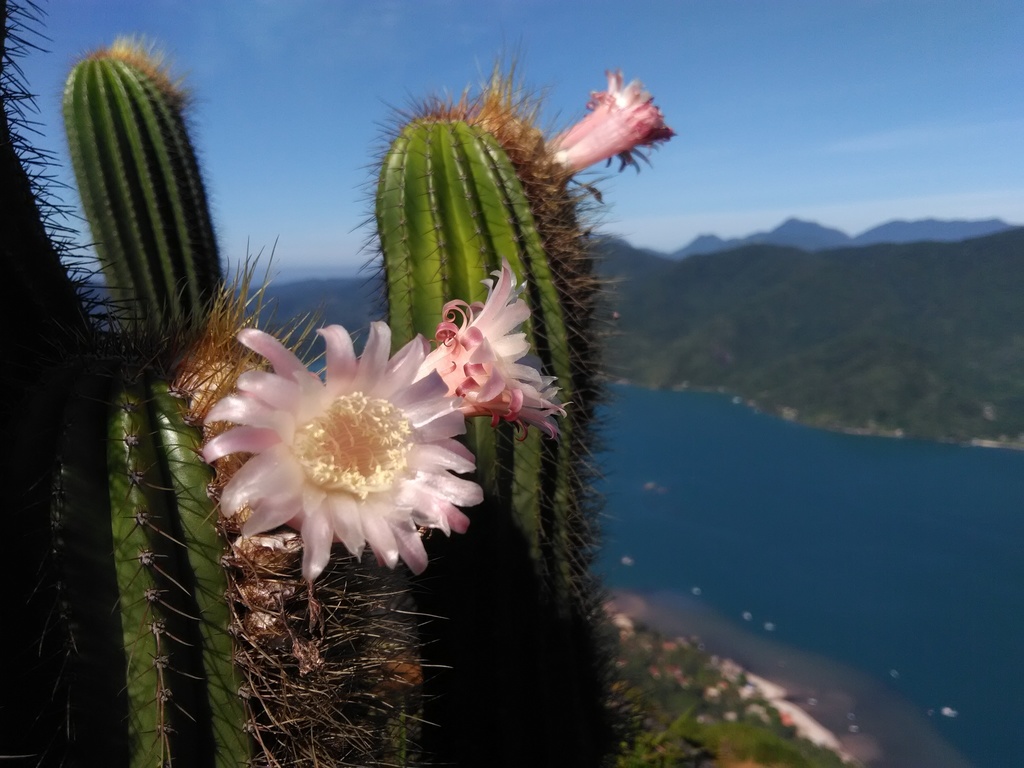
Coleocephalocereus fluminensis
Coleocephalocereus fluminensis is a species of succulent flowering plant in the genus Coleocephalocereus, within the family Cactaceae. It is endemic to southeastern Brazil.
From the article Coleocephalocereus fluminensis on Wikipedia (CC BY-SA), quoted section by section
Description
Coleocephalocereus fluminensis is a species of cactus whose stems initially grow in a prostrate manner, but then turn upwards. The stems are dark green in color, branch at the base, and may reach 3 m in height and 10 cm in diameter.
This species has 5-17 straight ribs which are slightly divided into tubercles; the areoles are situated on top of the tubercles. The areoles have one central spine that is initially yellow-brown in color, but then changes to gray over time. There are 4-14 yellowish radial spines which also turn gray with age; these may measure up to 3 cm in length. The flowers are off-white to light pink in color. They open at night and measure up to 7 cm in length. They develop from a woolly structure on the sides of the vertical stems called the pseudocephalium; this may measure up to 5 cm in width and 1 m in length. The pseudocephalium is made up of thick white wool and bristles, as well as many fine spines. The fruits are thin and club-shaped. They are bright purple in color and measure 2-3 cm in length.
Range & habitat
This species is native to southeastern Brazil, where it is found in eastern and southern Minas Gerais, Espirito Santo, Rio de Janeiro, and northeastern São Paulo. It grows primarily in the seasonally-dry tropical biome.
Wikipedia: “Distribution and habitat”
How it is grown
This species is cultivated mainly as an ornamental. It may be propagated vegetatively via cuttings, or via seed.
Wikipedia: “Cultivation”
Where it lives
Recorded sightings
—
geo-referenced records in GBIF, from museums, herbaria and field observers.
Drag the globe to turn it. Dots are where records exist, not a range map; darker means more records.
In the stacks
This page is assembled live from iNaturalist, GBIF, Wikipedia, the Source Library and the Internet Archive. It is not yet part of the hand-edited codex. iNaturalist taxon 438325.