- Plants
- ›Vascular Plants
- ›flowering plants
- ›Dicots
- ›pinks, cactuses, and allies
- ›cacti
- ›globular cacti, moonlight cacti, torch cacti, and allies
- ›Trichocereeae
- ›Echinopsis
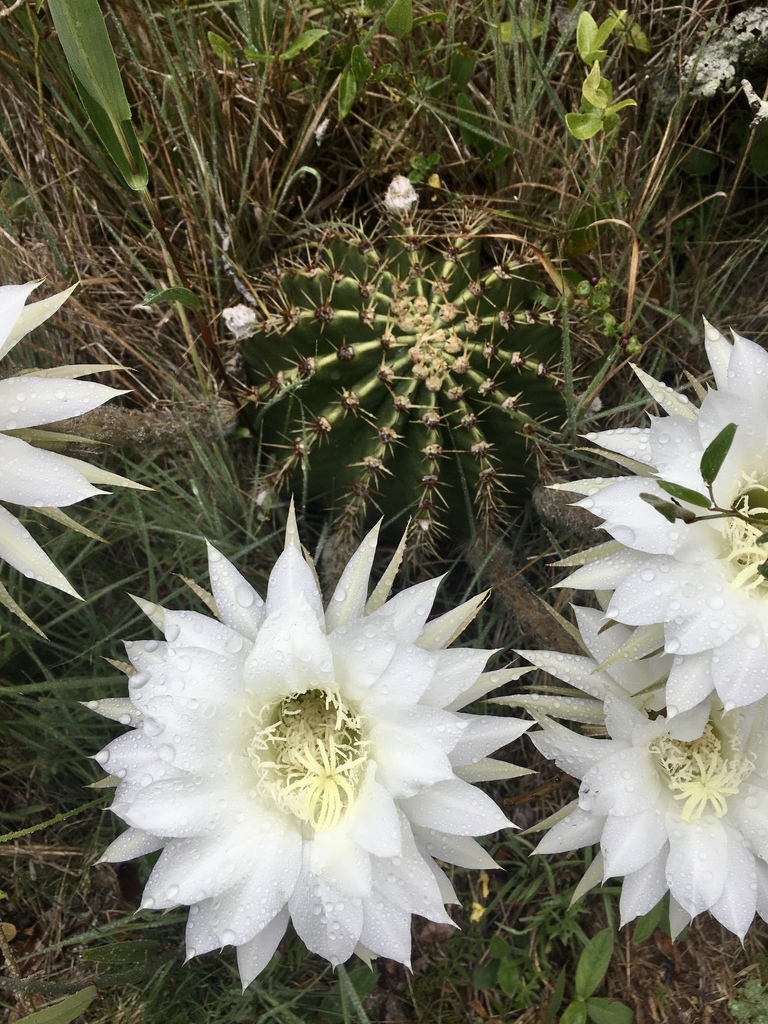
Easter Lily Cactus
Echinopsis oxygona
Echinopsis oxygona, also known as Eyries cactus, Easter lily cactus or sea-urchin cactus, is a species of flowering plant in the cactus family Cactaceae, native to south Brazil, Uruguay, Paraguay and northeastern Argentina. Some species that have been described separately, including Echinopsis eyriesii and Echinopsis tubiflora, are now considered to be synonymous. The features of the species include a large flower, with sharply pointed lavender or white petals, and a sweet scent.
From the article Echinopsis oxygona on Wikipedia (CC BY-SA), quoted section by section
Description
Echinopsis oxygona grows singly or in groups. The spherical to short cylindrical, dark green shoots reach heights of up to 75 cm (30 in) with a diameter of up to 15 cm (5.9 in). There are 8 to 18 ribs. The white to tan, gray or black areoles are up to 2 cm (0.79 in) apart. The spines that emerge from the areoles vary in size and number. In plants that have been treated as E. eyriesii, there are 10–15 very short spines. In plants that have been treated as E. oxygona, the spines are longer: the one to five strong central spines are up to 3–3.5 cm (1.2–1.4 in) long, and there are up to 20 thinner radial spines up to 2.5 cm (1.0 in) long. Plants produce white, lavender or pale red flowers that open at night. The flowers are up to 25 cm (9.8 in) long and up to 10 cm (3.9 in) across.
Range & habitat
Echinopsis oxygona, native to Southern Brazil, Uruguay, Paraguay and Entre Ríos Province, Argentina, thrives in lowland environments, reaching altitudes of up to 1,000 meters above sea level. In these areas, there is a tropical and continental climate, characterized by arid winters and humid summers. The annual precipitation in these regions amounts to approximately 1,500 mm, sustaining an average annual temperature range of 25–30°C, rarely dropping below zero degrees.
Wikipedia: “Habitat”
How it is grown
Echinopsis oxygona is known for having huge, showy flowers at the ends of long tubes which are connected to the cactus. The flower has a sweet smell. The flower opens in the evening and wilts the next afternoon on hot days. It grows well in full sun, or light shade. These cacti can stand strong heat, and even temperatures as low as −10 °C (14 °F). Usually these are outdoor plants. They are used to the dry, desert climate, so they do not need to be watered every day. In the 19th century, Echinopsis oxygona was extensively hybridized with other Echinopsis and Lobivia species, giving rise to a number of cultivars with large colourful flowers.
In cultivation in the UK this plant has received the Royal Horticultural Society's Award of Garden Merit.
Propagation. Usually, the cactus will start to have small offsets appear at its base. These can be plucked off and transplanted into a different pot for further growth into a mature cactus. Usually, the cactus will bloom in mid summer. If cultivated away from seasonal temperature changes, the bloom can be initiated any time during the year (assuming sufficient maturity), by watering the cactus after a longer dry period.
Wikipedia: “Cultivation”
Where it lives
Recorded sightings
—
geo-referenced records in GBIF, from museums, herbaria and field observers.
Drag the globe to turn it. Dots are where records exist, not a range map; darker means more records.
In the stacks
Searching the stacks…
Every page naming Echinopsis oxygona in the Biodiversity Heritage Library →
This page is assembled live from iNaturalist, GBIF, Wikipedia, the Source Library and the Internet Archive. It is not yet part of the hand-edited codex. iNaturalist taxon 438589.