- Plants
- ›Vascular Plants
- ›flowering plants
- ›Dicots
- ›pinks, cactuses, and allies
- ›cacti
- ›globular cacti, moonlight cacti, torch cacti, and allies
- ›Notocacteae
- ›Eulychnia
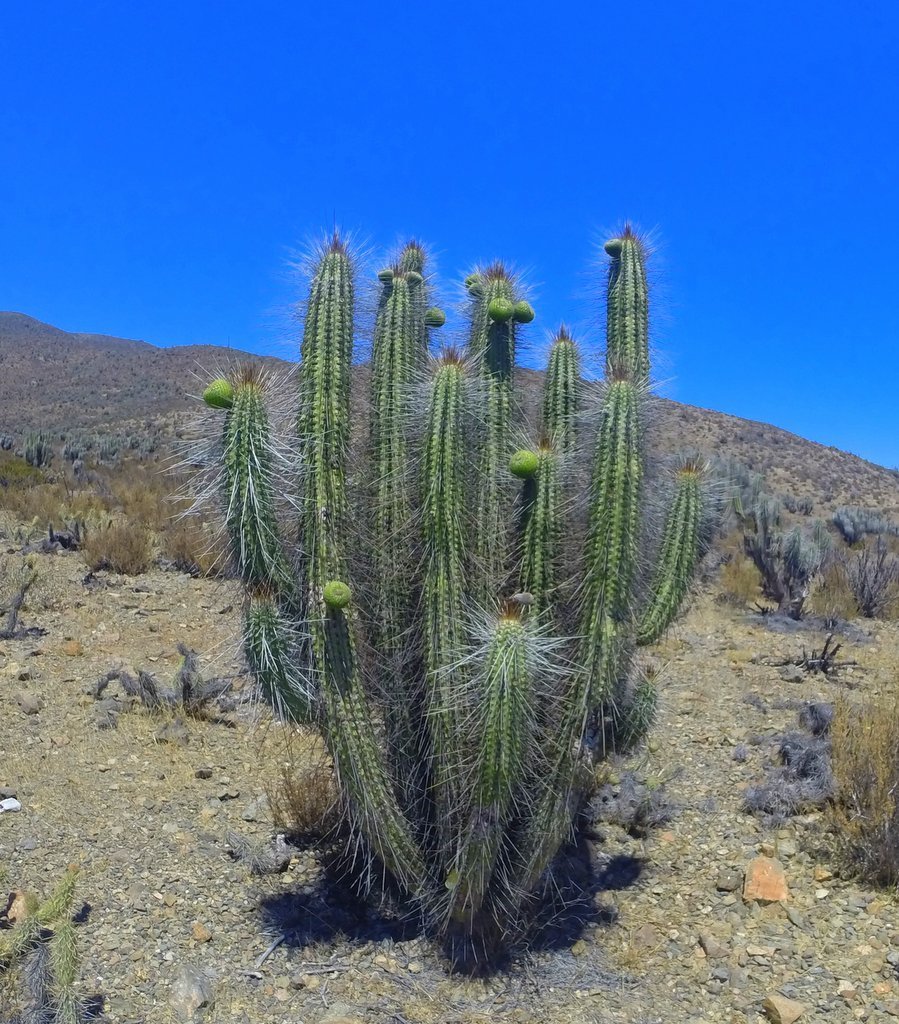
Eulychnia acida
Eulychnia acida is a flowering plant in the family Cactaceae that is found in Chile.
From the article Eulychnia acida on Wikipedia (CC BY-SA), quoted section by section
Description
Eulychnia acida is a arborescent columnar cactus typically exhibits a tree-like form, reaching between 1.5 and 4 meters in height, though it can grow up to 7 meters in favorable conditions. It usually develops a distinct trunk about one meter long, from which it branches to form a rounded crown. Alternatively, some individuals lack a clear trunk and present a low, highly branched, and often prostrate or ascending form, rarely exceeding one meter in height. The cactus's development is often irregular and asymmetrical, a result of its struggle for moisture, leading to a disordered appearance. Its stems, which can be erect or almost prostrate and range from 6 to 12 cm (2.4 to 4.7 in) in diameter, are intensely spiny even from the seedling stage. The greenish-gray epidermis is often coated with accumulated dirt and dust. It is common to observe dead or dying parts alongside inactive living tissue, making it difficult to discern active from dormant areas. The stems feature 10 to 16 broad, low ribs, with areoles spaced 7 to 15 mm (0.28 to 0.59 in) apart along these ribs. The spination is highly variable, characterized by almost straight, erect, needle-shaped spines that are dark brown when young, aging to gray. …
Range & habitat
Eulychnia acida's native range spans northern and central Chile, from north of Vallenar to south of Illapel found in desert and dry scrub biomes from sea level up to approximately 1300 meters in altitude. It thrives in coastal valleys and mountain slopes, often alongside other cacti like Leucostele chiloensis, and shows a preference for rocky, fog-exposed areas where condensation provides moisture to its root system. While it can be found on gentler slopes and plains with minimal water, its presence in these habitats, with rainfall rarely exceeding 50 mm annually, highlights its remarkable adaptation to extreme aridity. This species is a significant component of its native scrubland ecosystems, exhibiting considerable morphological variation influenced by both genetic factors and local environmental conditions. Capable of reaching great longevity, with some individuals surviving for centuries, Eulychnia acida plays a vital ecological role in the Huasco and Aconcagua valleys. It also engages in a highly specialized interaction, being exclusively parasitized by the hemiparasitic plant Tristerix aphyllus.
Wikipedia: “Distribution”
Where it lives
Recorded sightings
—
geo-referenced records in GBIF, from museums, herbaria and field observers.
Drag the globe to turn it. Dots are where records exist, not a range map; darker means more records.
In the stacks
Searching the stacks…
Every page naming Eulychnia acida in the Biodiversity Heritage Library →
This page is assembled live from iNaturalist, GBIF, Wikipedia, the Source Library and the Internet Archive. It is not yet part of the hand-edited codex. iNaturalist taxon 438759.