- Plants
- ›Vascular Plants
- ›flowering plants
- ›Dicots
- ›pinks, cactuses, and allies
- ›cacti
- ›globular cacti, moonlight cacti, torch cacti, and allies
- ›Trichocereeae
- ›Gymnocalycium
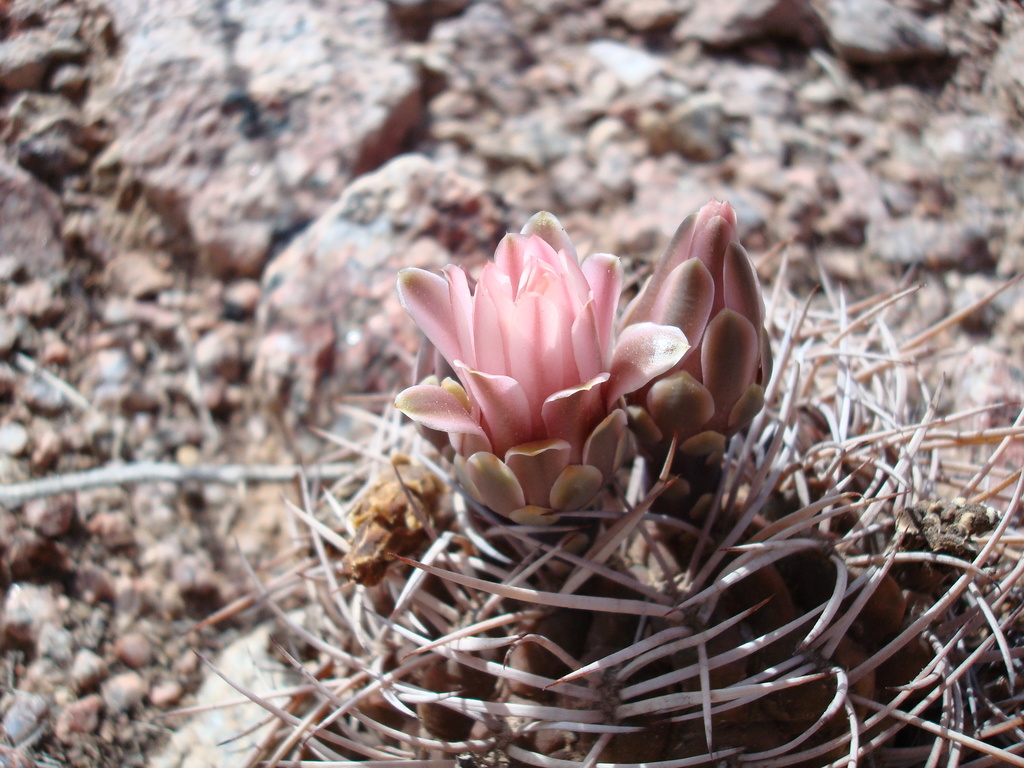
Gymnocalycium schickendantzii
Gymnocalycium schickendantzii is a species of succulent flowering plant in the genus Gymnocalycium, within the family Cactaceae. It is endemic to northern Argentina.
From the article Gymnocalycium schickendantzii on Wikipedia (CC BY-SA), quoted section by section
Description
Gymnocalycium schickendantzii is a species of cactus with a solitary habit. It is small in size. Its growth form is globose to short-cylindrical, reaching 10–14 cm in diameter and up to 80 cm in height. The epidermis is olive-green to green-brown in color. The root system is solely composed of fibrous roots.The plant has 7-14 ribs; occasionally up to 18. These ribs have well-defined tubercules, which will often merge with one another. On the tubercules sit the areoles; these are elongated, white in color, and densely woolly. This species generally lacks central spines, although certain specimens may have one. There are 6-7 radial spines, which are somewhat flattened and curved laterally or downwards. The radial spines can reach over 3 cm long, and are red-gray to yellow-brown in color; they become an ashy gray color with age.
The flowers develop a distance from the apex, occasionally in the middle ("shoulder") area of the plant. They possess large hypanthia, and are funnel-shaped in their top part. They grow to 5 cm long and up to 3.5 cm in diameter. They may be white, pink, or dull yellow-green in color, and are fragrant. The stigma has 12 lobes, which are yellowish in color. The fruit is ovoid to narrowly club-shaped. It is green to slate-blue in color, although it may also be reddish.
Range & habitat
Gymnocalycium schickendantzii is native to the provinces of Catamarca, Córdoba, La Rioja, Mendoza, Salta, Santiago del Estero, San Juan, San Luis, and Tucumán in northern Argentina. It is mainly found in the subtropical biome at altitudes from 100 to 1200 meters above sea level. It grows in areas that are flat and sandy or silty, away from rocks and inclines and often in the shade of shrubs.
Wikipedia: “Distribution and habitat”
How it is grown
Gymnocalycium schickendantzii is cultivated mainly as an ornamental. It is easy to grow if its basic needs are met. During the winter, it should be kept almost dry and at a temperature above 0 °C (32 °F). It grows best in substrates with lower pH levels, since calcium-rich substrates can stunt its growth. It tolerates high-light environments; however, exposing it to direct sun in the hottest parts of summer can sunburn it or limit its growth. It should be transplanted every other year, or whenever its container is no longer sufficient for its size. It is propagated via seed, since it does not produce pups. To obtain the seeds, it is necessary to wait until the fruit is completely ripe or even to an advanced stage of ripeness. Then, extract, clean, and dry the seeds before storing or sowing them.
Wikipedia: “Cultivation”
Where it lives
Recorded sightings
—
geo-referenced records in GBIF, from museums, herbaria and field observers.
Drag the globe to turn it. Dots are where records exist, not a range map; darker means more records.
In the stacks
This page is assembled live from iNaturalist, GBIF, Wikipedia, the Source Library and the Internet Archive. It is not yet part of the hand-edited codex. iNaturalist taxon 438977.