- Plants
- ›Vascular Plants
- ›flowering plants
- ›Dicots
- ›pinks, cactuses, and allies
- ›cacti
- ›globular cacti, moonlight cacti, torch cacti, and allies
- ›Trichocereeae
- ›Weberbauerocereus
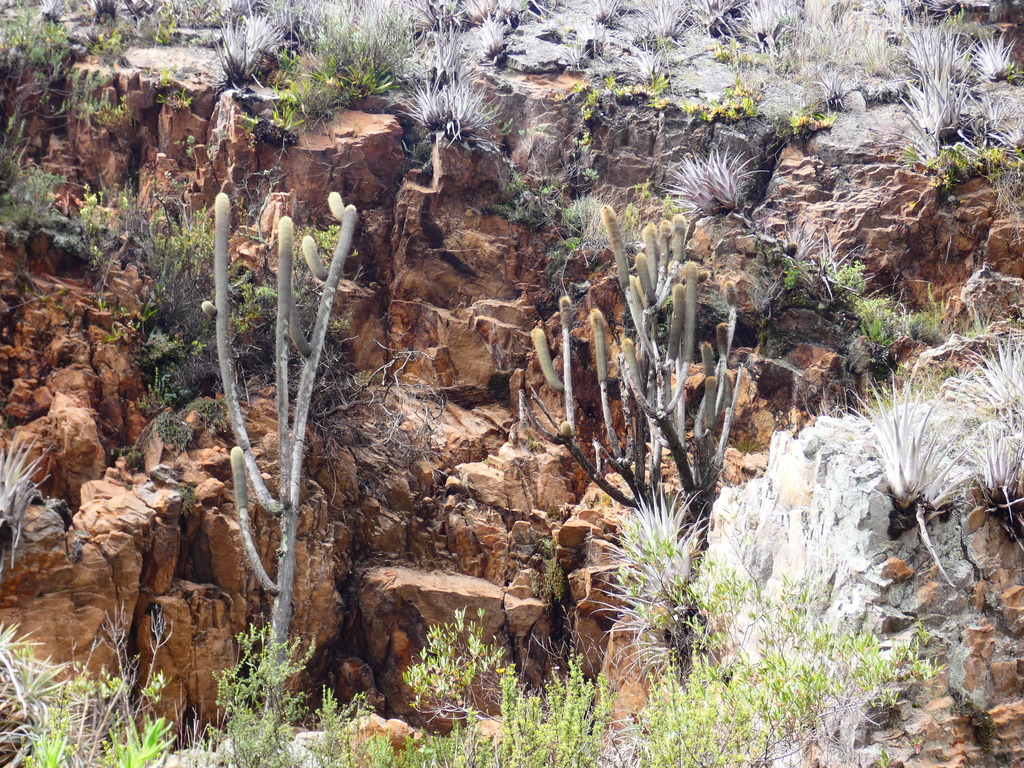
Weberbauerocereus albus
Weberbauerocereus albus is a species of Weberbauerocereus from Peru.
From the article Weberbauerocereus albus on Wikipedia (CC BY-SA), quoted section by section
Description
Weberbauerocereus albus grows like a tree with straight, usually upright, gray-green shoots that branch out in the lower third and reaches heights of up to 6 meters with a diameter of 8 cm (3.1 in). The branches have 15 to 18 ribs are 1 cm (0.39 in) high and extremely blunt with brown areoles. The areoles have one to two central spines and 15 to 25 radial spines arise from them. The very strong, light brownish-yellow central spines are subulate and 5 to 10 mm (0.20 to 0.39 in) long. The light yellow to brownish yellow radial spines are up to 10 mm (0.39 in) long with the lowest of them are finer. In the flowering areas, the shape of the thorns change and they eventually become hairs that are up to 10 cm (3.9 in) long. The somewhat zygomorphic and somewhat fragrant flowers open at night but remain open until the next morning. They are up to 12 cm (4.7 in) long and have a diameter of 5.5 to 7.5 cm (2.2 to 3.0 in) with bracts are white to pink. The spherical fruits are greenish to reddish and reach a diameter of up to 3 cm (1.2 in). They are densely covered with wool.
Range & habitat
Weberbauerocereus albus is distributed in the Peruvian regions of Cajamarca and Ancash at altitudes of 2000 to 3000 meters.
Wikipedia: “Distribution”
Where it lives
Recorded sightings
—
geo-referenced records in GBIF, from museums, herbaria and field observers.
Drag the globe to turn it. Dots are where records exist, not a range map; darker means more records.
In the stacks
Searching the stacks…
Every page naming Weberbauerocereus albus in the Biodiversity Heritage Library →
This page is assembled live from iNaturalist, GBIF, Wikipedia, the Source Library and the Internet Archive. It is not yet part of the hand-edited codex. iNaturalist taxon 444815.