- Plants
- ›Vascular Plants
- ›flowering plants
- ›Dicots
- ›Nances, Willows, and Allies
- ›Spurge Family
- ›Euphorbioideae
- ›Euphorbieae
- ›Euphorbiinae
- ›Euphorbia
- ›Athymalus
- ›Anthacanthae
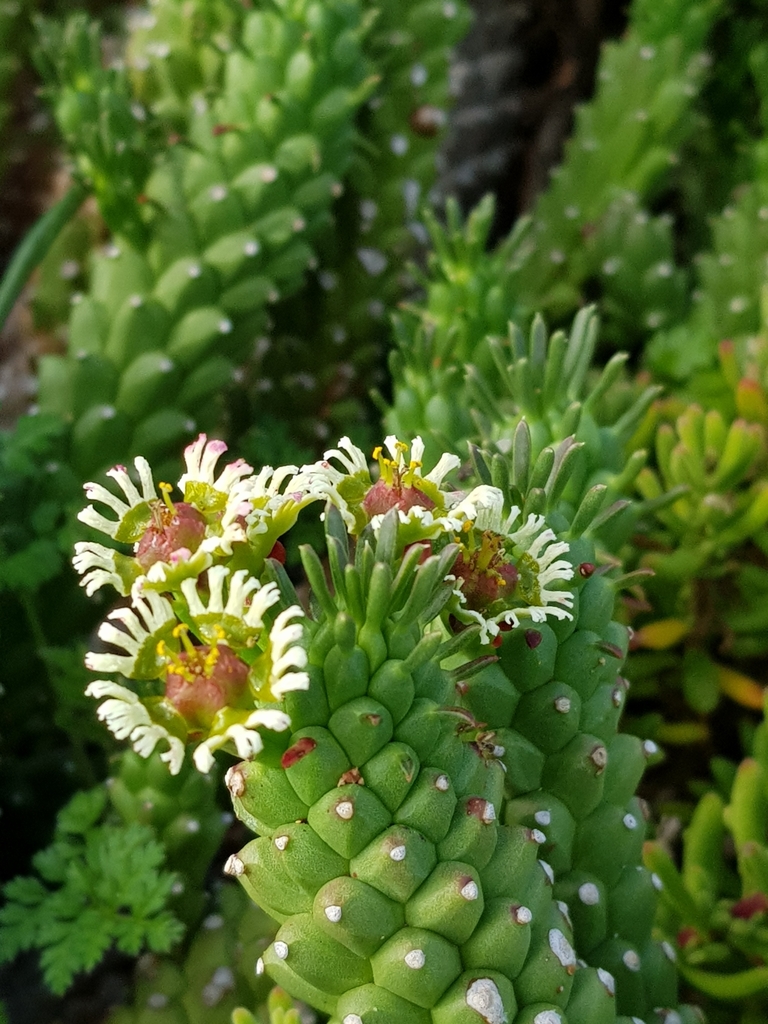
Medusa's-head
Euphorbia caput-medusae
Euphorbia caput-medusae ("Medusa's Head") is a plant of the genus Euphorbia that occurs in and around Cape Town, South Africa.
From the article Euphorbia caput-medusae on Wikipedia (CC BY-SA), quoted section by section
Description
This succulent resembles the head of Medusa, with many serpent-like stems arising from a short, central caudex. They sometimes exceed 1 metre (3 ft 3 in) in diameter, partly buried in the ground, covered with numerous crowded branches. Euphorbia caput-medusae was introduced to the Netherlands around 1700 and was one of the early plants described by Linnaeus (Species Plantarum, 1753).
Range & habitat
This species is primarily coastal, occurring along the western coast of South Africa, southwards to the Cape Peninsula. It is still common around Cape Town where it grows in deep sand or rocky outcrops on the coast. It is particularly common in the Peninsula Shale Renosterveld vegetation of Signal Hill. It also occurs along the south coast of the Western Cape Province, from Cape Town the form previously known as muirii extends along the coast eastwards as far as Mossel Bay.
Wikipedia: “Distribution”
Where it lives
Recorded sightings
—
geo-referenced records in GBIF, from museums, herbaria and field observers.
Drag the globe to turn it. Dots are where records exist, not a range map; darker means more records.
In the stacks
Searching the stacks…
Every page naming Euphorbia caput-medusae in the Biodiversity Heritage Library →
This page is assembled live from iNaturalist, GBIF, Wikipedia, the Source Library and the Internet Archive. It is not yet part of the hand-edited codex. iNaturalist taxon 464427.