- Animals
- ›Arthropods
- ›Hexapods
- ›Insects
- ›Winged and Once-winged Insects
- ›Butterflies and Moths
- ›Mandibulate Archaic Moths
- ›Micropterigidae
- ›Sabatinca
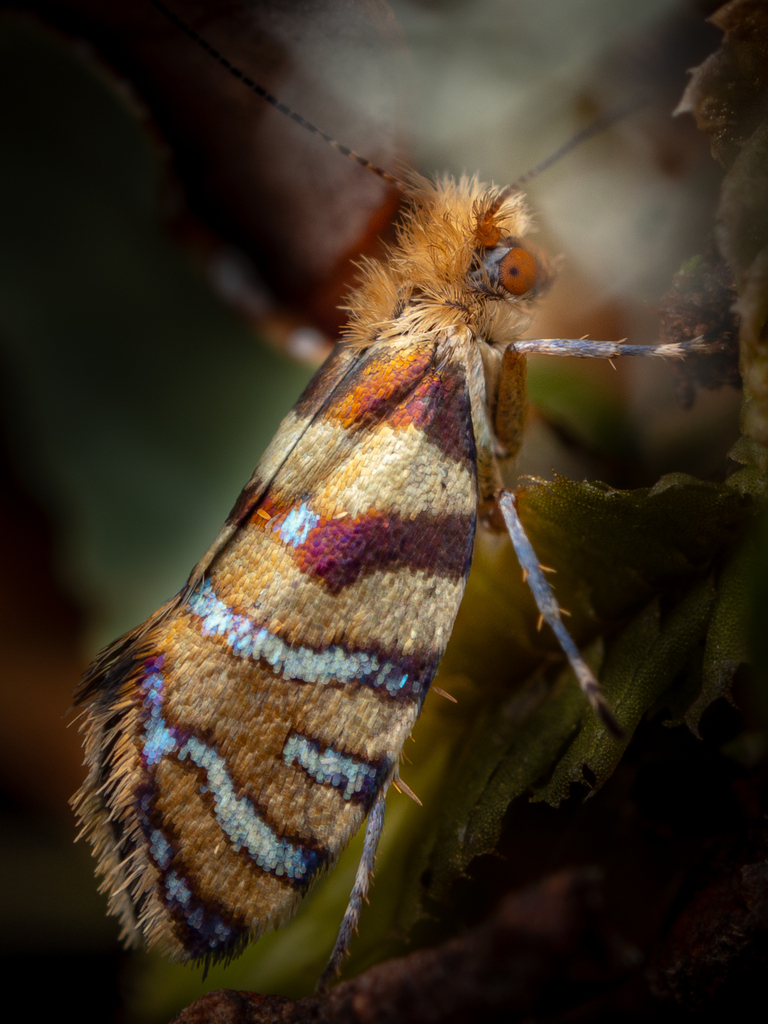
Sabatinca aurella
Sabatinca aurella is a species of moth of the family Micropterigidae. It is endemic to New Zealand. The larvae of this species are variable in appearance but tend to be coloured yellow-green with greyish patches. The adults of the species have a pale golden appearance with silver or purple coloured bars on the forewings. The moth has an approximate wingspan of around 1 cm. This species is found from the Coromandel Peninsula to the Fox Glacier and is on the wing from September to January. A larval host species is the liverwort Heteroscyphus lingulatus. The preferred habitat of this species is at higher altitudes than other New Zealand endemic species in this genus; and the moth tends to prefer forest or subalpine grass or scrubland.
From the article Sabatinca aurella on Wikipedia (CC BY-SA), quoted section by section
Description
The larvae of this species are variable in appearance but tend to be coloured yellow-green with greyish patches. Hudson described the adults of this species as follows:
The expansion of the wings is 7⁄16 inch. The fore wings, which have the costa very abruptly arched at the base and the termen very oblique, are bright, golden-ochreuus with the veins well marked and deeply depressed; there is a large crimson-orange-metallic basal patch, purple on the costa; a curved transverse band at about 1⁄3 deep crimson-purple-metallic on the costa, metallic-blue below the middle, and crimson on the dorsum; another narrower band at about 1⁄3, deep purple on the costa, thence brilliant metallic-blue to the dorsum; two long costal bars beyond this, purple on the costa, pale metallic-blue towards the disc; an irregular confluent series of crimson and metallic-blue spots on the termen; the cilia are golden-ochreous. The hind wings are blackish with strong purple reflections. The head and thorax are clothed with long rusty-orange hairs. The abdomen is blackish. The antennae are orange, black towards the apex. A "pale shining golden" species, these moths have a forewing length of between 4.2 and 5.2mm. The wing patterns of S. aurella are regarded as being the most "straightforward" of New Zealand species in this genus. The forewing pattern is similar to that of Sabatinca doroxena.
Range & habitat
This species is endemic to New Zealand. It is one of New Zealand's most frequently encountered jaw-moths, this species is found from as far North as the Coromandel Peninsula to as far South as Fox Glacier.
Wikipedia: “Distribution”
What it does
This species is on the wing from the beginning of September until the end of January. It is most common from mid-November to the end of December.
Wikipedia: “Behaviour”
Listen
Looking for field recordings…
Where it lives
Recorded sightings
—
geo-referenced records in GBIF, from museums, herbaria and field observers.
Drag the globe to turn it. Dots are where records exist, not a range map; darker means more records.
In the stacks
Searching the stacks…
Every page naming Sabatinca aurella in the Biodiversity Heritage Library →
This page is assembled live from iNaturalist, GBIF, Wikipedia, the Source Library and the Internet Archive. It is not yet part of the hand-edited codex. iNaturalist taxon 468626.