- Animals
- ›Arthropods
- ›Hexapods
- ›Insects
- ›Winged and Once-winged Insects
- ›Butterflies and Moths
- ›Mandibulate Archaic Moths
- ›Micropterigidae
- ›Sabatinca
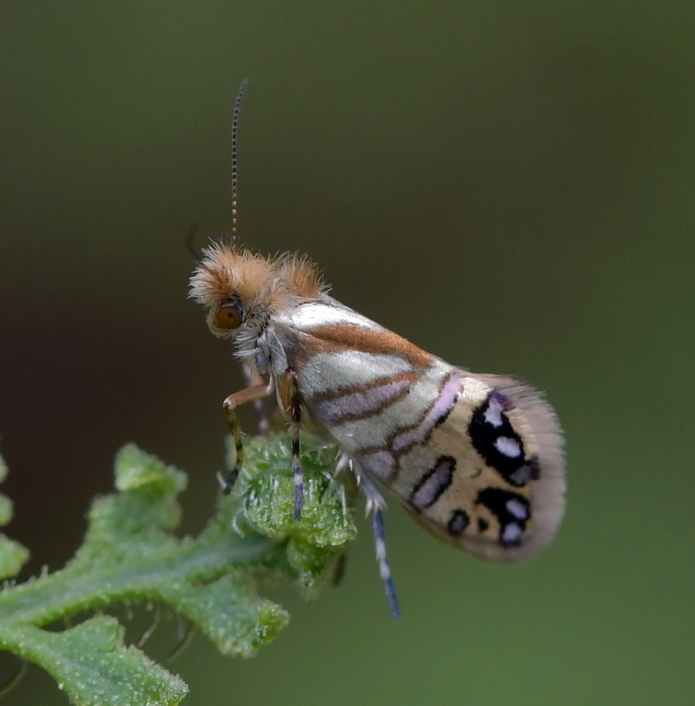
Sabatinca doroxena
Sabatinca doroxena is a species of moth belonging to the family Micropterigidae. It is endemic to the North Island of New Zealand. This small moth has a colourful forewing pattern with stripes and dots evident. It has been hypothesised that the forewing pattern is intended to resemble a jumping spider in order to allow the adult moth to escape predation. Adults of this species are on the wing from the beginning of September until mid January. It prefers damp but sunny habitat in deep forest, at the forest edge or in open shrubland. Larvae feed on foliose liverwort species including on Leptoscyphus normalis. Adults of this species have been located at the blossoms of flowering Cordyline and Ranunculus species.
From the article Sabatinca doroxena on Wikipedia (CC BY-SA), quoted section by section
Description
Meyrick described the adults of the species as follows:
Female wingspan 11 mm. Head and palpi light ochreous, sides of crown brown. Antennae dark fuscous, annulated with whitish-ochreous. Thorax ochreous-brown. Abdomen dark grey. Legs dark grey, ringed with pale ochreous. Forewings oblong, costa abruptly bent near base, thence gently arched, apex round-pointed, hindmargin straight, very oblique; neuration quite as in P. chalcophanes, but 7 and 8 separate; pale shining golden; two rather narrow oblique coppery-bronze fasciæ from costa near base and at 1⁄3, confluent on inner margin before middle; a straight rather narrow whitish-purplish fascia, margined with coppery-bronze, from middle of costa to inner margin beyond middle; a whitish-purplish black-margined transverse spot from costa at 2⁄3, reaching half across wing; a black semi-annular mark, its extremities touching costa at 4⁄5 and apex, marked with three shining whitish-purplish spots, and including a spot of ground-colour which contains a black costal dot; a semi-oval black anal blotch, not marginal except at extremities, containing three shining whitish-purplish spots near lower edge, and one in a small projection on upper edge: cilia pale golden, with blackish apical, median, and anal spots. Hindwings dark purple-grey; cilia grey.
Range & habitat
This species prefers damp but sunny habitat and can be found within deep forest, at the forest edge or in open shrubland. Larvae feed on foliose liverwort species including on Heteroscyphus normalis now known as Leptoscyphus normalis. Adults of this species have been located at the blossoms of flowering Cordyline and Ranunculus species.
Wikipedia: “Habitat and host species”
What it does
Adults of this species are on the wing from the beginning of September until mid January. This moth has been collected by sweeping plant foliage.
== References ==
Wikipedia: “Behaviour”
Listen
Looking for field recordings…
Where it lives
Recorded sightings
—
geo-referenced records in GBIF, from museums, herbaria and field observers.
Drag the globe to turn it. Dots are where records exist, not a range map; darker means more records.
In the stacks
Searching the stacks…
Every page naming Sabatinca doroxena in the Biodiversity Heritage Library →
This page is assembled live from iNaturalist, GBIF, Wikipedia, the Source Library and the Internet Archive. It is not yet part of the hand-edited codex. iNaturalist taxon 468627.