- Animals
- ›Arthropods
- ›Hexapods
- ›Insects
- ›Winged and Once-winged Insects
- ›Ants, Bees, Wasps, and Sawflies
- ›Narrow-waisted Wasps, Ants, and Bees
- ›Ants, Bees, and Stinging Wasps
- ›Formicoidea
- ›Ants
- ›Formicine Ants
- ›Formicini
- ›Polyergus
- ›Polyergus rufescens
Western Amazon Ant
Polyergus mexicanus
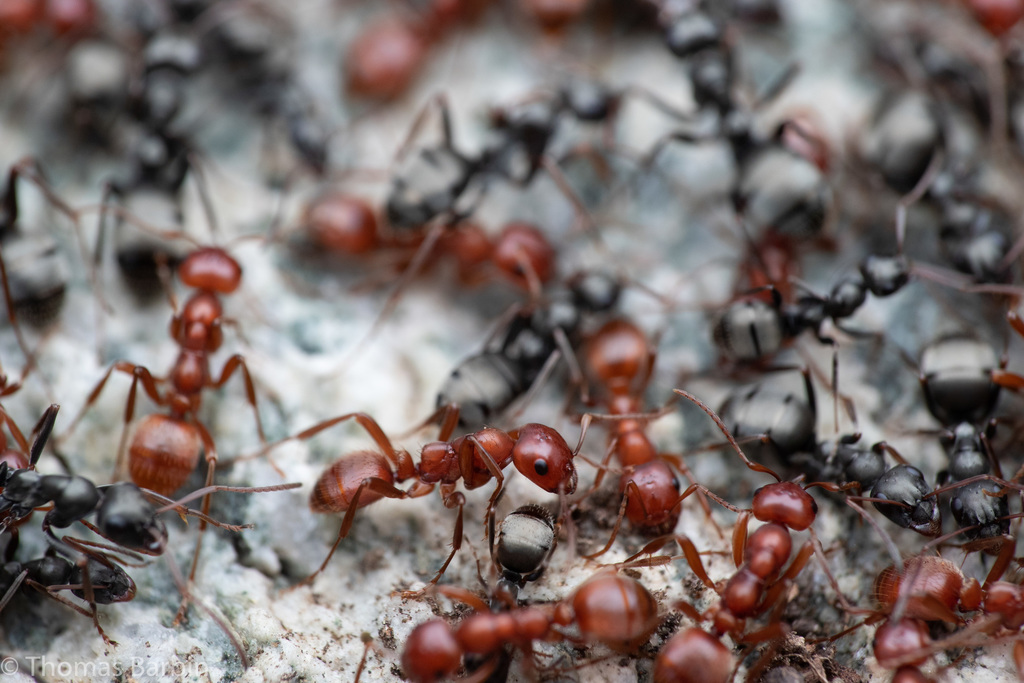
Polyergus mexicanus is a species of slave-making ant in the subfamily Formicinae. It is the most widely distributed species of Polyergus in North America. It is an obligatory social parasite, unable to feed itself or look after the colony and reliant on ants of another species, Formica, to undertake these tasks. The parasitic ants are known as "dulotics" (from the Greek δοῦλος doulos, meaning a slave) and the ants they parasitise are known as "hosts".
From the article Polyergus mexicanus on Wikipedia (CC BY-SA), quoted section by section
Description
Polyergus mexicanus is somewhat variable across its range and averages 6 millimetres (0.24 in) in total length. The head is glossy in the south of its range and more matte in eastern and northern populations. The mesonotum is matte dorsally and usually shining laterally. The gaster is also shining but this is partially concealed by a covering of short erect hairs, especially dorsally. The colour is generally red with the posterior portion of the tergites being tinged with brown. The legs may be a slightly darker colour than the body, and the hairs on the dorsal surface are grey, never yellowish as they are in P. breviceps. This species also bears longer brownish macrosetae (hairs) but they often get worn away, leaving dark scars on the tergites.
Range & habitat
Polyergus mexicanus is the most widely distributed species in the genus Polyergus in North America. It is native to the western United States and Canada, North Dakota, South Dakota, Arkansas and Mexico. It usually inhabits open woodland with little undergrowth or mixed wood and grassland habitats. Further south it is restricted to higher altitudes; in the Chiricahua Mountains of Mexico it occurs at 2,200 metres (7,200 ft) and in Chihuahua is found at 2,800 metres (9,200 ft), typically in open coniferous forests.
Wikipedia: “Distribution and habitat”
What it does
Polyergus mexicanus is an obligate parasite of other species of ant. These "hosts" are species of Formica ants in the groups F. fusca and F. neogagates. A newly mated female of P. mexicanus enters the nest of a potential host, employing pheromones to subdue the resident workers. She then kills the existing Formica queen and becomes accepted by the Formica workers. These then proceed to rear her brood as well as maintaining the nest and feeding the dulotic queen and the ants which develop from the eggs she lays. The dulotic ants are unable to carry out these tasks themselves. The workforce of the colony is periodically replenished by a raid being undertaken on another nearby colony of Formica ants. The raid is made by the Polyergus worker ants and usually takes place on a hot afternoon in the summer. A scout ant locates a suitable target nest and a column of dulotic ants move towards it. On arriving at the nest they may mill around for a while, perhaps clearing debris such as small stones or twigs away from the entrance. They then surge inside and quickly begin to emerge carrying host pupae, prepupae and sometimes late-stage larvae back to the dulotic nest. There, the host workers care for them as well as the dulotic young developing from eggs laid by the Polyergus queen. …
Wikipedia: “Behaviour”
Listen
Looking for field recordings…
Where it lives
Recorded sightings
—
geo-referenced records in GBIF, from museums, herbaria and field observers.
Drag the globe to turn it. Dots are where records exist, not a range map; darker means more records.
In the stacks
Searching the stacks…
Every page naming Polyergus mexicanus in the Biodiversity Heritage Library →
This page is assembled live from iNaturalist, GBIF, Wikipedia, the Source Library and the Internet Archive. It is not yet part of the hand-edited codex. iNaturalist taxon 472214.