- Plants
- ›Vascular Plants
- ›flowering plants
- ›Dicots
- ›pinks, cactuses, and allies
- ›cacti
- ›globular cacti, moonlight cacti, torch cacti, and allies
- ›Globular Cactuses
- ›Epithelantha
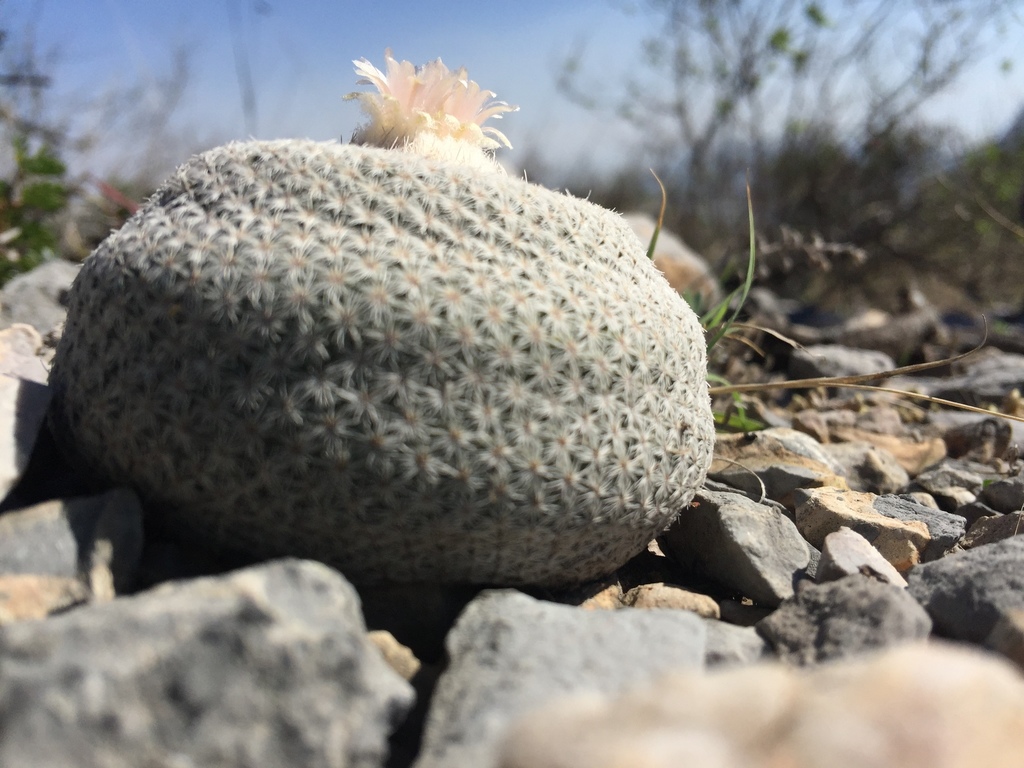
Epithelantha ilariae
Epithelantha ilariae is a species of Epithelantha found in Mexico.
From the article Epithelantha ilariae on Wikipedia (CC BY-SA), quoted section by section
Description
Epithelantha ilariae is a small cactus species that almost always grows alone. It has flattened, spherical stems over 6 cm in diameter. When dehydrated and losing turgor, sunken rings become visible on the stem's surface. The stem is covered with short tubercles, each ending in an areole bearing 30 to 52 spines arranged in two or three overlapping layers. The spines are elliptical in cross-section and waxy white, especially in young plants. Under a microscope, they lack marginal denticles (small teeth). The apex is usually hidden beneath dense white hairs that protect young tissues during growth. Flowers are small, funnel-shaped, and appear at the stem's apex. They range in color from white to pale pink. The elongated, bright red fruits contain small black seeds. Flowering occurs from spring through autumn. This species closely resembles Epithelantha bokei, making field identification challenging. However, E. ilariae has fewer spines per areola, with fewer overlapping layers. A key feature for identification is the absence of denticles (tiny teeth) on the spine margins, which are smooth in E. ilariae when viewed under a microscope. In contrast, E. bokei's spines have fringed or denticulate edges.
Range & habitat
Epithelantha ilariae is native to northeastern Mexico. Its distribution spans from the southern slopes of Sierra de Obayos—about 50 km north of Monclova, Coahuila and eastward to areas north of Montemorelos, Nuevo León. It inhabits a broad strip along low-altitude mountain ranges surrounding the Monterrey metropolitan area. Its natural habitat includes deserts and dry scrublands, typically at elevations between 300 and 570 meters. It grows on gently sloping rocky areas with gravel and soil containing moderate organic matter. In some locations, it shares its habitat with other regional cacti, such as Ariocarpus trigonus, Mammillaria lasiacantha, and Echinocereus enneacanthus.
Wikipedia: “Distribution”
Where it lives
Recorded sightings
—
geo-referenced records in GBIF, from museums, herbaria and field observers.
Drag the globe to turn it. Dots are where records exist, not a range map; darker means more records.
In the stacks
Searching the stacks…
Every page naming Epithelantha ilariae in the Biodiversity Heritage Library →
This page is assembled live from iNaturalist, GBIF, Wikipedia, the Source Library and the Internet Archive. It is not yet part of the hand-edited codex. iNaturalist taxon 474698.